April 27, 2011 feature
Sensitivity of precision measurements enhanced by the environment
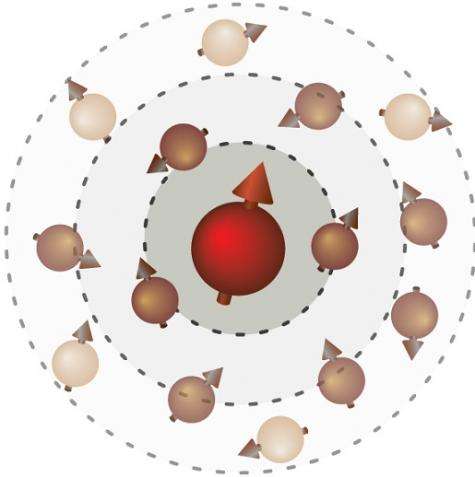
(PhysOrg.com) -- When it comes to quantum measurements, interaction with the environment usually limits sensitivity, since it causes decoherence. But in a new study, scientists have shown that the environment can be advantageous. They have designed a method to increase the sensitivity of quantum precision measurements by using the environment to enhance a quantum sensor’s response to weak perturbations in an external field.
The researchers, Garry Goldstein from Harvard University, along with coauthors from Harvard, MIT, Copenhagen University, and the California Institute of Technology, have published their study called “Environment-Assisted Precision Measurement” in a recent issue of Physical Review Letters. In their study, the scientists first describe an idealized case, and then demonstrate that it works in two different cases: quantum clocks with trapped ions and spin-based magnetometry.
“We realized that part of the environment can be used to increase sensitivity,” coauthor Paola Cappellaro of MIT told PhysOrg.com. “We found that entangled states, other than the ones usually proposed for metrology (GHZ states, squeezed states) can improve the sensitivity while being more robust to decoherence.”
As the scientists explain, a quantum sensor can be constructed with a central spin coupled to a bath of dark spins, which are part of the environment. All of these spins act as qubits, each having a state of 0, 1, or a superposition of both. While the central spin can be controlled and read out, the dark spins can only be collectively controlled and not directly detected. Also, the central spin and the dark spins can be coupled, and this coupling can be effectively turned on and off at will.
The central spin can indirectly measure the external field, such as a magnetic field, by sensing the dynamics of the surrounding dark spins, which are in turn affected by the external field. To do this, the researchers first entangled the central spin to the dark spins, and then used this entangled state to sense the external field. As the entangled dark spins evolve, they acquire a phase that depends on the state of the central spin. Then, the researchers could flip the central spin and read out its signal. By reading this signal, the researchers could measure the phase difference between the states of the dark spins, which provides a measurement of the external field.
Importantly, the additional phase difference due to the dark spins amplifies the signal of the central spin and allows it to read out a smaller field than before; the smaller the field that a sensor can read out during a given time, the higher its quantum sensitivity. While the signal is enhanced, the background noise stays the same.
“Here we assume that part of the environment (the ‘dark spins’) can be controlled, although it cannot be directly measured,” Cappellaro said. “In this scenario, there are two possible strategies: manipulate the environment dark spins to decouple them from the sensor or exploit them by creating an entangled state with the sensor spin. We found that this second strategy is viable and yields better sensitivity.”
Overall, the method achieves precision that approaches the Heisenberg limit. This limit results from the Heisenberg uncertainty principle and marks the maximum sensitivity that any measurement can achieve.
When comparing this method to another measurement precision procedure based on a spin-echo, the researchers found that the new method has greater sensitivity due to the central spin’s signal amplification. Both methods have about the same coherence times, since, for both methods, decoherence arises from interactions among dark spins, not the rest of the environment.
As the simulations demonstrated, the new method could have applications in improving clock sensitivity using trapped ions and magnetic sensing based on electronic spins in diamond. The scientists also predict that this method could be applied more generally to a wide variety of systems.
“Extremely sensitive clocks are very important, for example, for global positioning,” Cappellaro said. “Magnetic sensors could find applications in a broad range of areas, from materials science to bio-imaging.”
More information: G. Goldstein, et al. “Environment-Assisted Precision Measurement.” Physical Review Letters 106, 140502 (2011). DOI:10.1103/PhysRevLett.106.140502
Abstract
We describe a method to enhance the sensitivity of precision measurements that takes advantage of the environment of a quantum sensor to amplify the response of the sensor to weak external perturbations. An individual qubit is used to sense the dynamics of surrounding ancillary qubits, which are in turn affected by the external field to be measured. The resulting sensitivity enhancement is determined by the number of ancillas that are coupled strongly to the sensor qubit; it does not depend on the exact values of the coupling strengths and is resilient to many forms of decoherence. The method achieves nearly Heisenberg-limited precision measurement, using a novel class of entangled states. We discuss specific applications to improve clock sensitivity using trapped ions and magnetic sensing based on electronic spins in diamond.
Copyright 2010 PhysOrg.com.
All rights reserved. This material may not be published, broadcast, rewritten or redistributed in whole or part without the express written permission of PhysOrg.com.


