Satellite tracking of sea turtles reveals potential threat posed by manmade chemicals
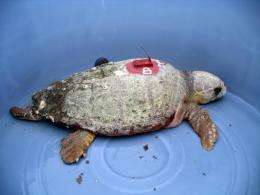
This is a turtle from Port Canaveral. Credit: Dr. Jennifer Keller, National Institute of Standards and Technology (NIST)
The first research to actively analyze adult male sea turtles (Caretta caretta) using satellite tracking to link geography with pollutants has revealed the potential risks posed to this threatened species by manmade chemicals. The research, published today in Environmental Toxicology and Chemistry, examines the different levels of chemicals in the blood of both migratory and residential turtles.
"The risks posed by persistent organic pollutants (POPs) remain largely a mystery for threatened loggerhead sea turtles," said lead author Jared Ragland from the College of Charleston, South Carolina. "A clear understanding of these risks is critical for wildlife managers trying to maintain both the health of reproductively active individuals and a sustainable population overall."
Twenty-nine turtles were captured near Port Canaveral, Florida and fitted with satellite transmitters as part of a National Marine Fisheries Service-funded project. Blood was analyzed for traces of organochlorine pesticides (OCPs), polychlorinated biphenyls (PCBs), polybrominated diphenyl ethers (PBDEs) and toxaphenes, chemicals documented to have carcinogenic and neurodevelopmental effects.
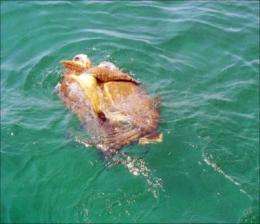
This is a turtle from Port Canaveral. Credit: Mary Ellen Williams, South Carolina Department of Natural Resources (SCDNR)
Of the 29 turtles tracked, 19 were analyzed for POPs for which they were separated into two groups and tracked for 60 days. Ten transient turtles travelled north along the U.S. Atlantic coast, eventually arriving in shelf water between New Jersey and South Carolina, while nine turtles remained resident at Cape Canaveral.The tracking data revealed significantly different movement patterns between transient and resident adult males. Individuals migrating north after breeding season were found to have elevated blood plasma concentrations of POPs, putting them at higher risk to toxic effects compared to the turtles that remained in Florida.
The findings support the idea that foraging location can influence exposure to, and patterns of, POPs in highly mobile species such as sea turtles. Migrating turtles face cumulative poisoning as contaminants infiltrate the food chain through prey species, such as crabs.
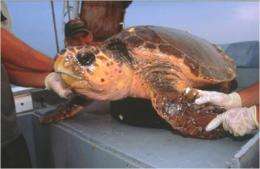
This is a turtle from Port Canaveral. Credit: Witt Langstaff, (wittlangstaffinc.com)
"Our research is the first to examine POPs in the rarely studied adult male sea turtle and to couple contaminant measurements with satellite tracking," concluded Ragland. "Although the turtle has been listed as threatened for more than 30 years, it is only now that we can begin to examine the effects of manmade chemicals on these animals in the wild."Provided by
Wiley
-
From lemons to lemonade: Reaction uses carbon dioxide to make carbon-based semiconductor,
32 comments
-
Thioridazine kills cancer stem cells in human while avoiding toxic side-effects of conventional cancer treatments,
3 comments
-
SpaceX private rocket blasts off for space station (Update),
42 comments
-
Climate scientists say they have solved riddle of rising sea,
31 comments
-
Research team claims to have found evidence Lake Cheko is impact crater for Tunguska Event,
18 comments
-
What would stain as translucent on light-coloured fabric?
12 hours ago
-
How do I identify different bacteria on culture plates?
22 hours ago
-
Why Do Dogs do Strange things...
May 25, 2012
-
What does exophillic and endophillic mean in terms of mosquito and their control?
May 24, 2012
-
Semen stains glows under black lights (uv light)?
May 23, 2012
-
Question on Human Chromosome 2
May 23, 2012
- More from Physics Forums - Biology
More news stories
Scientist: Evolution debate will soon be history
(AP) -- Richard Leakey predicts skepticism over evolution will soon be history. Not that the avowed atheist has any doubts himself.
11 hours ago |
3.5 / 5 (11) |
29
It's in the genes: Research pinpoints how plants know when to flower
Scientists believe they've pinpointed the last crucial piece of the 80-year-old puzzle of how plants "know" when to flower.
May 25, 2012 |
3.9 / 5 (9) |
1
|
Researchers solve structure of human protein critical for silencing genes
In a study published in the journal Cell on May 24, Cold Spring Harbor Laboratory (CSHL) scientists describe the three-dimensional atomic structure of a human protein bound to a piece of RNA that "guides" the pr ...
May 25, 2012 |
4.7 / 5 (7) |
0
|
Thousands of shellfish found dead in Peru
Thousands of crustaceans were found dead off the coast of Lima following the mystery mass death of dolphins and pelicans, the Peruvian Navy said Friday.
21 hours ago |
4.8 / 5 (4) |
6
Copy of the genetic makeup travels in a protein suitcase
Scientists from the Institute for Physical and Theoretical Chemistry at the University of Bonn have succeeded for the first time in the real time filming of the transport of an important information carrier in biological ...
May 25, 2012 |
not rated yet |
0
|
Nvidia trumpets Tegra 3 phone design wins for 2012
(Phys.org) -- Nvidias competitive war paint has a name, Tegra 3. On the heels of Nvidia announcements about lowering costs of its Tegra 3 processors and Nvidia-enabled tablets running Android Ice Cream ...
Browser wars flare in mobile space
The browser wars are heating up again, but this time the fight is for dominance of the mobile Internet.
Dell tablet leak: 10.1-inch display, two-battery choice
(Phys.org) -- Headline after headline talks about vendors tablets in the wings as likely number-one contenders for the iPad. Such claims have justifiably been taken with a grain of salt, considering ...
SpaceX capsule has 'new car' smell, astronauts say (Update)
SpaceX's Dragon cargo vessel smells like a new car, said astronauts at the International Space Station after opening the hatches Saturday following the spacecraft's landmark mission to the orbiting lab.
Of mice and mental models: Neuroscientific implications of risk-optimized behavior in the mouse
(Medical Xpress) -- Regardless of an organism’s biological complexity, every encephalized animal continuously makes under-informed behavioral choices that can have serious consequences. Despite its ubiquity, ...
SpotterRF debuts Radar Backpack Kit (w/ Video)
(Phys.org) -- SpotterRF has announced a special radar backpack kit designed to enhance situational awareness for soldiers on the ground. The company says its special radar is designed for warfighters as part ...

