OSU chemist developing solution to nerve agent exposure
April 5, 2011

OSU chemist developing solution to nerve agent exposure

Enlarge

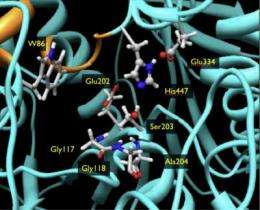
Preliminary simulations conducted at the Ohio Supercomputer Center by Ohio State Professor Christopher Hadad, Ph.D., identify catalytic amino acid residues and other critical binding residues in the active site of AChE. Credit: Hadad/OSU

Scientists are working to develop a new drug that will regenerate a critical enzyme in the human body that "ages" after a person is exposed to deadly chemical warfare agents.

Christopher Hadad, Ph.D., professor of chemistry at The Ohio State University (OSU), is leveraging Ohio Supercomputer Center (OSC) resources to help develop a more effective antidote to lethal chemicals called organophosphorus (OP) nerve agents.

"This project is a combination of synthetic and computational organic chemistry conducted through OSC at Ohio State, and biochemical studies conducted by colleagues at the U.S. Army Medical Research Institute of Chemical Defense at Aberdeen Proving Ground in Maryland," said Hadad.

OP nerve agents inhibit the ability of an enzyme called acetylcholinesterase (AChE) to turn off the messages being delivered by (ACh), a neurotransmitter, to activate various muscles, glands and organs throughout the body. After exposure to OP agents, AChE undergoes a series of reactions, culminating in an "aging" process that inhibits AChE from performing its critical . Without the application of an effective antidote, neurosynaptic communication continues unabated, resulting in uncontrolled secretions from the mouth, eyes and nose, as well as severe muscle spasms, which, if untreated, result in death.

Conventional antidotes to OP nerve agents block the activity of the nerve agent by introducing oxime compounds, which have been the focus of a number of studies. These compounds attach to the phosphorus atom of the nerve agent, after the OP is bound to AChE, and then split it away from the AChE enzyme, allowing the AChE to engage with receptors and finally relax the tissues.

However, in some cases, the combined nerve agent/AChE molecule undergo a process called aging, in which groups of single-bonded carbon and called alkyl groups are removed from the molecule and a phosphonate residue is left behind in the AChE active site. Relatively unstudied in nerve agents, this process, called dealkylation, makes the nerve agent/AChE molecule unreceptive to oximes – an unfortunate situation, considering that certain nerve agents (e.g., soman) can undergo aging within minutes of exposure to AChE.
OSU chemist developing solution to nerve agent exposure
Enlarge

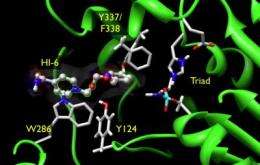
A docking simulation constructed at the Ohio Supercomputer Center by Ohio State Professor Christopher Hadad, Ph.D., illustrates binding in the active site of tabun-inhibited AChE. Credit: Hadad/OSU

Hadad's study is focused on the identification of compounds that would return an appropriate alkyl group to the aged nerve agent/AChE molecule, thus allowing treatment with oximes to provide for complete recovery. The project is investigating common OP Tabun, VX, VR, Sarin, Soman, Cyclosarin and Paraoxon, all of which take on a similar molecular structure upon aging.

"Computational studies of the interaction of the alkylating compounds with AChE were used to provide insight for the design of selective reagents," Hadad explained. "Ligand-receptor docking, followed by molecular dynamics simulations of the interactions of alkylating compounds with aged OP-AChE, was carried out in conjunction with experimental studies to investigate the binding of alkylating compounds to AChE. These results were then used to suggest interactions that aided in the orientation of alkylating compounds for maximal efficacy."

Throughout the project, Hadad employed computational studies to guide the progress of each objective, as well as to rationalize the observed experimental results.

"Dr. Hadad's work on this project has made use of a range of the tools of electronic structure theory, molecular docking, molecular dynamics and hybrid quantum mechanical/molecular mechanical methods," said Ashok Krishnamurthy, interim co-executive director of OSC. "It was by design that OSC's flagship system, the Glenn IBM 1350 Opteron cluster, was developed to meet the needs of the bioscience research investigators, such as Dr. Hadad."

Provided by Ohio Supercomputer Center


Rank not rated yet
Relevant PhysicsForums posts
  • Schwartz reagent-- NMR/MS/IR
    created18 hours ago
  • High school chemistry EEI
    createdMay 25, 2012
  • oxidation of I- by KMnO4
    createdMay 25, 2012
  • Inversion temp
    createdMay 25, 2012
  • Hybridization of SnCl3 -
    createdMay 25, 2012
  • Electrons And Radiation
    createdMay 25, 2012
  • More from Physics Forums - Chemistry

More news stories

From lemons to lemonade: Reaction uses carbon dioxide to make carbon-based semiconductor

(Phys.org) -- A materials scientist at Michigan Technological University has discovered a chemical reaction that not only eats up the greenhouse gas carbon dioxide, it also creates something useful. And, by ...

Chemistry / Materials Science

created May 21, 2012 | popularity 4.7 / 5 (88) | comments 32 | with audio podcast

New CO2-removing catalyst can take the heat

(Phys.org) -- The current method of removing the greenhouse gas carbon dioxide (CO2) from the flues of coal-fired power plants uses so much energy that no one bothers to use it. So says Roger Aines, principal ...

Chemistry / Materials Science

created May 24, 2012 | popularity 5 / 5 (7) | comments 7 | with audio podcast

High-speed method to aid search for solar energy storage catalysts

Eons ago, nature solved the problem of converting solar energy to fuels by inventing the process of photosynthesis.

Chemistry / Materials Science

created May 25, 2012 | popularity 5 / 5 (3) | comments 4 | with audio podcast

Researchers demonstrate possible primitive mechanism of chemical info self-replication

(Phys.org) -- When scientists think about the replication of information in chemistry, they usually have in mind something akin to what happens in living organisms when DNA gets copied: a double-stranded molecule ...

Chemistry / Materials Science

created May 25, 2012 | popularity 5 / 5 (4) | comments 2 | with audio podcast

Castor oil: Action mechanism of one of the oldest drugs known to man elucidated

Castor oil is known primarily as an effective laxative; however, it was also used in ancient times with pregnant women to induce labour. Only now have scientists at the Max Planck Institute for Heart and Lung ...

Chemistry / Biochemistry

created May 21, 2012 | popularity 3 / 5 (2) | comments 3 | with audio podcast


Scientist: Evolution debate will soon be history

(AP) -- Richard Leakey predicts skepticism over evolution will soon be history. Not that the avowed atheist has any doubts himself.

Dell tablet leak: 10.1-inch display, two-battery choice

(Phys.org) -- Headline after headline talks about vendors’ tablets in the wings as likely number-one contenders for the iPad. Such claims have justifiably been taken with a grain of salt, considering ...

SpotterRF debuts Radar Backpack Kit (w/ Video)

(Phys.org) -- SpotterRF has announced a special radar backpack kit designed to enhance situational awareness for soldiers on the ground. The company says its special radar is designed for warfighters as part ...

SpaceX capsule has 'new car' smell, astronauts say (Update)

SpaceX's Dragon cargo vessel smells like a new car, said astronauts at the International Space Station after opening the hatches Saturday following the spacecraft's landmark mission to the orbiting lab.

Thousands of shellfish found dead in Peru

Thousands of crustaceans were found dead off the coast of Lima following the mystery mass death of dolphins and pelicans, the Peruvian Navy said Friday.

Astronomers seize last chance in lifetime for Venus Transit

Astronomers are gearing for one the rarest events in the Solar System: an alignment of Earth, Venus and the Sun that will not be seen for another 105 years.