NASA's Kepler reaches into the stars
We are entering a golden era for "stellar physics" – a term coined to describe research about the formation, evolution, interior and the atmospheres of stars. Thanks to a partnership forged among stellar astrophysics, scientists and NASA’s Kepler Mission, a goldmine of data is now available to support the world's efforts to detect planets in the habitable zone around other stars.
The Kepler photometric data is a measurement of light’s “brightness,” and provides an unprecedented opportunity for the emerging field of asteroseismology, the study of the internal structure of stars by observing minuscule pulsations in the star brightness. Asteroseismic research is giving insights into the fundamental properties of stars, including their mass, size, age and internal structure. Kepler enables studies of a large number of stars representing a broad range of types. This asteroseismic research will substantially improve our understanding of stellar evolution. It also will help determine the properties of stars that have planetary systems studied in the Kepler exoplanet program.
The Kepler Asteroseismic Science Consortium (KASC) pushes the envelope in this field of study. Using the unparalleled precision and quality of Kepler data, the KASC research is contributing to stellar astrophysics in profound ways. The consortium is comprised of more than 400 scientists and is led by the Danish Asteroseismology Centre in the Department of Physics and Astronomy at the University of Aarhus, Denmark.
The KASC recently presented new findings published in three papers in the journal Science. In combination, these latest results illustrate the power of the Kepler Space Telescope to probe the internal structure of distant stars.
Kepler Listens to an Orchestra of Sun-like Stars to Tune the Galactic Models
The scientific investigation of sun-like stars has taken a major step forward thanks to the Kepler Mission. In addition to searching for exoplanets, it is providing exquisite data on stellar oscillations.
"The sound inside the stars makes them ring or vibrate like musical instruments," said Bill Chaplin from the University of Birmingham’s School of Physics and Astronomy, the lead author of this paper. "If you measure the pitch of the notes produced by an instrument it can tell you how big the instrument is. The bigger the instrument is, the lower the pitch and deeper the sound. This is how we can tell how big a star is - from its stellar music."
Oscillation measurements are used to accurately determine fundamental stellar properties like mass, size, and age. This is where theory meets observation. Scientists can synthesize a snapshot of our galaxy and all the stars it contains using models based on everything we know about how much raw material there is in our galaxy for building stars, what types of stars are made, how they evolve with time, and how long they live. They can then compare the properties of stars in this synthetic snapshot with the properties of the sun-like stars in the asteroseismic survey. In essence, the team has taken a census and compared it to predictions, and found that the sizes of the stars are consistent with the predictions, but the masses are not. The asteroseismic survey suggests that the number of low mass stars is slightly larger than expected. This work sends theoreticians back to refine their models and will ultimately lead to a better understanding of the structure and evolution of stars in our galaxy.
"Before Kepler we had asteroseismic data on only about 20 such stars - We now have an orchestra of stars to play with," said Hans Kjeldsen from Aarhus from the Danish Asteroseismology Centre in Aarhus, who coordinates KASC. "This opens up huge possibilities for probing stellar evolution and obtaining a clearer picture of the past and future of our own sun and how our galaxy, and others like it, has evolved over time. We can, for example, pick out stars that have the same mass of the sun but have different ages, to, in effect, follow the sun in time."
To read the full paper in Science: Ensemble Asteroseismology of Solar-type Stars with the NASA Kepler Mission, by W. J. Chaplin et al, Science 8 April 2011: 213-216. [DOI:10.1126/science.1201827]
Astronomers Detect Echoes from the Depth of a Red Giant Star
An international team of astronomers reports the unexpected discovery of waves inside a star that travel so deep that they reach the core. Waves traversing stars, similar to sound waves here on Earth, were already known to exist, but until now only waves traveling the outer part of the star, or as deep as hundreds of thousands of kilometers, were detected. At a certain depth, the stellar material is too dense for waves to penetrate so they bounce back to the surface. The detection of waves that reach the star's core reveal conditions that open a window to an inferno that otherwise would remain unreachable and hidden. The discovery was made in a red giant star, an elderly star, similar to what our sun will become in about 5 billion years.
"Having a view into the core of these red giants will teach us exactly what will happen to our sun when it grows older," said Paul Beck, a PhD student at Leuven University in Belgium.
To read the full paper in Science: Kepler-Detected Gravity-Mode Period Spacings in a Red Giant Star, by P.G. Beck et al, Science 8 April 2011: 180-181. [DOI: 10.1126/science.1203887]
Kepler Discovery of a Unique Triply Eclipsing Triple Star
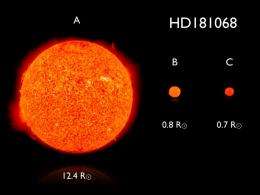
Aliz Derekas of Eotvos University and Konkoly Observatoryin Budapest, Hungary, used Kepler data to learn more about a unique three-star system known as HD 181068, which the authors named 'Trinity.' The triple system is comprised of two red dwarfs orbiting each other and simultaneously orbiting a more distant red giant star that is 12.4 times larger than our sun (figure 1). These systems are important for testing theories of star formation and evolution. While triple systems are not uncommon, this particular triple system is oriented perfectly to make the red dwarfs and the red giant regularly eclipse each other. The surface brightness of the three stars are very similar, so just as a white rabbit is camouflaged in snow, when the red dwarfs are in front of the red giant, their eclipses are nearly undetectable. Careful analyses of red giant stars observed by Kepler have shown that they exhibit oscillations similar to those in the sun. Trinity’s red giant star does not. This would indicate a mysterious mechanism that suppresses the pulsation.
"Surprisingly, we do detect some variability but with periods that are closely linked to the orbital period of the close pair in the system," said Derekas. "This may indicate that tidal forces of the close pair induce vibrations in the red giant. The intriguing nature of this unique system remained unnoticed until now despite the fact that it is nearly bright enough to be visible to the naked eye. We really needed Kepler with its unprecedentedly precise and uninterrupted photometric monitoring to uncover such a rare gem," she added.
To read the full paper in Science: A Red Giant in a Triply-Eclipsing Compact Hierarchical Triple System, by Derekas et al, Science 8 April 2011: 216-218. [DOI:10.1126/science.1201762]
Provided by JPL/NASA


