Nanotech filter separates oil and water
Apr 13, 2011 By Marcia Goodrich
Nanotech filter separates oil and water
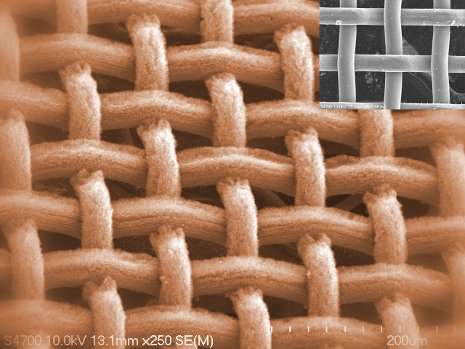
A scanning electron microscopy image of the carbon nanotube-coated filter. For comparison, the inset is bare stainless steel mesh.

(PhysOrg.com) -- Water and oil may not mix, but, like two boxers nearing the end of the final round, they can get awfully tangled up.

Now, Michigan Technological University scientists Yoke Khin Yap and Jaroslaw Drelich have created a filter that separates the two substances as quickly and cleanly as a ref breaking up a clinch.

Their fine, stainless steel mesh is coated with carbon nanotubes about 10 microns across. “They have a super-honeycomb structure that repels water,” says Yap, an associate professor of physics. “But they like organic stuff, like .”

The team poured an emulsion of water and gasoline over the filter to test it. Sure enough, the gas dripped through; all but 20 percent of the water stayed put.

It’s not as if you could filter the Gulf of Mexico through the device, Yap cautions. Their prototype is about the size of a quarter. Plus, the water drops can actually clog the spaces between the nanotubes, making it hard for anything to get through. “But the attractive thing is that it’s so simple,” he says. “It runs by gravitation.”

Drelich, an associate professor of materials science and engineering, thinks the filter has real-world potential. “These were just our first set of experiments,” he says. “We could supply electricity to it to heat it up, reducing the oil’s viscosity and evaporating the water. We could also create a vacuum that would suck oil through the filter to the other side. A good engineering design could get rid of clogging problem.”

Such technology could help purify oil from Canada’s tar sands, which is contaminated by traces of corrosive salt . Or, it could be used to recover oil from the wastewater of ocean-going vessels. It might even be able to scrub the oil inside your car’s engine.

“Our design would be completely novel, because it relies on nanotechnology, and it could be competitive,” says Drelich.

Their work was published in the Feb. 2 edition of the journal Carbon and is funded by the National Science Foundation.

Explore further: Unzipped nanotubes unlock potential for batteries

Related Stories

Using bark to vacuum oil spills

Nov 12, 2010

Cleaning up oil spills is a time consuming, difficult process. But a novel approach developed at the Norwegian University of Science and Technology (NTNU) uses a new kind of vacuum cleaner that blows bark ...

Recommended for you

Antioxidant with a long shelf life

17 hours ago

(Phys.org) —Scientists from ETH Zurich have developed a nanomaterial that protects other molecules from oxidation. Unlike many such active substances in the past, the ETH-Zurich researchers' antioxidant ...

Fast pollutant degradation by nanosheets

17 hours ago

(Phys.org) —Waste from textile and paint industries often contains organic dyes such as methylene blue as pollutants. Photocatalysis is an efficient means of reducing such pollution, and molybdenum trioxide ...

Unzipped nanotubes unlock potential for batteries

Jun 13, 2013

(Phys.org) —Researchers at Rice University have come up with a new way to boost the efficiency of the ubiquitous lithium ion (LI) battery by employing ribbons of graphene that start as carbon nanotubes.

Nanoparticle opens the door to clean-energy alternatives

Jun 13, 2013

(Phys.org) —Cheaper clean-energy technologies could be made possible thanks to a new discovery. Research team members led by Raymond Schaak, a professor of chemistry at Penn State University, have found ...

User comments : 2

Adjust slider to filter visible comments by rank

Display comments: newest first

CapitalismPrevails
1 / 5 (1) Apr 13, 2011
It looks like there's a lot of hope for cost effective oil extraction from the Alberta tar sands.
http://www.physor...led.html
robbor
not rated yet Apr 14, 2011
what about filtering Corexit?

More news stories

A breakthrough in plasmonics

EPFL scientists have discovered how optical signal transmission can be controlled, paving the way for the integration of plasmonics with conventional electronic circuits.

Fast pollutant degradation by nanosheets

(Phys.org) —Waste from textile and paint industries often contains organic dyes such as methylene blue as pollutants. Photocatalysis is an efficient means of reducing such pollution, and molybdenum trioxide ...

Antioxidant with a long shelf life

(Phys.org) —Scientists from ETH Zurich have developed a nanomaterial that protects other molecules from oxidation. Unlike many such active substances in the past, the ETH-Zurich researchers' antioxidant ...

An ultrasensitive molybdenum-based image sensor

A new material has the potential to improve the sensitivity of photographic image sensors by a factor of five. In 2011, an EPFL team led by Andras Kis discovered the amazing semi-conducting properties of ...

New language discovery reveals linguistic insights

A new language has been discovered in a remote Indigenous community in northern Australia that is generated from a unique combination of elements from other languages. Light Warlpiri has been documented by University of Michigan ...