New nanomaterial can detect and neutralize explosives
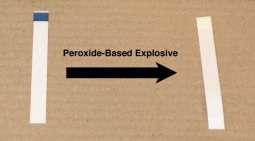
A test strip changes from blue to colorless in the presence of peroxide-based explosives like those favored by terrorists. Credit: Allen Apblett
(PhysOrg.com) -- Scientists today described development and successful initial tests of a spray-on material that both detects and renders harmless the genre of terrorist explosives responsible for government restrictions on liquids that can be carried onboard airliners. They reported on the new ink-like explosive detector/neutralizer at the 241st National Meeting & Exposition of the American Chemical Society (ACS), being held here this week.
"This stuff is going to be used anywhere terrorist explosives are used, including battlefields, airports, and subways," said study leader Allen Apblett, Ph.D. "It's going to save lives."
The material is a type of ink made of tiny metallic oxide nanoparticles so small that 50,000 could fit inside the diameter of a single human hair. The ink changes color, from dark blue to pale yellow or clear, in the presence of explosives. It also changes from a metallic conductor to a non-conducting material, making electronic sensing also possible.
This color-change feature allows the material to work as a sensor for quickly detecting the presence of vapors produced by explosives, Apblett said. Soldiers or firefighters could wear the sensors as badges on their uniforms or use them as paper-based test strips. Airports, subways and other facilities could use the sensors as part of stationary monitoring devices. The sensors could even be engineered into jewelry and cell phones, the scientist added.
The same color-changing material can also serve as an explosives neutralizer. Firefighters and bomb squad technicians could spray the ink onto bombs or suspicious packages until the color change indicates that the devices are no longer a threat, Apblett said. Technicians could also dump the explosives into vats containing the ink to neutralize them.
Apblett notes that authorities are concerned about peroxide-based explosives, made from hydrogen peroxide, which are easy to make and set off. These explosives first drew public attention in 2001, when thwarted "shoe bomber" Richard Reid tried to use one such substance as the detonator onboard a commercial airliner. In particular, they are concerned about a substance called triacetone triperoxide, or TATP, sometimes used in suicide vests and improvised explosive devices that have claimed such a toll among troops and civilians. However, current methods of detecting this explosive are ineffective, allowing the material to easily escape detection at airports and other locations.
The new ink provides a quick way to detect and test these explosives, which might be hidden in clothing, food, and beverages. The ink contains nanoparticles of a compound of molybdenum, a metal used in a wide variety of applications including missile and aircraft parts. The dark blue ink reacts with the peroxide explosives and turns yellow or clear.
When used as an electronic sensor, the highly-sensitive material is capable of detecting TATP vapors at levels as low as a 50 parts per million, equivalent to a few drops of the vapor in a small room, within 30 seconds. The same chemical reaction allows the materials to serve as an explosives neutralizer. In lab studies, the scientists showed that they could add the material to TATP or HMTD and make them nonexplosive.
"This does a really good job of neutralizing terrorists' explosives," said Apblett, a chemist at Oklahoma State University in Stillwater, Okla. "I'm excited to see it moving from the lab to the real world."
The material can also improve safety at laboratories that use explosive chemicals. Recently, Apblett developed pellets containing the ink that can be added to laboratory solvents to prevent the build-up of levels of dangerous peroxides, which can cause accidental explosions. The color-changing feature allows the users of the solvents know that they are safe.
Apblett and colleagues founded a company called Xplosafe to develop and market the material. They hope to see the explosive detecting ink used in airports in as little as a year.
Provided by
American Chemical Society
-
From lemons to lemonade: Reaction uses carbon dioxide to make carbon-based semiconductor,
32 comments
-
Thioridazine kills cancer stem cells in human while avoiding toxic side-effects of conventional cancer treatments,
3 comments
-
SpaceX private rocket blasts off for space station (Update),
42 comments
-
Climate scientists say they have solved riddle of rising sea,
30 comments
-
Research team claims to have found evidence Lake Cheko is impact crater for Tunguska Event,
18 comments
-
microstructure of titanium
10 hours ago
-
Steam in My Espresso Machine
16 hours ago
-
Density question
May 24, 2012
-
Mass transport originating from a point source at a solid gas interface
May 22, 2012
-
Ammonia dispersion in Air
May 22, 2012
-
Multi Choice Help
May 21, 2012
- More from Physics Forums - Materials & Chemical Engineering
More news stories
Dopant gives graphene solar cells highest efficiency yet
(Phys.org) -- By taking advantage of graphenes favorable electrical and optical properties, and then adding an organic dopant, researchers have achieved the highest power conversion efficiency yet for ...
Nanomedicine: Quantum dots appear safe in pioneering study on primates
A pioneering study to gauge the toxicity of quantum dots in primates has found the tiny crystals to be safe over a one-year period, a hopeful outcome for doctors and scientists seeking new ways to battle diseases ...
Nanotechnology / Bio & Medicine
May 20, 2012 |
4.3 / 5 (3) |
8
|
In nanorod crystal growth, nanoparticles seen as artificial atoms
In the growth of crystals, do nanoparticles act as "artificial atoms" forming molecular-type building blocks that can assemble into complex structures? This is the contention of a major but controversial theory ...
May 24, 2012 |
4.8 / 5 (6) |
0
|
First direct observation of oriented attachment in nanocrystal growth
Berkeley Lab researchers have reported the first direct observation of nanoparticles undergoing oriented attachment, the critical step in biomineralization and the growth of nanocrystals. A better understanding ...
May 24, 2012 |
4.7 / 5 (3) |
0
|
Synthetic nano-waste does not disappear
(Phys.org) -- Tiny particles of cerium oxide do not burn or change in the heat of a waste incineration plant. They remain intact on combustion residues or in the incineration system, as a new study by Swiss ...
Nanotechnology / Bio & Medicine
May 25, 2012 |
5 / 5 (2) |
1
|
Scientist: Evolution debate will soon be history
(AP) -- Richard Leakey predicts skepticism over evolution will soon be history. Not that the avowed atheist has any doubts himself.
Dell tablet leak: 10.1-inch display, two-battery choice
(Phys.org) -- Headline after headline talks about vendors tablets in the wings as likely number-one contenders for the iPad. Such claims have justifiably been taken with a grain of salt, considering ...
SpotterRF debuts Radar Backpack Kit (w/ Video)
(Phys.org) -- SpotterRF has announced a special radar backpack kit designed to enhance situational awareness for soldiers on the ground. The company says its special radar is designed for warfighters as part ...
SpaceX capsule has 'new car' smell, astronauts say (Update)
SpaceX's Dragon cargo vessel smells like a new car, said astronauts at the International Space Station after opening the hatches Saturday following the spacecraft's landmark mission to the orbiting lab.
Thousands of shellfish found dead in Peru
Thousands of crustaceans were found dead off the coast of Lima following the mystery mass death of dolphins and pelicans, the Peruvian Navy said Friday.
Astronomers seize last chance in lifetime for Venus Transit
Astronomers are gearing for one the rarest events in the Solar System: an alignment of Earth, Venus and the Sun that will not be seen for another 105 years.
Apr 01, 2011
Rank: not rated yet
Apr 01, 2011
Rank: 1 / 5 (1)
Apr 01, 2011
Rank: not rated yet
what is the actual chemistry behind that i don,t think all other explosives contain hydrogen peroxide? one more thing does the pale yellow color stay long enough ? other explosivescolor tests are not trust worthy bcuz the color change is not perminant
Apr 02, 2011
Rank: not rated yet
Apr 04, 2011
Rank: not rated yet
Likely so.. However, if we take away their ability to utilize super cheap and easy to produce explosives and force them into more complex and/or expensive ones we've acomplished something good.