Keck telescope images super-luminous supernova
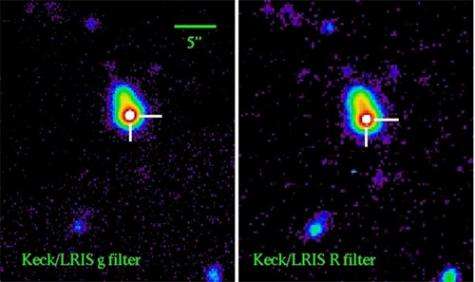
Images of SN 2008am obtained with the Keck I telescope's Low Resolution Imaging Spectrometer (LRIS).Credit: D. Perley & J. Bloom / W.M. Keck Observatory
(PhysOrg.com) -- The Keck I Telescope has played a key role in unraveling the mysteries of one of the brightest supernovas ever discovered.
The supernova, called Supernova 2008am, is 3.7 billion light-years away from Earth. At its peak luminosity, it was over 100 billion times brighter than the Sun. It emitted enough energy in one second to satisfy the power needs of the United States for one million times longer than the universe has existed. In-depth studies of this supernova, including images from the Keck I Low Resolution Imaging Spectrometer, are helping a team of astronomers to understand the science behind this new class of exploding stars.
Supernova 2008am was discovered by astronomers led by graduate student Emmanouil Manos Chatzopoulos and Dr. J. Craig Wheeler of The University of Texas at Austin. It is the latest addition to a new class of exploding stars that astronomers identified a few years ago. Supernova 2008am is one of the most intrinsically bright exploding stars ever observed. The teams research reveals that this supernova is the brightest self-interacting supernova yet discovered. In this type of stellar explosion, the extreme brightness is caused by interaction between the explosion shockwave and a shell of material previously expelled from the star. This research is published in the current issue of The Astrophysical Journal.
The supernova was discovered by the ROTSE Supernova Verification Project (RSVP, formerly called the Texas Supernova Search), which uses the 18-inch robotic ROTSE IIIb Telescope at The University of Texas at Austins McDonald Observatory. It was followed up by astronomers using some of the worlds largest ground-based telescopes, as well as telescopes in space, in a variety of wavelengths. These include the Keck I Telescope, the Hobby-Eberly Telescope, PAIRITEL, the Very Large Array, and the Swift satellite.
Chatzopoulos detailed analysis of the light from SN 2008am revealed that it is not a pair-instability supernova, the explosion of a massive star the light from which is powered by radioactive decay.
Rather, this supernovas extraordinary luminosity most likely comes from interaction between the debris from the stars explosion running into an envelope of gas around the star that the star had previously ejected. This model is called circumstellar interaction.
The researchers suspect that the progenitor star for this supernova might have been of the type known as a luminous blue variable. These massive stars puff off layers of material in episodes. The most famous example is Eta Carinae.
Prior to this discovery, the Texas Supernova Search found the first two brightest supernovae ever in SN 2005ap and 2006gy. The group has found five of the dozen published examples of this new class of stars, which it has dubbed super-luminous supernovae, or SLSNe.
SLSNe are about 100 times brighter than standard core-collapse supernovae, but extremely rare. Normal supernovae go off at a rate of about one per century in a galaxy; SLSNe may be more than a thousand times more rare.
Were now in the process of converting our discoveries into real science rather than just a new thing, Wheeler said. That makes it a little bit less flashy, but of course thats where the science really is, digging deeply into the nature of these very bright events. This new supernova has given us important new clues to their behavior.
Studies of SLSNe have led to new insights, Chatzopoulos said. For the first time, were probing high-mass stellar death. The traditional ideas we have about how supernovae are powered, why they are so bright, do not seem to apply for the case of these super-luminous supernovae. There are other mechanisms involved.
Not all SLSNe are the same. Theres a variety of progenitor stars that can give different outcomes, Chatztopoulos said. Its a zoo.
The common factor is their luminosity.
The fate of different stars depends on their mass, Wheeler said. He defines three categories of high-mass stars that explode as supernovae:
In the least massive case, around 10 to 20 solar masses, a star collapses in on itself because its iron core cannot hold out against the crushing gravity of the stars weight. This is the classic core-collapse supernova with normal brightness.
The second progenitor category consists of more massive stars, perhaps up to 100 solar masses. This type of star puffs off layers of material before it dies. The interaction between the supernova ejecta and the previously puffed-off material can cause the supernova to brighten to the super-luminous range.
The final category includes the most massive progenitor stars, those more than 100 solar masses. In this case, the current state of the art predicts that they make matter and antimatter, electron-positron pairs, because they are so hot, Wheeler said. That process destabilizes the whole star and it contracts, ignites the thermonuclear fuel, and then explodes, blowing the whole star up.
These are called pair-instability supernovae.
Of the three types of explosions Wheeler describes, the first two would leave behind a stellar remnant in the form of a neutron star or black hole. The third and most massive, though, would explode completely, leaving no remnant.
Though they set a record, the team isnt finished studying super-luminous supernovae. Their work on understanding SN 2008am might explain the origins of half of the known examples, but as Wheeler said, to a scientist, the interesting thing is, whats the other half? ... We want to understand them all before were done.
Provided by W. M. Keck Observatory
-
From lemons to lemonade: Reaction uses carbon dioxide to make carbon-based semiconductor,
32 comments
-
Thioridazine kills cancer stem cells in human while avoiding toxic side-effects of conventional cancer treatments,
3 comments
-
SpaceX private rocket blasts off for space station (Update),
42 comments
-
Climate scientists say they have solved riddle of rising sea,
30 comments
-
Research team claims to have found evidence Lake Cheko is impact crater for Tunguska Event,
18 comments
-
revamping general concept and cosmological principle
May 25, 2012
-
Transiting Exoplanet Light Curve
May 25, 2012
-
Math behind Theoretical Physics
May 24, 2012
-
Do we know whats at the center of galaxies yet?
May 23, 2012
-
Structure of the Milky Way?
May 20, 2012
-
What would it take to terraform Pluto and Charon?
May 19, 2012
- More from Physics Forums - General Astronomy
More news stories
SpaceX capsule has 'new car' smell, astronauts say (Update)
SpaceX's Dragon cargo vessel smells like a new car, said astronauts at the International Space Station after opening the hatches Saturday following the spacecraft's landmark mission to the orbiting lab.
Space & Earth / Space Exploration
18 hours ago |
4.5 / 5 (20) |
0
Astronomers seize last chance in lifetime for Venus Transit
Astronomers are gearing for one the rarest events in the Solar System: an alignment of Earth, Venus and the Sun that will not be seen for another 105 years.
18 hours ago |
5 / 5 (3) |
2
Australia hails surprise super-telescope decision
Australia has hailed a surprise decision giving it a role in a radio telescope project aimed at revolutionising astronomy, vowing to draw on its decades of experience in space science.
18 hours ago |
5 / 5 (4) |
1
Astronauts enter world's 1st private supply ship
(AP) -- Space station astronauts floated into the Dragon on Saturday, a day after its heralded arrival as the world's first commercial supply ship.
Space & Earth / Space Exploration
18 hours ago |
5 / 5 (5) |
0
Sophisticated simulations predict future warming
The chances of our planet being hit by a global warming of 3 degrees Celsius by 2050 is as likely as it being hit by an increase of 1.4 degrees, new research shows. Presented in the journal Nature Geoscience, the British study ...
Space & Earth / Earth Sciences
May 22, 2012 |
4.4 / 5 (9) |
51
Scientist: Evolution debate will soon be history
(AP) -- Richard Leakey predicts skepticism over evolution will soon be history. Not that the avowed atheist has any doubts himself.
Dell tablet leak: 10.1-inch display, two-battery choice
(Phys.org) -- Headline after headline talks about vendors tablets in the wings as likely number-one contenders for the iPad. Such claims have justifiably been taken with a grain of salt, considering ...
SpotterRF debuts Radar Backpack Kit (w/ Video)
(Phys.org) -- SpotterRF has announced a special radar backpack kit designed to enhance situational awareness for soldiers on the ground. The company says its special radar is designed for warfighters as part ...
Thousands of shellfish found dead in Peru
Thousands of crustaceans were found dead off the coast of Lima following the mystery mass death of dolphins and pelicans, the Peruvian Navy said Friday.
Keep food safety in mind this memorial day weekend
(HealthDay) -- Picnics, parades and cookouts are as much a part of Memorial Day weekend as tributes to the United States' war veterans.
Family history of Alzheimer's affects functional connectivity
(HealthDay) -- Cognitively normal individuals with a family history of late-onset Alzheimer's disease (AD) may display lower resting state functional connectivity in the default mode network (DMN) of the brain, ...
Apr 01, 2011
Rank: 5 / 5 (5)
A wild omatumr appears!
Apr 01, 2011
Rank: 5 / 5 (3)
I was reading about pair instability super novae last night, one of the stars mentioned above created some 40 stellar masses of nickel-56, decaying quickly to cobalt-56, then iron-56. 40 stellar masses was approximately the size of the star's core. This is the material seen interacting with gas and dust from the star's previous out-gassing.
Apr 01, 2011
Rank: 5 / 5 (5)
The progenitor of SN1987A (the star Sanduleak -69° 202a) is thought to be a Luminous Blue Variable, similar to SN2008am. 1987A is also another example of a core-collapse SN.
There has been some debate as to the specifics of the progenitor star (system?); here's a (nontechnical) paper that goes into some of the issues involved and looks at some potential future examples in our galaxy(e.g. Sher 25): http://arxiv.org/...66v1.pdf
Apr 02, 2011
Rank: not rated yet
Apr 02, 2011
Rank: 1 / 5 (2)
Well, see, that's where the "standard model" of the solar system and the universe fails.
The standard model alleges that some nearby star exploded, and that the planets are the remnants of the material ejected in this explosion.
The problems with this BS theory are manifold.
1) If the ejecta had sufficient velocity to escape the extremely close gravity well of a collapsing super-massive star, then it should have been moving FAR faster than any planet in our solar system currently moves. It should have skipped right by the Sun and never got caught, because it should have been moving around 1500km/s, like the crab nebula remnants, which is far, far more than is needed to escape the Sun's gravity, certainly at distances of 0.3A.u. to 40a.u.
2) Almost everything that orbits the Sun orbits in the same basic direction, and even along the same basic plane, and with relatively few exceptions.. continued...
Apr 02, 2011
Rank: 1 / 5 (2)
if the terrestrial objects in our solar system had actually originated from the explosion of a nearby star, then even if this material had been magically trapped by the Sun's woefully inadequate gravity, the planets should be orbiting in random directions along random planes, as the sector of an expanding "nearly spherical" cloud of gases passed the sun.
3) If a 100 solar masses star had exploded at a distance of 10 light years, totally ejecting it's entire mass in a spherical shell of 100% terrestrial matter, it would not have actually ejected enough material in the Sun's direction to make even a tiny fraction of a planet within the 40A.u. range of the 8 planets plus pluto.
Only one ten-millionth of a solar mass worth of ALL ejected matter would have passed within that disk, which comes to 2.08E23 kg. This is only enough terrestrial matter to make about 1/28th of the earth's mass...and certainly cannot explain the moon, mars, venus, mercury, and other objects.
Apr 13, 2011
Rank: 5 / 5 (1)
You can see spherical shells
of stellar novae ejecta
slamming into clouds of
neutral hydrogen and forming
Stars.