German cabinet approves CO2 storage bill
April 13, 2011

Fossil fuels provide around half of Germany's energy needs

Enlarge

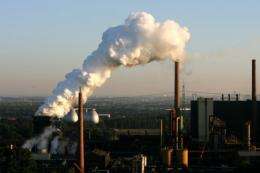
Steam rises from a coking plant in Bottrop, Germany. Germany's cabinet approved a draft law on storing carbon dioxide underground after months of debate as Europe's top economy wrangles over energy policy following Japan's nuclear disaster.

Germany's cabinet approved a draft law on storing carbon dioxide underground on Wednesday after months of debate as Europe's top economy wrangles over energy policy following Japan's nuclear disaster.

"Recent developments have again brought home to us the efforts we need to make to ensure power generation is sustainable, climate-friendly, safe and economically viable," Economy Minister Rainer Bruederle said.

"I am convinced that CCS (carbon capture and storage) opens up important opportunities, both for the continued use of fossil fuels and to reduce ."

The bill, which needs parliamentary approval and which implements a directive from the European Union, allows pilot and demonstration projects to go ahead ahead of an assessment of its viability in 2017, the government said.

It follows however months of debate with the governments of Germany's 16 states, and includes a clause giving them the say on where the storage sites are located.

It also comes as Chancellor Angela Merkel's government looks to speed up the transition to after the crisis at Japan's Fukushima following the March 11 earthquake and tsunami.

Merkel announced a few days later a three-month suspension of an earlier decision to extend the life of Germany's nuclear plants and the temporary shutdown of the country's seven oldest reactors pending a safety review.

Germany decided a decade ago to abandon nuclear power by around 2020 but Merkel last year postponed this by more than a decade, saying alternative sources of energy were not yet ready to fill the gap.

The country's 17 reactors produce around a third of its electricity. Fossil fuels provide around half of its energy needs and several new are either in construction or planned.

CCS aims to snare CO2 as it is pumped out from fossil-fuel burning plants, liquefy it and bury it underground, usually in disused natural gas storage chambers, to stop it escaping into the atmosphere and causing climate change.

It is also seen as a way of buying time for politicians to forge an effective treaty on greenhouse gases and wean the global economy off cheap but dirty .

Other major emitters including the United States, China and Australia see CCS as crucial and countries have earmarked tens of billions of dollars to develop a technology that is still only at an experimental stage.

But critics say CCS could be dangerous and that the large amount of investment needed would be better spent on renewable sources of energy, like solar and wind power, or on nuclear power.

(c) 2011 AFP

Filter


Move the slider to adjust rank threshold, so that you can hide some of the comments.


Display comments: newest first

kaasinees
Apr 13, 2011

Rank: 1 / 5 (1)
Depending on the qaulity of the soil this actually a good thing. The carbon could help hold down other minerals from rain and animal/plant death into the soil. If we can build a power plant in the ruined soil desert like in spain, output the wastes into the soil, bacteria will grow into the soil and "fertilize" it. In a few decades(+/-) it could turn from ruined soil into fertilized soil.

It is worth a study, and could help fighting the desertification in spain and other parts of the world.
Rank 3 /5 (1 vote)
Relevant PhysicsForums posts

More news stories

SpaceX capsule has 'new car' smell, astronauts say (Update)

SpaceX's Dragon cargo vessel smells like a new car, said astronauts at the International Space Station after opening the hatches Saturday following the spacecraft's landmark mission to the orbiting lab.

Space & Earth / Space Exploration

created 20 hours ago | popularity 4.5 / 5 (20) | comments 0

Astronomers seize last chance in lifetime for Venus Transit

Astronomers are gearing for one the rarest events in the Solar System: an alignment of Earth, Venus and the Sun that will not be seen for another 105 years.

Space & Earth / Astronomy

created 20 hours ago | popularity 5 / 5 (3) | comments 2

Australia hails surprise super-telescope decision

Australia has hailed a surprise decision giving it a role in a radio telescope project aimed at revolutionising astronomy, vowing to draw on its decades of experience in space science.

Space & Earth / Astronomy

created 20 hours ago | popularity 5 / 5 (4) | comments 1

Astronauts enter world's 1st private supply ship

(AP) -- Space station astronauts floated into the Dragon on Saturday, a day after its heralded arrival as the world's first commercial supply ship.

Space & Earth / Space Exploration

created 20 hours ago | popularity 5 / 5 (6) | comments 0

Sophisticated simulations predict future warming

The chances of our planet being hit by a global warming of 3 degrees Celsius by 2050 is as likely as it being hit by an increase of 1.4 degrees, new research shows. Presented in the journal Nature Geoscience, the British study ...

Space & Earth / Earth Sciences

created May 22, 2012 | popularity 4.4 / 5 (9) | comments 51


Scientist: Evolution debate will soon be history

(AP) -- Richard Leakey predicts skepticism over evolution will soon be history. Not that the avowed atheist has any doubts himself.

Dell tablet leak: 10.1-inch display, two-battery choice

(Phys.org) -- Headline after headline talks about vendors’ tablets in the wings as likely number-one contenders for the iPad. Such claims have justifiably been taken with a grain of salt, considering ...

SpotterRF debuts Radar Backpack Kit (w/ Video)

(Phys.org) -- SpotterRF has announced a special radar backpack kit designed to enhance situational awareness for soldiers on the ground. The company says its special radar is designed for warfighters as part ...

Thousands of shellfish found dead in Peru

Thousands of crustaceans were found dead off the coast of Lima following the mystery mass death of dolphins and pelicans, the Peruvian Navy said Friday.

Keep food safety in mind this memorial day weekend

(HealthDay) -- Picnics, parades and cookouts are as much a part of Memorial Day weekend as tributes to the United States' war veterans.

Family history of Alzheimer's affects functional connectivity

(HealthDay) -- Cognitively normal individuals with a family history of late-onset Alzheimer's disease (AD) may display lower resting state functional connectivity in the default mode network (DMN) of the brain, ...