Nothing fishy about sardine kill
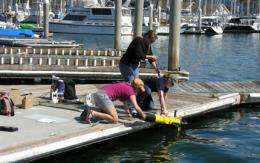
Algal bloom specialist David Caron knows exactly what caused the death of 2.5 million sardines at King Harbor and is producing a paper on his research. The city of Redondo Beach gave him and his team a coin medallion for their guidance on the recent die-off.
The few million silvery sardines that recently went belly up at Redondo Beach have been removed and the rotten egg smell has nearly dissipated.
But the fish kill story at King Harbor is not over.
“We’re going to have one of the best documented events of this kind that has ever been done probably anywhere in the world,” said David Caron, professor of biological sciences in USC Dana and David Dornsife College of Letters, Arts and Sciences.
“Our sensor equipment was in the water before, during and after it happened; luckily we had one right at ground zero,” Caron said. “And we physically got there the day it happened.”
Caron and his team are compiling their research on the March phenomenon in which more than 2 million — 175 tons — of sardines swam into the marina and died. An expert in aquatic ecosystems, Caron and his researchers are working closely with the city of Redondo Beach and King Harbor in finding answers about what caused the phenomenon and how such a fish kill may be prevented. They are also monitoring what is being done with the fish corpses.
Instruments suspended in the harbor throughout the event revealed that the fish were killed by a lack of oxygen in the harbor water — not toxins from an algal bloom which some news outlets had erroneously reported. Caron’s team also used an EcoMapper to help characterize water quality. The EcoMapper is a self-propelled device that traverses the water with a scanning sonar, mapping the ocean floor and collecting real-time water quality data.
“The fish were jammed in a small space in the harbor and ran out of oxygen,” Caron said. Although not the cause of death, the stomachs in the dead fish contained algae that produced domoic acid, a heterocyclic amino acid associated with harmful algal blooms. They ate the toxins before crowding into the harbor and running out of oxygen, Caron said, adding that a significant toxic algal bloom did exist in the coastal waters off the Palos Verdes Peninsula at the time of the event.
Caron and his researchers have been studying King Harbor since a fish kill occurred there in 2005. In 2006, they began taking weekly water samples and the next year, installed sensors that measure in part the temperature, salinity, chlorophyll and plant pigment in the water. Their sensors record the measurements every half hour, detecting any algal blooms and toxic algae that may be present.
“This allows us to have a finger on the pulse on what’s going on out there,” Caron said. “This most recent event happened virtually overnight.”
Early March 8, Caron received a call from one of the marinas about the dead fish, which had started perishing overnight. Several of Caron’s researchers were dispatched right away. Astrid Schnetzer, research assistant professor, was one who arrived the first day, then returned to collect samples and measurements for several consecutive days with engineering technician Carl Oberg, lab technician Alyssa Gellene and Ph.D. candidates Beth Stauffer and Erica Seubert.
“It became so packed with sardines you couldn’t see the water,” Schnetzer recounted, adding that in some places a 3-foot-thick layer of fish had settled along the harbor floor. “Fish corpses were everywhere. It looked as if you could walk between the boats across the sardines.”
After a few days, it got worse.
“The smell made me nauseous,” she said. “People were complaining that it made their eyes burn. It was the most rotten straightforward smell you can imagine.”
All their effort was worth it.
“We’ve been there waiting for something like this to happen for five years,” Caron said. “When these events usually happen, we’re basically chasing the ambulance. By the time we get there it’s over. In this case, we were there before it happened.”
Caron and his team have also been honored by the city of Redondo Beach, which acknowledged their assistance and expertise involving handing the fish and the inquiries surrounding the event. Caron has given many interviews on the science behind what occurred, has worked with the city on cleanup and is still monitoring the aftermath.
Right now, Caron is ensuring that all toxins in the fish are removed before they are turned into compost.
“The composting process should take care of any toxins,” he said, holding up a coin medallion engraved with King Harbor that Redondo Beach City Council members gave him during a recent public meeting to symbolize their appreciation. “No one has ever looked at the toxins [from a fish-die] during the composting process before.
“We know that in toxic blooms, the toxins don’t stay around forever, they get degraded by bacteria, light and increased temperatures. In the sea, there is a chemical and biological degradation of toxins, that we know. We don’t know if that applies to composting, but we’re about to find out.”
He’s not a fish behaviorist, so cannot say definitively what drove so many fish into the harbor at once. It could have been that predators chased the schools into the harbor, he said. Or possibly the domoic acid they ate caused the fish to become disoriented and swim erratically.
“You can speculate all sorts of things, but in fact nobody really knows what toxins will do to behavior in fish,” Caron said. “In the past, people have suggested it might cause swimming abnormalities but most recent evidence suggests that it probably doesn’t.”
Larger mammals such as sea lions who feed on toxic blooms do develop distinct neurological symptoms — resulting from nausea to convulsions and seizures to death, he said.
“There were thousands of birds feeding on the dead fish,” Caron said. “And we haven’t seen an abnormal increase in the mortality of birds or marine mammals, so that’s a good sign.”
Caron and his team’s research will also help Redondo Beach come up with solutions that may help the city avoid a similar situation in the future such as possibly putting an oxygenation system in place at the harbor. The Redondo Beach Patch reported that cleanup would cost the city at least $300,000.
“They may use it only once every three years or so,” Caron said of the aeration scheme, one of many possible solutions. "But they are going to avoid a costly problem.”
Provided by University of Southern California


