In fireflies, flightless females lose out on gifts from males
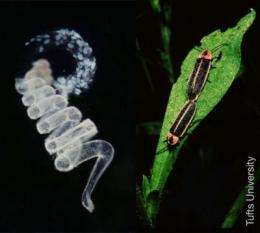
Every parent with young children knows that couples need to work together to accomplish the myriad tasks waiting both at work and at home. But it may come as a surprise that fireflies also juggle their commitments to find a comfortable work-family balance. According to new research led by biologists at Tufts University's School of Arts and Sciences, wingless "stay-at-home" female fireflies get less support from their mates than females who are able to fly.
There are more than 2000 species of fireflies around the globe, and these beetles show astoundingly diverse lifestyles. For some familiar backyard sparklers, both the male and female firefly have wings and can easily take to the air.
However, many female fireflies can only dream about flying because they don't have any wings. These wingless belles lounge on the ground or clamber onto twigs, where they lure flying males with a steady luminescent glow -- the common European glow-worm is a shining example.
A study published in the April 2011 issue of the journal Evolution (online Dec. 22) by Tufts biologists and collaborators at the University of Georgia and the Taiwan Museum of Science reveals a surprising link between these flightless females and how much their male partners are willing to contribute to their collective reproductive gain.
Like all creatures, firefly females maximize their evolutionary success by producing lots of offspring. Previous work by the Tufts research team has shown that some male fireflies donate a "nuptial gift" to females during mating. This gift contains sperm wrapped up in a nutritious high-protein package that helps a female to produce more eggs. Because most fireflies stop eating once they become adults, male nuptial gifts are significant for both sexes.
To explore these insects' work-family balance, the Tufts researchers set out to answer the question: When firefly females are flightless, does it change the division of reproductive labor between the sexes? That is, do firefly males still give nuptial gifts?
"These females are definitely committed to being 'stay-at-home-moms' because they're basically a huge sac of eggs," said Sara Lewis, professor of biology at Tufts and co-author of the paper. By giving up wings, such flightless females can devote all their energy to churning out eggs and so gain an advantage over their winged cousins.
"Since wingless females would already enjoy high reproductive output, we thought males might no longer need to support their partners' reproduction with added nutrients," explained Tufts doctoral candidate Adam South, the lead author on the paper.
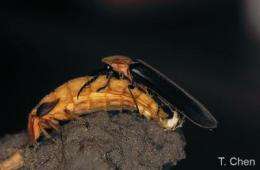
Working with firefly experts from around the world, the Tufts biologists studied the reproductive structures of 32 different species. They confirmed that in those with flying females, males did bestow nuptial gifts. In most species with flightless females, however, the males did not do so.
Looking Back at the First Fireflies
The researchers also peered back in time to the first fireflies.
In collaboration with colleagues in Georgia and Taiwan, the Tufts biologists used existing knowledge of the evolutionary relationships among different firefly species to examine how flight and nuptial gifts have changed over time.
In very early fireflies, the biologists discovered, females sported normal wings and accepted nuptial gifts from their male suitors. But the evolutionary tree also showed that nearly every time females stopped flying around, their partners retreated to transferring only sperm, revealing a surprising evolutionary correlation between these male and female traits.
So just like people, firefly couples also adjust how much effort each one will devote to work -- flight in this case -- or to family. With stay-at-home moms investing more in reproduction, some firefly males apparently decide that gifts are no longer worth giving.
Lewis noted that it remains to be seen whether this co-evolutionary linkage has also developed in other insects with flightless females. It is also unclear why females in some species of fireflies, but not others, have been able to survive and thrive without flight.
More information: South, Adam, Stanger-Hall, Kathrin, Jeng, Ming-Luen, and Lewis, Sara M., "Correlated Evolution of Female Neoteny and Flightlessness with Male Spermatophore Production in Fireflies (Coleopetera: Lampyridae)," Evolution, no. doi: 10.1111/j.1558-5646.2010.01199.x
Provided by Tufts University


