The eyes have it: Dinosaurs hunted by night
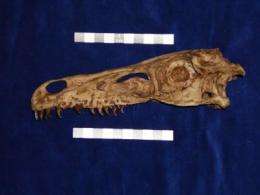
Velociraptor mongoliensis was a nocturnal carnivore. Credit: Lars Schmitz, UC Davis.
The movie Jurassic Park got one thing right: Those velociraptors hunted by night while the big plant-eaters browsed around the clock, according to a new study of the eyes of fossil animals. The study will be published online April 14 in the journal Science.
This conclusion overturns the conventional wisdom that dinosaurs were active by day while early mammals scurried around at night, said Ryosuke Motani, professor of geology at UC Davis and co-author of the paper.
"It was a surprise, but it makes sense," Motani said.
The research is also providing insight into how ecology influences the evolution of animal shape and form over tens of millions of years, according to Motani and collaborator Lars Schmitz, a postdoctoral researcher in the Department of Evolution and Ecology at UC Davis.
Motani and Schmitz, a former graduate student of Motani's, worked out the dinosaur's daily habits by studying their eyes.
Dinosaurs, lizards and birds all have a bony ring called the "scleral ring" in their eye, a structure that is lacking in mammals and crocodiles. Schmitz and Motani measured the inner and outer dimensions of this ring, plus the size of the eye socket, in 33 fossils of dinosaurs, ancestral birds and pterosaurs. They took the same measurements in 164 living species.
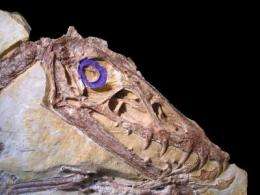
The pterosaur Scaphognathus crassirostris was a day-active, flying archosaur. Scleral ring highlighted. Credit: Lars Schmitz/UC Davis.
Day-active, or diurnal, animals have a small opening in the middle of the ring. In nocturnal animals, the opening is much larger. Cathemeral animals -- active both day and night -- tend to be in between.The size of these features is affected by a species' environment (ecology) as well as by ancestry (phylogeny). For example, two closely related animals might have a similar eye shape even though one is active by day and the other by night: The shape of the eye is constrained by ancestry.
Schmitz and Motani wrote a computer program to separate the "ecological signal" from the "phylogenetic signal." The results of that analysis are in a separate paper published simultaneously in the journal Evolution.
By looking at 164 living species, the UC Davis team was able to confirm that eye measurements are quite accurate in predicting whether animals are active by day, by night or around the clock.
They then applied the technique to fossils from plant-eating and carnivorous dinosaurs, flying reptiles called pterosaurs, and ancestral birds.
The measurements revealed that the big plant-eating dinosaurs were active day and night, probably because they had to eat most of the time, except for the hottest hours of the day when they needed to avoid overheating. Modern megaherbivores like elephants show the same activity pattern, Motani said.
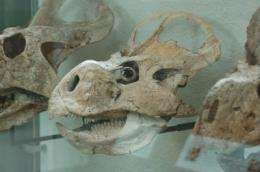
This plant-eating dinosaur, Protoceratops andrewsi, was active day and night, like many other herbivorous dinosaurs. Credit: Lars Schmitz, UC Davis.
Velociraptors and other small carnivores were night hunters, Schmitz and Motani showed. They were not able to study big carnivores such as Tyrannosaurus rex, because there are no fossils with sufficiently well-preserved scleral rings.Flying creatures, including early birds and pterosaurs, were mostly day-active, although some of the pterosaurs -- including a filter-feeding animal that probably lived rather like a duck, and a fish-eating pterosaur -- were apparently night-active.
The ability to separate out the effects of ancestry gives researchers a new tool to understand how animals lived in their environment and how changes in the environment influenced their evolution over millions of years, Motani said.
Provided by University of California - Davis
-
From lemons to lemonade: Reaction uses carbon dioxide to make carbon-based semiconductor,
32 comments
-
Thioridazine kills cancer stem cells in human while avoiding toxic side-effects of conventional cancer treatments,
3 comments
-
SpaceX private rocket blasts off for space station (Update),
42 comments
-
Climate scientists say they have solved riddle of rising sea,
30 comments
-
Research team claims to have found evidence Lake Cheko is impact crater for Tunguska Event,
18 comments
-
What would stain as translucent on light-coloured fabric?
10 hours ago
-
How do I identify different bacteria on culture plates?
20 hours ago
-
Why Do Dogs do Strange things...
May 25, 2012
-
What does exophillic and endophillic mean in terms of mosquito and their control?
May 24, 2012
-
Semen stains glows under black lights (uv light)?
May 23, 2012
-
Question on Human Chromosome 2
May 23, 2012
- More from Physics Forums - Biology
More news stories
Social welfare cuts ultimately come with heavy price, researchers say
(Phys.org) -- Slashing government funding for Medicaid, food stamps and other programs that serve the poor while politically popular with some lawmakers and many conservatives may do more harm ...
Other Sciences / Social Sciences
May 24, 2012 |
4.2 / 5 (15) |
124
Ancient Bethlehem seal unearthed in Jerusalem
Israeli archaeologists have discovered a 2,700-year-old seal that bears the inscription "Bethlehem," the Israel Antiquities Authority announced Wednesday, in what experts believe to be the oldest artifact ...
Other Sciences / Archaeology & Fossils
May 23, 2012 |
3.5 / 5 (14) |
23
Oldest Jewish archaeological evidence on the Iberian Peninsula
German archaeologists of the Friedrich Schiller University Jena found one of the oldest archaeological evidence so far of Jewish Culture on the Iberian Peninsula at an excavation site in the south of Portugal, ...
Other Sciences / Archaeology & Fossils
May 25, 2012 |
4.3 / 5 (4) |
12
Dollars and sense: Why are some people morally against tax?
As the U.S. presidential election campaigns heat up, the economic debate is dominated by bailouts, austerity and, inevitably, taxation. Now a new study published in Symbolic Interaction asks why tax is such an important issue ...
Other Sciences / Social Sciences
May 23, 2012 |
3 / 5 (2) |
12
Oldest art even older
New dates from Geißenklösterle Cave in Southwest Germany document the early arrival of modern humans and early appearance of art and music.
Other Sciences / Archaeology & Fossils
May 24, 2012 |
5 / 5 (2) |
6
Scientist: Evolution debate will soon be history
(AP) -- Richard Leakey predicts skepticism over evolution will soon be history. Not that the avowed atheist has any doubts himself.
Dell tablet leak: 10.1-inch display, two-battery choice
(Phys.org) -- Headline after headline talks about vendors tablets in the wings as likely number-one contenders for the iPad. Such claims have justifiably been taken with a grain of salt, considering ...
SpotterRF debuts Radar Backpack Kit (w/ Video)
(Phys.org) -- SpotterRF has announced a special radar backpack kit designed to enhance situational awareness for soldiers on the ground. The company says its special radar is designed for warfighters as part ...
SpaceX capsule has 'new car' smell, astronauts say (Update)
SpaceX's Dragon cargo vessel smells like a new car, said astronauts at the International Space Station after opening the hatches Saturday following the spacecraft's landmark mission to the orbiting lab.
Thousands of shellfish found dead in Peru
Thousands of crustaceans were found dead off the coast of Lima following the mystery mass death of dolphins and pelicans, the Peruvian Navy said Friday.
Astronomers seize last chance in lifetime for Venus Transit
Astronomers are gearing for one the rarest events in the Solar System: an alignment of Earth, Venus and the Sun that will not be seen for another 105 years.


Apr 15, 2011
Rank: 5 / 5 (1)