The shocking environment of hot Jupiters
(PhysOrg.com) -- Jupiter-like worlds around other stars push shock waves ahead of them, according to a team of UK astronomers. Just as the Earth's magnetic "bow-shock" protects us from the high-energy solar wind, these planetary shocks protect their atmospheres from their star's damaging emissions. Team member Dr Aline Vidotto of the University of St Andrews will present a new model based on observations made with the SuperWASP (Wide Angle Search for Planets) project on Monday 18 April at the National Astronomy Meeting in Llandudno, Wales.
In 2008, observations of WASP-12 detected a periodic dip in light as a large planet (catalogued as WASP-12b) passed in front of its host star. Planet hunting with transit instruments like SuperWASP allows astronomers to obtain a wealth of information about exoplanetary systems including their composition and size.
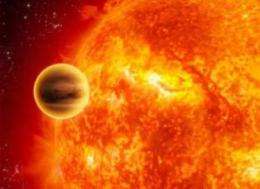
WASP-12b turns out to be one of the largest exoplanets found to date and completes each orbit around its parent star in just 26 hours. The planet is more than 250,000 km across, with its atmosphere swollen by the intense heat it receives from the star, making it a so-called ‘hot Jupiter’.
Hot Jupiters are similar to the planet Jupiter in our own Solar System but located far closer to their host star (WASP-12b is 3.4 million km away from WASP-12 which compares with the Earth-Sun distance of 150 million km). With such a small distance between them violent interactions between the star and the planet can take place.
As one of the largest hot Jupiters discovered to date, WASP-12b also gives a unique opportunity to observe the interactions between the planetary magnetic field and the host star’s magnetic field. The very presence of a magnetic field reveals that the planet must have a conducting, rotating interior.
Video: Simulation of a planet and bow shock transiting a limb-darkened star. The parameters have been tuned to be representative of the WASP-12 system.
There is now tantalizing new evidence from Hubble Space Telescope data that a magnetosphere exists around WASP-12b. Observations of the planet taken in ultraviolet wavelengths by a team including scientists from the Open University reveal that the start of the dip in the light from the star during the transit of the planet is earlier in ultraviolet than visible light. Originally, this was thought to be caused by material flowing from the planet onto the star. The St Andrews group have however determined that the planet ploughs into a supersonic headwind and pushes a shock ahead it – just like the one around a supersonic jet aircraft.
The St Andrews astronomers carried out simulations of a planet and its bow shock transiting a star and by investigating various shock geometries, orientations and densities have reproduced the dip in ultraviolet light observed in WASP-12b.
Team leader Dr Aline Vidotto commented on the new result. "The location of this bow shock provides us with an exciting new tool to measure the strength of planetary magnetic fields. This is something that presently cannot be done in any other way."
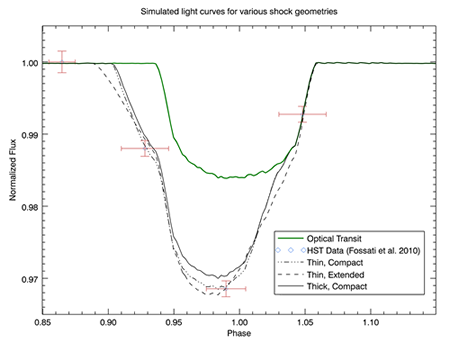
Joe Llama, a PhD student who carried out the simulations of the bow shock, said "Our models are able to reproduce the data from the Hubble Space telescope for a range of wind speeds implying that bow shocks could be far more commonplace than had been thought.”
Bow shocks may also protect the atmospheres of hot Jupiters from their harsh environment. These planets are constantly bombarded with highly charged, energized particles from the wind from their parent stars, meaning that their atmosphere can be eroded. The presence of a magnetic field could greatly reduce the amount of stellar wind the planet is exposed to, effectively acting as a shield and helping the atmosphere survive.
Joe Llama concludes, “Although our model predicts a bow shock similar to that of the Earth, we are not expecting any messages from WASP-12b as it is too hot to support life. But the first hints that extrasolar planets have magnetosphere is a big step forward in understanding and identifying the habitable zones where we ultimately hope to find signs of life”.
More information: This work was also displayed in a poster at the conference. The poster can be viewed here.
Provided by Royal Astronomical Society


