Earth from space: Dust and plankton
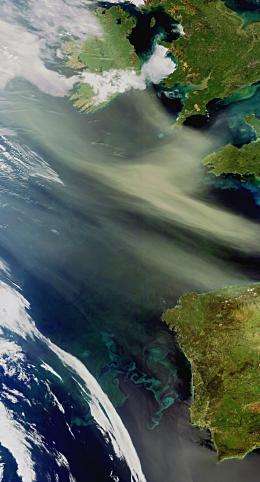
Envisat captures dust and sand from the Algerian Sahara Desert, located in northern Africa, blowing west across the Atlantic Ocean. Sandstorms are very common over the Sahara, and large concentrations of the dust can be found in the tropical Atlantic and the Caribbean. The dust contains many nutrients, including nitrogen, phosphorus and iron, which act as a fertiliser and stimulate the production of massive plankton blooms. In this image, plankton blooms are visible in the Atlantic as blue and green swirls. Although some types of plankton are individually microscopic, the chlorophyll they use for photosynthesis collectively tints the colour of the surrounding ocean waters. This allows dedicated 'ocean colour' satellite sensors, such as Envisat's Medium Resolution Imaging Spectrometer (MERIS), to detect them from space. MERIS acquired this image on 8 April at a resolution of 300 m. Credit: ESA
(PhysOrg.com) -- Envisat captures dust and sand from the Algerian Sahara Desert, located in northern Africa, blowing west across the Atlantic Ocean last week.
Stretching across the eastern Atlantic, strong winds carry the plume over the northwestern tip of the Iberian Peninsula (bottom), the western tip of France, the southwestern tip of England (top right) and the southwestern coast of Ireland (top left).
Dust from the Sahara Desert the worlds largest desert, encompassing around 8.6 million sq km can be transported over thousands of kilometres by atmospheric convection currents. These convection currents form when warm, lighter air rises and cold, heavier air sinks.
Sandstorms are very common over the Sahara, and large concentrations of the dust can be found in the tropical Atlantic and the Caribbean. The dust contains many nutrients, including nitrogen, phosphorus and iron, which act as a fertiliser and stimulate the production of massive plankton blooms.
In this image, plankton blooms are visible in the Atlantic as blue and green swirls. (The various shades of green and tan in the English Channel and around Wales are due to sediments being transported in the water.)
Plankton are microscopic marine plants that drift on or near the surface of the sea and are the basic food on which all other marine life depends. They contain chlorophyll pigments and are able to convert inorganic compounds, such as water, nitrogen and carbon, into complex organic materials.
With their ability to 'digest' these compounds, they remove as much carbon dioxide from the atmosphere as terrestrial plants. As a result, the oceans have a profound influence on climate. Since plankton influence the amount of carbon in the atmosphere, it is important to monitor and model them into calculations of future climate change.
Although some types of plankton are individually microscopic, the chlorophyll they use for photosynthesis collectively tints the colour of the surrounding ocean waters. This allows dedicated 'ocean colour' satellite sensors, such as Envisat's Medium Resolution Imaging Spectrometer (MERIS), to detect them from space.
MERIS acquired this image on 8 April at a resolution of 300 m.
Provided by
European Space Agency
-
From lemons to lemonade: Reaction uses carbon dioxide to make carbon-based semiconductor,
32 comments
-
Thioridazine kills cancer stem cells in human while avoiding toxic side-effects of conventional cancer treatments,
3 comments
-
SpaceX private rocket blasts off for space station (Update),
42 comments
-
Climate scientists say they have solved riddle of rising sea,
30 comments
-
Research team claims to have found evidence Lake Cheko is impact crater for Tunguska Event,
18 comments
-
Hypothetical desert earth
6 hours ago
-
More human population = greater mass?
May 25, 2012
-
Conversion from aircraft bearing to normal degrees
May 23, 2012
-
Interpretation/Analysis of the Lab results(HEPA filter)
May 22, 2012
-
Has anyone here attended the The Urbino Summer School in Paleoclimatology?
May 22, 2012
-
Earthquakes: Mag 6 N. Italy and Mag 5.6 W. Bulgaria
May 21, 2012
- More from Physics Forums - Earth
More news stories
SpaceX capsule has 'new car' smell, astronauts say (Update)
SpaceX's Dragon cargo vessel smells like a new car, said astronauts at the International Space Station after opening the hatches Saturday following the spacecraft's landmark mission to the orbiting lab.
Space & Earth / Space Exploration
19 hours ago |
4.5 / 5 (20) |
0
Astronomers seize last chance in lifetime for Venus Transit
Astronomers are gearing for one the rarest events in the Solar System: an alignment of Earth, Venus and the Sun that will not be seen for another 105 years.
19 hours ago |
5 / 5 (3) |
2
Australia hails surprise super-telescope decision
Australia has hailed a surprise decision giving it a role in a radio telescope project aimed at revolutionising astronomy, vowing to draw on its decades of experience in space science.
19 hours ago |
5 / 5 (4) |
1
Astronauts enter world's 1st private supply ship
(AP) -- Space station astronauts floated into the Dragon on Saturday, a day after its heralded arrival as the world's first commercial supply ship.
Space & Earth / Space Exploration
19 hours ago |
5 / 5 (5) |
0
Sophisticated simulations predict future warming
The chances of our planet being hit by a global warming of 3 degrees Celsius by 2050 is as likely as it being hit by an increase of 1.4 degrees, new research shows. Presented in the journal Nature Geoscience, the British study ...
Space & Earth / Earth Sciences
May 22, 2012 |
4.4 / 5 (9) |
51
Scientist: Evolution debate will soon be history
(AP) -- Richard Leakey predicts skepticism over evolution will soon be history. Not that the avowed atheist has any doubts himself.
Dell tablet leak: 10.1-inch display, two-battery choice
(Phys.org) -- Headline after headline talks about vendors tablets in the wings as likely number-one contenders for the iPad. Such claims have justifiably been taken with a grain of salt, considering ...
SpotterRF debuts Radar Backpack Kit (w/ Video)
(Phys.org) -- SpotterRF has announced a special radar backpack kit designed to enhance situational awareness for soldiers on the ground. The company says its special radar is designed for warfighters as part ...
Thousands of shellfish found dead in Peru
Thousands of crustaceans were found dead off the coast of Lima following the mystery mass death of dolphins and pelicans, the Peruvian Navy said Friday.
Keep food safety in mind this memorial day weekend
(HealthDay) -- Picnics, parades and cookouts are as much a part of Memorial Day weekend as tributes to the United States' war veterans.
Family history of Alzheimer's affects functional connectivity
(HealthDay) -- Cognitively normal individuals with a family history of late-onset Alzheimer's disease (AD) may display lower resting state functional connectivity in the default mode network (DMN) of the brain, ...