Diamond X-rays used to discover tooth decay enzymes
April 29, 2011

Diamond X-rays used to discover tooth decay enzymes

Enlarge

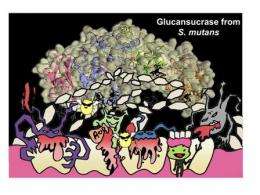
An artist’s impression of a glucansucrase enzyme from the dental caries pathogen S. mutans forming a biofilm, and the acids within. Glucansucrase catalyses the formation of glucan (white, hexagonal chains) with various types of glucosidic linkages, from disaccharide sucrose (glucose + fructose).  Then, the high-molecular sticky glucan adheres to tooth surfaces to form dental plaques, which can in turn cause additional infections, periodontal disease and halitosis. Reprinted from the Journal of Molecular Biology, Vol 408, Issue 2, Keisuke Ito et al. ‘Crystal Structure of Glucansucrase from the Dental Caries Pathogen Streptococcus mutans’. Pages 177-378, Copyright (2011), with permission from Elsevier.”

Scientists using Diamond Light Source have made a breakthrough in the battle against tooth decay, with research published in the leading Journal of Molecular Biology (JMB) on 29 April 2011.

Researchers from the UK and Japan used the Diamond synchrotron in Oxfordshire and the Photon Factory in Tsukuba city, Japan, to solve the 3D structure of an enzyme that plays a key role in caused by sugar.
 
Tooth decay can occur when a biofilm, or dental plaque as it is more commonly known, is formed by a large and sticky glucose polymer called glucan. The glucan biofilm contains bacteria and food debris and forms on the surface of the tooth. As they grow, the bacteria secrete acids which break down the tooth’s hard enamel on the surface. The structural information published in JMB provides a critical insight into how the enzyme ‘GTF-SI’, a glucansucrase, forms glucan, the sticky biofilm substance.

“With the use of the Diamond synchrotron and the Photon Factory we have been able to solve not only the structure of the enzyme alone but also its structure when bound to an existing inhibitor. Several inhibitors that prevent this type of enzyme forming glucan have been identified but to date there has been little structural information available. With the data we collected at Diamond and the Photon Factory, we now have a better understanding of how the enzyme functions and how it can be stopped. This structural information should be useful in the design of novel inhibitors that will prevent the biofilm formation by glucansucrases and reduce the risk of possible side effects such as hypoglycaemia. These novel inhibitors could be incorporated into toothpaste and mouthwash, making them more effective at preventing tooth decay," said Sohei Ito, Laboratory of Food Protein Engineering, University of Shizuoka in Japan, and lead researcher on the project.
 
Diamond X-rays used to discover tooth decay enzymes
Enlarge

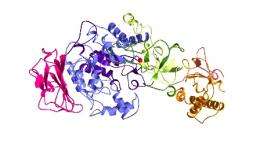
Ribbon diagram showing the structure of glucansucrase from the dental caries pathogen S. mutans. Courtesy Sohei Ito, University of Shizuoka, Japan.

The structural data collection at the Diamond synchrotron was carried out on the I02 Macromolecular Crystallography (MX) experimental station. Principal Beamline Scientist, Professor Thomas Sorensen, says, “Knowing the 3D structure of the enzyme is like knowing the shape of a lock you need to find a key for – it makes it much easier to find the right key that will fit. In this case, the inhibitor acts like the key, fitting into the lock in just the right way so that it can do its job.”

Sweet is an important favourable taste quality linked to food intake in humans and sucrose, the most common form of sugar, is the most highly consumed sweetener. But sucrose causes tooth decay, or dental caries as it is known. According to the World Oral Health Report 2003, dental caries is a major health problem in most industrialized countries, affecting 60-90% of school children and the vast majority of adults. If left untreated for a long period of time it can result in pain and tooth loss, and can lead to additional infections, periodontitis (gum disease), halitosis (bad breath) and in some cases even death by sepsis. Novel inhibitors open up the potential of reducing the risk of tooth decay by preventing the formation of dental plaque.
 
Diamond Light Source produces the extremely intense X-ray beams required for looking at the molecular interactions involved in a variety of biological processes. Advances in structural biology have accelerated greatly as a result of access to the synchrotron facilities that have been developed around the world in the past 25 years. Biologists have been swift to recognise the huge potential that lies behind understanding the multitude of processes that take place within living organisms at a molecular level. Researchers in the UK are at the forefront of this work and Diamond Light Source plays its part in providing cutting edge facilities for protein structure determination.
 
Diamond currently has five experimental stations dedicated to structural biology as well as an on-site Membrane Protein Laboratory. The work carried out at the synchrotron has the potential to affect our everyday lives. Previous breakthroughs using structural data from Diamond include gaining a better understanding of hypertension in the pre-natal condition pre-eclampsia, learning how a key tuberculosis drug is activated, understanding how bird flu can affect humans, and revealing the mechanism used by HIV to attack the body.

More information: ‘Crystal Structure of Glucansucrase from the Dental Caries Pathogen Streptococcus mutans’ Keisuke Ito, et al. Journal of Molecular Biology, Volume 408, Issue 2, Pages 177-378 (29 April 2011) http://dx.doi.org/ … 02.028 

Provided by Diamond Light Source


Rank 5 /5 (1 vote)
Relevant PhysicsForums posts
  • Schwartz reagent-- NMR/MS/IR
    created17 hours ago
  • Inversion temp
    created22 hours ago
  • High school chemistry EEI
    createdMay 25, 2012
  • oxidation of I- by KMnO4
    createdMay 25, 2012
  • Invesion temp
    createdMay 25, 2012
  • Hybridization of SnCl3 -
    createdMay 25, 2012
  • More from Physics Forums - Chemistry

More news stories

From lemons to lemonade: Reaction uses carbon dioxide to make carbon-based semiconductor

(Phys.org) -- A materials scientist at Michigan Technological University has discovered a chemical reaction that not only eats up the greenhouse gas carbon dioxide, it also creates something useful. And, by ...

Chemistry / Materials Science

created May 21, 2012 | popularity 4.7 / 5 (88) | comments 32 | with audio podcast

New CO2-removing catalyst can take the heat

(Phys.org) -- The current method of removing the greenhouse gas carbon dioxide (CO2) from the flues of coal-fired power plants uses so much energy that no one bothers to use it. So says Roger Aines, principal ...

Chemistry / Materials Science

created May 24, 2012 | popularity 5 / 5 (7) | comments 7 | with audio podcast

High-speed method to aid search for solar energy storage catalysts

Eons ago, nature solved the problem of converting solar energy to fuels by inventing the process of photosynthesis.

Chemistry / Materials Science

created May 25, 2012 | popularity 5 / 5 (3) | comments 4 | with audio podcast

Researchers demonstrate possible primitive mechanism of chemical info self-replication

(Phys.org) -- When scientists think about the replication of information in chemistry, they usually have in mind something akin to what happens in living organisms when DNA gets copied: a double-stranded molecule ...

Chemistry / Materials Science

created May 25, 2012 | popularity 5 / 5 (4) | comments 2 | with audio podcast

Castor oil: Action mechanism of one of the oldest drugs known to man elucidated

Castor oil is known primarily as an effective laxative; however, it was also used in ancient times with pregnant women to induce labour. Only now have scientists at the Max Planck Institute for Heart and Lung ...

Chemistry / Biochemistry

created May 21, 2012 | popularity 3 / 5 (2) | comments 3 | with audio podcast


Scientist: Evolution debate will soon be history

(AP) -- Richard Leakey predicts skepticism over evolution will soon be history. Not that the avowed atheist has any doubts himself.

Dell tablet leak: 10.1-inch display, two-battery choice

(Phys.org) -- Headline after headline talks about vendors’ tablets in the wings as likely number-one contenders for the iPad. Such claims have justifiably been taken with a grain of salt, considering ...

SpotterRF debuts Radar Backpack Kit (w/ Video)

(Phys.org) -- SpotterRF has announced a special radar backpack kit designed to enhance situational awareness for soldiers on the ground. The company says its special radar is designed for warfighters as part ...

SpaceX capsule has 'new car' smell, astronauts say (Update)

SpaceX's Dragon cargo vessel smells like a new car, said astronauts at the International Space Station after opening the hatches Saturday following the spacecraft's landmark mission to the orbiting lab.

Thousands of shellfish found dead in Peru

Thousands of crustaceans were found dead off the coast of Lima following the mystery mass death of dolphins and pelicans, the Peruvian Navy said Friday.

Astronomers seize last chance in lifetime for Venus Transit

Astronomers are gearing for one the rarest events in the Solar System: an alignment of Earth, Venus and the Sun that will not be seen for another 105 years.