Deep-sea worms eat found to eat fish bones
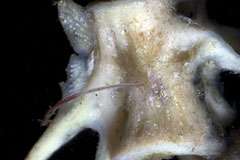
A female osedax, or boneworm, living on a fish bone. Image: Greg Rouse
(PhysOrg.com) -- A new study led by a scientist at Scripps Institution of Oceanography at UC San Diego is painting a more complete picture of an extraordinary sea worm that makes its living in the depths of the ocean on the bones of dead animals.
Discovered fewer than 10 years ago off Monterey, Calif., but since identified in other oceans, the flower-like marine "boneworms," or Osedax, have been documented mainly living upon whale carcasses that fall to the ocean floor, leading some scientists to argue that Osedax specializes in whale bones. But Scripps Professor Greg Rouse, along with colleagues at Occidental College and Monterey Bay Aquarium Research Institute (MBARI) wondered: Do Osedax boneworms also live on the bones of non-mammals?
To assess the question, the researchers carried out an experiment, which is described in the April 13 online edition of Biology Letters, a Royal Society journal. The team employed MBARI's remotely operated vehicles Ventana and Doc Ricketts to deploy tuna and wahoo bones, as well as shark cartilage inside wire cages at approximately 1,000-meter (3,280-foot) depth off Monterey, Calif. When the researchers retrieved the cages five months later, they found Osedax living on the fish bones, although the shark cartilage had already been eaten by unknown organisms.
"We weren't sure that Osedax boneworms would be able to settle on fish bone and to grow to maturity and breed. When it actually turned out that we could establish all these things it was very satisfying," said Rouse. "That we actually found three different Osedax species living on the fish bones was a further bonus. The finding shows that Osedax boneworms are not whale bone specialists, but are arguably generalists and able to exploit a variety of vertebrate bones."
The finding also lends support to a hypothesis they have previously proposed that Osedax and its bone-eating lifestyle may have evolved millions of years ago during a time known as the Cretaceous period, well before the dawn of marine mammals.
"These bone-eating worms may have expanded their feeding niche several times to exploit the bones of large marine vertebrates as they successively colonized the world's oceans from land," say the authors in the paper.
The scientists say Osedax's ability to exploit non-mammalian bones could be an ancestral trait: "We suggest that whalebones are but one in a long series of food sources that Osedax has exploited and continues to exploit."
"Our experimental studies at MBARI have identified 17 species of Osedax from various depths in Monterey submarine canyon," said MBARI's Bob Vrijenhoek, a paper coauthor. "We now know that the worms are capable of subsisting on a variety of bones from cows, pigs and seals, but this new discovery of Osedax on fish bones forces us to take a fresh look at their nutritional limits and evolution."
The team now plans to further study the possible use of shark remains by Osedax and describe and further understand a host of new species of boneworms they have discovered off Monterey. They also plan to study how the worms actually eat into bone.
In addition to Rouse and Vrijenhoek, coauthors of the study include Shana Goffredi of Occidental College and Shannon Johnson of MBARI.
Provided by
The Scripps Research Institute
-
From lemons to lemonade: Reaction uses carbon dioxide to make carbon-based semiconductor,
32 comments
-
Thioridazine kills cancer stem cells in human while avoiding toxic side-effects of conventional cancer treatments,
3 comments
-
SpaceX private rocket blasts off for space station (Update),
42 comments
-
Climate scientists say they have solved riddle of rising sea,
30 comments
-
Research team claims to have found evidence Lake Cheko is impact crater for Tunguska Event,
18 comments
-
What would stain as translucent on light-coloured fabric?
10 hours ago
-
How do I identify different bacteria on culture plates?
20 hours ago
-
Why Do Dogs do Strange things...
May 25, 2012
-
What does exophillic and endophillic mean in terms of mosquito and their control?
May 24, 2012
-
Semen stains glows under black lights (uv light)?
May 23, 2012
-
Question on Human Chromosome 2
May 23, 2012
- More from Physics Forums - Biology
More news stories
Scientist: Evolution debate will soon be history
(AP) -- Richard Leakey predicts skepticism over evolution will soon be history. Not that the avowed atheist has any doubts himself.
9 hours ago |
3.4 / 5 (8) |
21
Thousands of shellfish found dead in Peru
Thousands of crustaceans were found dead off the coast of Lima following the mystery mass death of dolphins and pelicans, the Peruvian Navy said Friday.
19 hours ago |
4.8 / 5 (4) |
6
More plant species responding to global warming than previously thought
(Phys.org) -- Far more wild plant species may be responding to global warming than previous large-scale estimates have suggested.
May 22, 2012 |
4.6 / 5 (14) |
18
|
Totally rad: Scientists create rewritable digital data storage in DNA
(Phys.org) -- Scientists from Stanford's Department of Bioengineering have devised a method for repeatedly encoding, storing and erasing digital data within the DNA of living cells.
May 21, 2012 |
4.9 / 5 (17) |
11
|
For monogamous sparrows, it doesn't pay to stray (but they do it anyway)
It's quite common for a female song sparrow to stray from her breeding partner and mate with the male next door, but a new study shows that sleeping around can be costly.
May 22, 2012 |
5 / 5 (1) |
7
|
Dell tablet leak: 10.1-inch display, two-battery choice
(Phys.org) -- Headline after headline talks about vendors tablets in the wings as likely number-one contenders for the iPad. Such claims have justifiably been taken with a grain of salt, considering ...
SpotterRF debuts Radar Backpack Kit (w/ Video)
(Phys.org) -- SpotterRF has announced a special radar backpack kit designed to enhance situational awareness for soldiers on the ground. The company says its special radar is designed for warfighters as part ...
SpaceX capsule has 'new car' smell, astronauts say (Update)
SpaceX's Dragon cargo vessel smells like a new car, said astronauts at the International Space Station after opening the hatches Saturday following the spacecraft's landmark mission to the orbiting lab.
Astronomers seize last chance in lifetime for Venus Transit
Astronomers are gearing for one the rarest events in the Solar System: an alignment of Earth, Venus and the Sun that will not be seen for another 105 years.
Keep food safety in mind this memorial day weekend
(HealthDay) -- Picnics, parades and cookouts are as much a part of Memorial Day weekend as tributes to the United States' war veterans.
Australia hails surprise super-telescope decision
Australia has hailed a surprise decision giving it a role in a radio telescope project aimed at revolutionising astronomy, vowing to draw on its decades of experience in space science.