New crops show potential for sustainable biomass
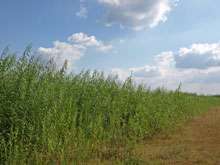
Short rotation willow coppice.
A new source of biomass grown on unused land could help the UK meet renewable energy targets without affecting food production or the environment, according to the results of a new study.
Researchers at Southampton University looked at the potential of short-rotation coppice (SRC) poplar and willow so-called 'second generation' energy crops which are grown purely for biomass and don't come from food products like wheat.
Their results show that SRC could contribute 4 per cent of the UK's current target to produce 30 per cent of its electricity from renewable sources, and doesn't compete with food production or conservation.
But currently, energy crop yields are achieving less than 50 per cent of their potential.
By law, 15 per cent of all the UK's energy must come from renewable sources by 2020. It will take around 7.5 million tonnes of biomass for energy crops to meet their 1 per cent share of this target, and many people are worried about the effect this could have on other land uses and the environment.
Unlike traditional biomass, SRC can be grown on marginal land land that isn't good enough arable farming or is simply disused so it doesn't take land away from food crops or push prices up by doing so.
Nevertheless, SRC hasn't been adopted widely yet. 'This is partly down to financial barriers,' explains Professor Gail Taylor from Southampton's school of biological sciences, lead author of the research which is published in the journal Biofuels.
'But landowners can also be reluctant to take on new crops and technologies, and worry that these perennial crops will restrict their long-term use of the land. A cultural change is needed as well as a technological one for these crops to be accepted,' she continues.
In a project funded by the UK Energy Research Centre (UKERC), the researchers used models to predict whether SRC grown just on marginal land across England could produce the biomass needed.
They also looked at a range of social, economic and environmental factors, to see whether the crops would be profitable and what effect they would have on things like biodiversity and conservation areas.
The results showed that England's marginal land could produce 4 per cent of our target to get 30 per cent of our electricity from renewable sources, and that this wouldn't have the large detrimental effects on food production or the environment that some people fear.
'Overall, the effects on biodiversity were positive,' says Taylor. 'Different groups of plants and animals come to the fore in SRC compared with arable land, but the diversity of both increases.'
Because of their large areas of marginal land, the southwest and northwest of England have the potential to produce more than a third of the total biomass needed.
This regionalisation is important, say the researchers: it means that in the future different areas could take a more local approach to the balance of biomass versus other fuel sources.
If bioenergy is going to be viable and sustainable, the researchers write, careful consideration must be given to making sure energy crops are both economically competitive and complementary to other types of land use.
This story is republished courtesy of Planet Earth online, a free, companion website to the award-winning magazine Planet Earth published and funded by the Natural Environment Research Council (NERC).
More information: Matthew J Aylott, Eric Casella, Kate Farrall, Gail Taylor, 2010, Estimating the supply of biomass from short-rotation coppice in England, given social, economic and environmental constraints to land availability. Biofuels, 1(5), 719-717
Provided by
PlanetEarth Online
-
From lemons to lemonade: Reaction uses carbon dioxide to make carbon-based semiconductor,
32 comments
-
Thioridazine kills cancer stem cells in human while avoiding toxic side-effects of conventional cancer treatments,
3 comments
-
SpaceX private rocket blasts off for space station (Update),
42 comments
-
Climate scientists say they have solved riddle of rising sea,
30 comments
-
Research team claims to have found evidence Lake Cheko is impact crater for Tunguska Event,
18 comments
-
Hypothetical desert earth
6 hours ago
-
More human population = greater mass?
May 25, 2012
-
Conversion from aircraft bearing to normal degrees
May 23, 2012
-
Interpretation/Analysis of the Lab results(HEPA filter)
May 22, 2012
-
Has anyone here attended the The Urbino Summer School in Paleoclimatology?
May 22, 2012
-
Earthquakes: Mag 6 N. Italy and Mag 5.6 W. Bulgaria
May 21, 2012
- More from Physics Forums - Earth
More news stories
SpaceX capsule has 'new car' smell, astronauts say (Update)
SpaceX's Dragon cargo vessel smells like a new car, said astronauts at the International Space Station after opening the hatches Saturday following the spacecraft's landmark mission to the orbiting lab.
Space & Earth / Space Exploration
19 hours ago |
4.5 / 5 (20) |
0
Astronomers seize last chance in lifetime for Venus Transit
Astronomers are gearing for one the rarest events in the Solar System: an alignment of Earth, Venus and the Sun that will not be seen for another 105 years.
19 hours ago |
5 / 5 (3) |
2
Australia hails surprise super-telescope decision
Australia has hailed a surprise decision giving it a role in a radio telescope project aimed at revolutionising astronomy, vowing to draw on its decades of experience in space science.
19 hours ago |
5 / 5 (4) |
1
Astronauts enter world's 1st private supply ship
(AP) -- Space station astronauts floated into the Dragon on Saturday, a day after its heralded arrival as the world's first commercial supply ship.
Space & Earth / Space Exploration
19 hours ago |
5 / 5 (5) |
0
Sophisticated simulations predict future warming
The chances of our planet being hit by a global warming of 3 degrees Celsius by 2050 is as likely as it being hit by an increase of 1.4 degrees, new research shows. Presented in the journal Nature Geoscience, the British study ...
Space & Earth / Earth Sciences
May 22, 2012 |
4.4 / 5 (9) |
51
Scientist: Evolution debate will soon be history
(AP) -- Richard Leakey predicts skepticism over evolution will soon be history. Not that the avowed atheist has any doubts himself.
Dell tablet leak: 10.1-inch display, two-battery choice
(Phys.org) -- Headline after headline talks about vendors tablets in the wings as likely number-one contenders for the iPad. Such claims have justifiably been taken with a grain of salt, considering ...
SpotterRF debuts Radar Backpack Kit (w/ Video)
(Phys.org) -- SpotterRF has announced a special radar backpack kit designed to enhance situational awareness for soldiers on the ground. The company says its special radar is designed for warfighters as part ...
Thousands of shellfish found dead in Peru
Thousands of crustaceans were found dead off the coast of Lima following the mystery mass death of dolphins and pelicans, the Peruvian Navy said Friday.
Keep food safety in mind this memorial day weekend
(HealthDay) -- Picnics, parades and cookouts are as much a part of Memorial Day weekend as tributes to the United States' war veterans.
Family history of Alzheimer's affects functional connectivity
(HealthDay) -- Cognitively normal individuals with a family history of late-onset Alzheimer's disease (AD) may display lower resting state functional connectivity in the default mode network (DMN) of the brain, ...
Apr 29, 2011
Rank: not rated yet
First. There is no such thing as 'unused land'. Mother nature always uses the land. We humans merely transfer its use for our own ends.
Second. The basic laws of physics and conservation of mass and energy:
http://en.wikiped..._of_mass
http://en.wikiped...f_energy
You cannot get out of the ground anymore than is there to start with so where is all this energy creating biomass going to come from? There has to be some input before there can be any output. Hence my reference to the conservation of energy and mass laws.
Then there is the issue of conservation of biodiversity. Whilst these habitats exist they are havens for multitudes of displaced species which have no other place to live due to our greed for land space to plough, develop or turn into golf courses and then spray to death with chemicals to keep the wildlife subdued.
Time to conserve our use of energy by reducing demand not meeting it. Simple.