April 5, 2011 feature
Chameleon's ballistic tongue inspires robotic manipulators
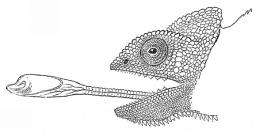
(PhysOrg.com) -- Although the lungless salamander and some frog species have developed ballistic tongues, the chameleon's ballistic tongue is the fastest, the longest, and the one that can catch the heaviest prey. A chameleon’s tongue can elongate more than six times its rest length, zipping forward at speeds of 3.5-10.5 meters/second – faster than a human eye can follow. The tongue is called ballistic because, like all ballistic objects, it moves freely without any applied force during its forward motion. Once the chameleon's accordion-like tongue is ejected, it continues moving forward under its own inertia.
With the aim to mimic the mechanisms and performance of the chameleon’s tongue, researcher Alexis Debray of Canon, Inc., in Tokyo, Japan, has developed four ballistic robotic manipulators. Each of the four manipulators excels at copying a certain part of the chameleon’s tongue, and insights from each design could eventually be combined to create a more advanced chameleon tongue that could have manufacturing applications. Debray’s study is published in a recent issue of Bioinspiration & Biomimetics.
“As far as I know, this is the first published demonstration of manipulators based on the chameleon tongue,” Debray told PhysOrg.com. “The particular mechanism of the tongue of the chameleon allows for fast accelerations and velocities and also applies no force during most of the motion.”
As Debray explains, what we normally think of as the tongue of the chameleon is actually a larger system called the hyolingual apparatus. The tongue is just a small component on the front tip of the hyolingual apparatus. The majority of the hyolingual apparatus consists of the long, thin hyoglossus complex, which is the part that folds up like an accordion inside the chameleon’s mouth.
The rapid movement of the chameleon’s hyolingual apparatus involves three phases: projection, catching, and retraction. Each of these three phases is controlled by a different system. The tongue (tip of the hyolingual apparatus) contains the accelerator muscle and collagens that control the projection. When the chameleon is ready to project, it slowly protrudes its tongue out of its mouth. Then, the tongue’s accelerator muscle projects the tongue off a bone inside the chameleon’s mouth. No applied force is needed to keep the tongue – and the rest of the hyolingual apparatus – moving forward. When the tongue reaches its prey, a tongue pad containing a small suction on the tip of the tongue can stick to the prey. Finally, the hyoglossus muscle in the accordion-like hyoglossus complex retracts the tongue at a constant velocity. Although the three phases are controlled by different systems, they occur in a single smooth, continuous motion.
Like the chameleon tongue, Debray’s robotic manipulators use different specialized systems for projection, catching, and retraction. To project, all four manipulators use a coilgun in place of the chameleon tongue’s accelerator muscle. Elastomers and/or cotton string is used in place of the chameleon’s hyolingual apparatus. Instead of folding up like an accordion, the elastomers and string are wound around a reel. As for catching, the robotic manipulators use magnets on the tip of the elastomers, which attract magnetic “prey.” For retraction, the manipulators use either an elastomer, a DC motor connected to a reel and string, or a combination of both. One of the manipulators also had wings on the mobile part, which could allow researchers to take advantage of aerodynamic effects.
“In the future, movable wings will allow controlling the trajectory after the ejection of the tongue, which is not possible now,” Debray said. “In our experiments, the wings are not movable. However, their aerodynamic effect on the trajectory of the tongue has been demonstrated experimentally. So far, aerodynamic effects have been poorly studied in the field of manipulators.”
Using a high-speed camera, Debray could track the manipulators in motion. The results showed that the robotic manipulators could reach a projection velocity of 3.8 meters/second without the need for a continuously applied force, which is similar to the velocity of the chameleon tongue. In addition, the robotic manipulators could reach an acceleration of 919 meters/second2, which exceeds that of the chameleon (374 meters/second2). The manipulators that used a DC motor and string for retraction had the same extension ability as the chameleon tongue, and could also adapt to variations in the targets’ distances, as chameleons can.
By incorporating various end effectors onto the robotic manipulators, the devices could have a variety of applications, especially for products passing on a factory line. For example, manipulators with sensors could be used to sense data on products. Stamps and catching devices could be used to deposit patterns and manipulate objects, respectively. Using a mechanism based on the chameleon’s ballistic tongue could provide certain advantages compared with other manipulators due to the small size and flexibility. Further, because ballistic manipulators do not apply a continuous force during their forward motion, an accidental collision would be less severe and likely cause less damage compared to a device being pushed forward. As Debray explained, the current manipulators lack reliability, and so they cannot yet be put to practical use.
“The work presented in the paper is a first step towards manipulators inspired by the chameleon tongue,” Debray said. “Further development is needed in order to use them in factory lines. However, the ultimate goal of this work is the manufacture of Canon products such as cameras and printers, among others.”
More information: Alexis Debray. “Manipulators inspired by the tongue of the chameleon.” Bioinsp. Biomim. 6 (2011) 026002 (15pp). DOI:10.1088/1748-3182/6/2/026002
Copyright 2010 PhysOrg.com.
All rights reserved. This material may not be published, broadcast, rewritten or redistributed in whole or part without the express written permission of PhysOrg.com.


