Astronomers peer into the dark
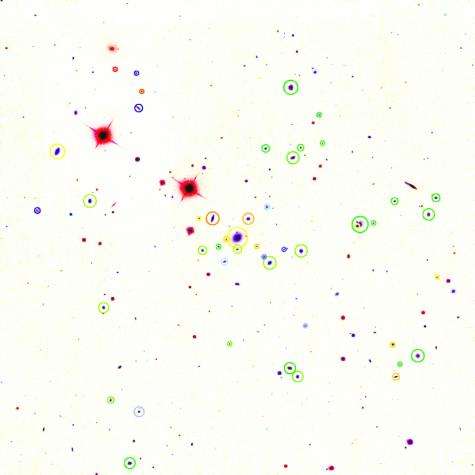
An image of a galaxy cluster discovered in the GAMA group catalogue. This is a inverse colour composite of ultraviolet, visible light and infrared images so redder galaxies appear blue and vice-versa. Galaxies in the cluster are highlighted with circles, with the size of the circle proportional to the mass of the galaxy. The colour of the circle indicates the true colour of the galaxy. In this image a mixture of galaxy types are visible, but very few blue (star-forming) galaxies. The brightest galaxy is located at the centre. Credit: GAMA / Aaron Robotham.
(PhysOrg.com) -- Astronomers from the Scottish Universities Physics Alliance (SUPA) have produced a completely new catalogue of ~15,000 groups of galaxies that gives a new insight into dark matter, the material of unknown composition that makes up a fifth of the mass of the Universe. Dr. Aaron Robotham of the University of St Andrews will present the work of the Galaxy and Mass Assembly (GAMA) team in his talk on Thursday 21 April at the Royal Astronomical Society's National Astronomy Meeting in Llandudno, Wales.
Current models of the Universe predict that galaxies reside in large clumps of dark matter, commonly referred to as dark matter halos. Unlike individual galaxies, galaxy groups provide a unique environment in which to study the properties of this elusive material. Understanding the 20% of the cosmos comprised of dark matter is important in comparison only 3% of the mass of Universe consists of 'ordinary' matter.
"The motions of the galaxies inside the groups provide a direct method for studying the properties of dark matter", says Dr Aaron Robotham who leads the group catalogue project. "Studying dark matter in galaxies is confused by normal processes such as star formation, while this unseen material dominates the motions of galaxies in groups."
Dr. Robotham describes the construction of the group catalogue, which is a significant improvement on previous similar attempts with much shallower surveys. "The sample has some of the most massive bound structures ever measured. These range from the equivalent of a million billion times the mass of the Sun down to a mere few thousand billion solar masses. To have this range of dark matter halo masses within a single study is unprecedented."
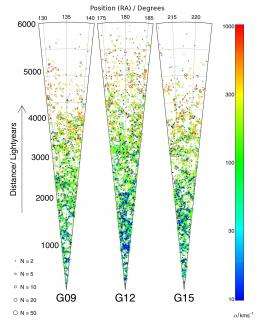
The segments show 12-degree wide maps of the positions of the galaxies in the GAMA catalogue. The Earth is at the bottom of each wedge, with the most distant galaxies at the top (at a distance of 6000 lightyears). Circles indicate groups included in the catalogue, where larger circles show groups with more members. Credit GAMA / Aaron Robotham.
"Some of our groups contain hundreds of galaxies while others only a handful", says Dr. Peder Norberg, a co-investigator based at the Royal Observatory Edinburgh, "the ratio of the number of very high mass to very low mass groups is a direct indicator of the type of dark matter that the Universe contains. Hot or warm dark matter (meaning light particles) suppresses the formation of low mass halos while cold dark matter (heavy particles) encourages their formation."It will take a further few years of detailed studies, with a large range of models, before a definite conclusion can be reached on whether the new GAMA data and supercomputer predictions (based on the popular Cold Dark Matter model of the Universe) are in good agreement or not.
"Currently the differences seen between the model and the data can be understood as limitations in the galaxy formation model used, explaining why intense modelling and further studies are required, and hopefully leading to some exciting new findings in the years ahead with possibly the first new insight into the properties of dark matter particles," adds Dr. Norberg.
GAMA team leader Professor Simon Driver of the University of St Andrews and the International Centre for Radio Astronomy Research at the University of Western Australia, says this group catalogue is the first big step of 4 years of data gathering by the GAMA Team at the Anglo-Australian Telescope. "The catalogue will provide the opportunity to study how gravity works over an unprecedented mass range and using data from other telescopes around the world we will shed fresh light on how dark mater helps to turn gas into stars".
Provided by
Royal Astronomical Society
-
From lemons to lemonade: Reaction uses carbon dioxide to make carbon-based semiconductor,
32 comments
-
Thioridazine kills cancer stem cells in human while avoiding toxic side-effects of conventional cancer treatments,
3 comments
-
SpaceX private rocket blasts off for space station (Update),
42 comments
-
Climate scientists say they have solved riddle of rising sea,
30 comments
-
Research team claims to have found evidence Lake Cheko is impact crater for Tunguska Event,
18 comments
-
revamping general concept and cosmological principle
May 25, 2012
-
Transiting Exoplanet Light Curve
May 25, 2012
-
Math behind Theoretical Physics
May 24, 2012
-
Do we know whats at the center of galaxies yet?
May 23, 2012
-
Structure of the Milky Way?
May 20, 2012
-
What would it take to terraform Pluto and Charon?
May 19, 2012
- More from Physics Forums - General Astronomy
More news stories
SpaceX capsule has 'new car' smell, astronauts say (Update)
SpaceX's Dragon cargo vessel smells like a new car, said astronauts at the International Space Station after opening the hatches Saturday following the spacecraft's landmark mission to the orbiting lab.
Space & Earth / Space Exploration
19 hours ago |
4.5 / 5 (20) |
0
Astronomers seize last chance in lifetime for Venus Transit
Astronomers are gearing for one the rarest events in the Solar System: an alignment of Earth, Venus and the Sun that will not be seen for another 105 years.
19 hours ago |
5 / 5 (3) |
2
Australia hails surprise super-telescope decision
Australia has hailed a surprise decision giving it a role in a radio telescope project aimed at revolutionising astronomy, vowing to draw on its decades of experience in space science.
19 hours ago |
5 / 5 (4) |
1
Astronauts enter world's 1st private supply ship
(AP) -- Space station astronauts floated into the Dragon on Saturday, a day after its heralded arrival as the world's first commercial supply ship.
Space & Earth / Space Exploration
19 hours ago |
5 / 5 (5) |
0
Sophisticated simulations predict future warming
The chances of our planet being hit by a global warming of 3 degrees Celsius by 2050 is as likely as it being hit by an increase of 1.4 degrees, new research shows. Presented in the journal Nature Geoscience, the British study ...
Space & Earth / Earth Sciences
May 22, 2012 |
4.4 / 5 (9) |
51
Scientist: Evolution debate will soon be history
(AP) -- Richard Leakey predicts skepticism over evolution will soon be history. Not that the avowed atheist has any doubts himself.
Dell tablet leak: 10.1-inch display, two-battery choice
(Phys.org) -- Headline after headline talks about vendors tablets in the wings as likely number-one contenders for the iPad. Such claims have justifiably been taken with a grain of salt, considering ...
SpotterRF debuts Radar Backpack Kit (w/ Video)
(Phys.org) -- SpotterRF has announced a special radar backpack kit designed to enhance situational awareness for soldiers on the ground. The company says its special radar is designed for warfighters as part ...
Thousands of shellfish found dead in Peru
Thousands of crustaceans were found dead off the coast of Lima following the mystery mass death of dolphins and pelicans, the Peruvian Navy said Friday.
Keep food safety in mind this memorial day weekend
(HealthDay) -- Picnics, parades and cookouts are as much a part of Memorial Day weekend as tributes to the United States' war veterans.
Family history of Alzheimer's affects functional connectivity
(HealthDay) -- Cognitively normal individuals with a family history of late-onset Alzheimer's disease (AD) may display lower resting state functional connectivity in the default mode network (DMN) of the brain, ...

Apr 21, 2011
Rank: 5 / 5 (1)
Apr 21, 2011
Rank: 2.5 / 5 (2)
Apr 22, 2011
Rank: not rated yet
how does that compare with 90%+ of all baryoinic matter??