Traits, genes associated with establishment of new populations revealed in butterfly study
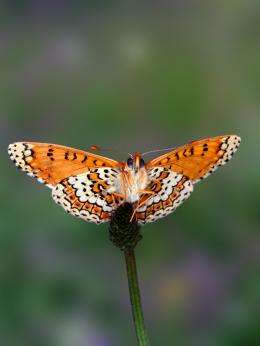
(PhysOrg.com) -- A team of scientists has discovered that descendants of "exploratory" butterflies that colonized new habitats differ genetically from their more cautious cousins. The team, led by James Marden, a professor of biology at Penn State University, and Christopher Wheat, a post-doctoral scholar working at both Penn State and the University of Helsinki, has revealed some of the genetic bases for faster egg maturation, a higher rate of energy metabolism, and superior flight ability -- traits that provide an advantage to butterflies that stray from familiar territory to found new populations in previously unoccupied habitat patches. This research will be published in the print edition of the journal Molecular Ecology in May, and is available online now. The results have potentially broad importance because they show how natural selection may act in species that occupy spatially distinct habitat patches.
Marden explained that most species are not found everywhere because they tend to require very specific habitats. "Butterflies, like many other species, are specialists. They are picky about where they live. This pickiness gives a species what ecologists call a clumped or patchy distribution," Marden said. "In a patchy environment, individual organisms face a fundamental choice between remaining in their native patch or venturing forth to find a different patch of suitable habitat. Staying put is safer for immediate survival but may expose one's offspring to crowding or parasites, whereas dispersal is dangerous but offers a potentially big payoff if a large, unoccupied patch is located."
Marden and Wheat collaborated with Ilkka Hanski, a professor at the University of Helsinki, to study how a particular species of butterfly successfully establishes new populations. "We wanted to understand better the genes and physiology involved in determining sedentary, 'stay-at-home' traits versus exploratory, 'venture-forth' traits," Marden said. "Evolutionary biologists are fascinated by cost-benefit questions such as how natural selection produces and maintains both 'stay-at-home' and 'venture-forth' varieties within species." Marden also explained that the "stay-at-home versus venture-forth" dichotomy is fundamentally important for ecology because habitat changes, disease, and chance events cause local extinction of small populations in individual patches. "Species persistence on a regional scale requires that the rate of establishment of new populations must be at least as high as the rate of local-population extinctions," Marden said. "Dispersal of individual females is what determines the establishment rate, along with the number of patches and distances between them." Much of what is known about the biology of species in patches — called metapopulations — comes from Hanski's butterfly research, for which he will be awarded this year's Craaford Prize, generally considered as ecology's version of a Nobel prize.
Together, Marden and Hanski's labs used new gene-sequencing technology to characterize thousands of protein-coding genes in Glanville fritillary butterflies from the Åland Islands of Finland. Then, they measured and compared the variation in gene-expression levels in females from established populations of butterflies — those originating from old, local populations that had persisted for a minimum of five years — with new, local populations that had been founded by dispersing butterflies. They found that new-population and old-population butterflies differed most prominently in how they expressed certain genes that control the timing and release of stored proteins for egg production and the maintenance of flight-muscle proteins. They also differed in flight metabolic rate — a measure of muscle performance and flight ability.
Previous work by members of this team and other collaborators had revealed that an allele — a variable DNA sequence — in a gene called phosphoglucose isomerase (Pgi) differed significantly between the old and the new populations. One Pgi allele was associated with two important aspects of metabolism within the butterfly's abdomen and its thorax. First, the new-population, "venture-forth" females were more likely to possess a particular Pgi allele associated with faster egg production. "It's easy to imagine why this kind of ovarian-function trait would provide 'venture-forth' females with an advantage," Marden explained. "Abandoning the secure, known environment can be a perilous endeavor, and life expectancy for such butterflies is probably greatly reduced. Under these conditions, the ability to get a reproductive head start would allow these adventurers to mate earlier, and to fly off to lay their eggs in new habitat patches sooner." Second, the scientists found that the same Pgi allele predominates in females that are better "sprinters," able to fly better for short distances. Marden explained that for those individuals that fly away to colonize new areas, exceptional muscle function could be a more crucial trait than it would be for "stay-at-home" non-explorers.
In the new study, another gene variant also stood out as an important indicator of butterfly flight ability. New-population females were more often missing a small part of the succinate dehydrogenase gene (Sdhd) and this small deletion was associated with the ability to maintain flight for a greater duration. "The Pgi gene variant seems to be associated with sprinting, and the Sdhd gene variant appears to be associated with endurance," Marden said. "It's easy to see why these traits and their associated genes would be found at higher frequencies in new populations. Better flight ability allows certain butterflies to be able to reach and settle new habitat patches."
Wheat, the paper's lead author, said, "We already knew about Pgi from previous work in other butterflies and what has been done so far in the Glanville fritillary butterfly. Now with Sdhd we have two genes in the same carbohydrate-metabolism pathway containing alleles of major effect for ecologically important traits." Marden also commented on the differences in gene expression involving protein dynamics. "Butterflies obtain protein only during larval feeding, whereas the adults rely on nectar, from which they obtain only carbohydrate," he said. "The timing and level of expenditure of stored proteins is one way to manipulate life history in a species where no more protein will be available to the adult."
Marden also said that this study system provides a great opportunity to observe evolution in action, in near-real time, and in ways that are coupled tightly with the ecology of the species. "Most evolutionary studies don't have nearly as much ecological detail as this study system, and comparable ecological systems generally don't address the physiology and genetic variants involved," he said. "We've set the stage for a powerful synthesis as this work moves forward."
Provided by Pennsylvania State University


