Exploding stars and stripes
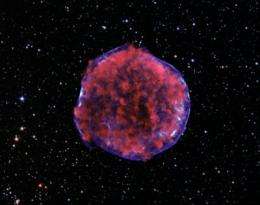
This image comes from a very deep Chandra observation of the Tycho supernova remnant, produced by the explosion of a white dwarf star in our Galaxy. Low-energy X-rays (red) in the image show expanding debris from the supernova explosion and high energy X-rays (blue) show the blast wave, a shell of extremely energetic electrons. These high-energy X-rays show a pattern of X-ray "stripes" never previously seen in a supernova remnant. Some of the brightest stripes can be seen on the right side of the remnant pointing from the outer rim to the interior. The stellar background is from the Digitized Sky Survey and only shows stars outside the remnant. Credit: X-ray: NASA/CXC/Rutgers/K. Eriksen et al.; Optical: DSS
The discovery of a pattern of X-ray "stripes" in the remains of an exploded star may provide the first direct evidence that a cosmic event can accelerate particles to energies a hundred times higher than achieved by the most powerful particle accelerator on Earth.
This result comes from a very long observation of the Tycho supernova remnant with NASA's Chandra X-ray Observatory. It could explain how some of the extremely energetic particles bombarding the Earth, called cosmic rays, are produced.
"We've seen lots of intriguing structures in supernova remnants, but we've never seen stripes before," said Kristoffer Eriksen, a postdoctoral researcher at Rutgers University who led the study. "This made us think very hard about what's happening in the blast wave of this powerful explosion." This latest study from Chandra provides support for a theory about how magnetic fields can be dramatically amplified in such blast waves.
In this theory, the magnetic fields become highly tangled and the motions of the particles very turbulent near the expanding supernova shock wave at the front edge of the supernova remnant. High-energy charged particles can bounce back and forth across the shock wave repeatedly, gaining energy with each crossing. Theoretical models of the motion of the most energetic particles which are mostly protons are predicted to leave a messy network of holes and dense walls corresponding to weak and strong regions of magnetic fields, respectively.
The X-ray stripes discovered by the Chandra researchers are thought to be regions where the turbulence is greater and the magnetic fields more tangled than surrounding areas, and may be the walls predicted by the theory. Electrons become trapped in these regions and emit X-rays as they spiral around the magnetic field lines.
However, the regular and almost periodic pattern of the X-ray stripes was not predicted by the theory.
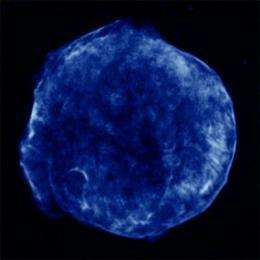
High-energy X-rays in this image of the Tycho supernova remnant show a pattern of X-ray "stripes" never previously seen in a supernova remnant. These stripes may provide the first direct evidence that supernova remnants can accelerate particles to energies a hundred times higher than achieved by the most powerful particle accelerator on Earth, the Large Hadron Collider. The results could explain how some of the extremely energetic particles bombarding the Earth, called cosmic rays, are produced, and they provide support for a theory about how magnetic fields can be dramatically amplified in such blast waves. Credit: X-ray: NASA/CXC/Rutgers/K. Eriksen et al.; Optical: DSS
"It was a big surprise to find such a neatly arranged set of stripes," said co-author Jack Hughes, professor of physics and astronomy at Rutgers. "We were not expecting so much order to appear in so much chaos. It could mean that the theory is incomplete, or that there's something else we don't understand."
Assuming that the spacing between the X-ray stripes corresponds to the radius of the spiraling motion of the highest energy protons in the supernova remnant, the spacing corresponds to energies about 100 times higher than reached in the Large Hadron Collider. These energies equal the highest energies of cosmic rays thought to be produced in our Galaxy.
Because cosmic rays are composed of charged particles, like protons and electrons, their direction of motion changes when they encounter magnetic fields throughout the galaxy. So, the origin of individual cosmic rays detected on Earth cannot be determined.
Supernova remnants have long been considered a good candidate for producing the most energetic cosmic rays in our Galaxy. The protons can reach energies that are hundreds of times higher than the highest energy electrons, but since they do not radiate efficiently like the electrons, direct evidence for the acceleration of cosmic ray protons in supernova remnants has been lacking.
These results also support the prediction that magnetic fields in interstellar space are greatly amplified in supernova remnants, but the difference between the observed and predicted structures means that other interpretations cannot be ruled out.
"We were excited to discover these stripes because they might allow us to directly track, for the first time, the origin of the most energetic particles produced in our galaxy," said Eriksen. "But, we're not claiming victory yet."
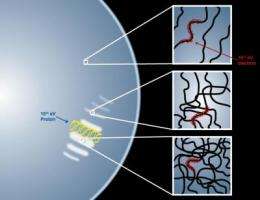
X-ray stripes are thought to be regions where the turbulence is greater and the magnetic fields more tangled than surrounding areas. Electrons become trapped in these regions and emit X-rays as they spiral around the magnetic field lines. Regions with enhanced turbulence and magnetic fields were expected in supernova remnants, but the motion of the most energetic particles -- mostly protons -- was predicted to leave a messy network of holes and dense walls corresponding to weak and strong regions of magnetic fields, respectively. Credit: CXC/M. Weiss
The Tycho supernova remnant is named for the famous Danish astronomer Tycho Brahe, who reported observing the supernova in 1572. Scientists think the explosion occurred when a white dwarf star grew in mass and exceeded its weight limit, forming a so-called Type Ia supernova. The Tycho remnant is located in the Milky Way, about 13,000 light years from Earth."Supernova remnants are our best cosmic laboratories for understanding how nature accelerates the highest energy cosmic rays," said Roger Blandford of Stanford University, a noted expert in this field who was not involved with these findings. "These careful measurements provide a very strong clue as to what actually happens at these giant shock fronts."
More information: These results were published in the February 20th, 2011 issue of The Astrophysical Journal Letters.
Provided by
Chandra X-ray Center
-
From lemons to lemonade: Reaction uses carbon dioxide to make carbon-based semiconductor,
32 comments
-
Thioridazine kills cancer stem cells in human while avoiding toxic side-effects of conventional cancer treatments,
3 comments
-
SpaceX private rocket blasts off for space station (Update),
42 comments
-
Climate scientists say they have solved riddle of rising sea,
30 comments
-
Research team claims to have found evidence Lake Cheko is impact crater for Tunguska Event,
18 comments
-
revamping general concept and cosmological principle
May 25, 2012
-
Transiting Exoplanet Light Curve
May 25, 2012
-
Math behind Theoretical Physics
May 24, 2012
-
Do we know whats at the center of galaxies yet?
May 23, 2012
-
Structure of the Milky Way?
May 20, 2012
-
What would it take to terraform Pluto and Charon?
May 19, 2012
- More from Physics Forums - General Astronomy
More news stories
SpaceX capsule has 'new car' smell, astronauts say (Update)
SpaceX's Dragon cargo vessel smells like a new car, said astronauts at the International Space Station after opening the hatches Saturday following the spacecraft's landmark mission to the orbiting lab.
Space & Earth / Space Exploration
18 hours ago |
4.5 / 5 (20) |
0
Astronomers seize last chance in lifetime for Venus Transit
Astronomers are gearing for one the rarest events in the Solar System: an alignment of Earth, Venus and the Sun that will not be seen for another 105 years.
18 hours ago |
5 / 5 (3) |
2
Australia hails surprise super-telescope decision
Australia has hailed a surprise decision giving it a role in a radio telescope project aimed at revolutionising astronomy, vowing to draw on its decades of experience in space science.
18 hours ago |
5 / 5 (4) |
1
Astronauts enter world's 1st private supply ship
(AP) -- Space station astronauts floated into the Dragon on Saturday, a day after its heralded arrival as the world's first commercial supply ship.
Space & Earth / Space Exploration
18 hours ago |
5 / 5 (5) |
0
Sophisticated simulations predict future warming
The chances of our planet being hit by a global warming of 3 degrees Celsius by 2050 is as likely as it being hit by an increase of 1.4 degrees, new research shows. Presented in the journal Nature Geoscience, the British study ...
Space & Earth / Earth Sciences
May 22, 2012 |
4.4 / 5 (9) |
51
Scientist: Evolution debate will soon be history
(AP) -- Richard Leakey predicts skepticism over evolution will soon be history. Not that the avowed atheist has any doubts himself.
Dell tablet leak: 10.1-inch display, two-battery choice
(Phys.org) -- Headline after headline talks about vendors tablets in the wings as likely number-one contenders for the iPad. Such claims have justifiably been taken with a grain of salt, considering ...
SpotterRF debuts Radar Backpack Kit (w/ Video)
(Phys.org) -- SpotterRF has announced a special radar backpack kit designed to enhance situational awareness for soldiers on the ground. The company says its special radar is designed for warfighters as part ...
Thousands of shellfish found dead in Peru
Thousands of crustaceans were found dead off the coast of Lima following the mystery mass death of dolphins and pelicans, the Peruvian Navy said Friday.
Keep food safety in mind this memorial day weekend
(HealthDay) -- Picnics, parades and cookouts are as much a part of Memorial Day weekend as tributes to the United States' war veterans.
Family history of Alzheimer's affects functional connectivity
(HealthDay) -- Cognitively normal individuals with a family history of late-onset Alzheimer's disease (AD) may display lower resting state functional connectivity in the default mode network (DMN) of the brain, ...


Mar 24, 2011
Rank: 1 / 5 (6)
Two questions:
1. Was a neutron star at the core of the star before it exploded?
2. Was the explosion triggered by the neutron rich core of the supernova?
Obviously, I want to know if neutron repulsion has been ruled out as the energy source of the explosion:
a.) "Attraction and repulsion of nucleons: Sources of stellar energy", J. Fusion Energy 19, 93-98 (2001).
b.) "Nuclear systematics: III. The source of solar luminosity", J. Radioanal. Nucl. Chem. 252, 3-7 (2002).
c.) "Neutron repulsion confirmed as energy source", J. Fusion Energy 20, 197-201 (2003).
d.) "Neutron Repulsion," The APEIRON Journal, in press (2011), 19 pages
http://arxiv.org/...2.1499v1
With kind regards,
Oliver K. Manuel
Mar 24, 2011
Rank: 5 / 5 (4)
Mar 24, 2011
Rank: 1 / 5 (5)
1. The Sun's origin:
www.youtube.com/w...e_Qk-q7M
2. The Sun's composition:
www.youtube.com/w...QSSHIe6k
3. The Sun's source of energy:
www.youtube.com/w...yLYSiPO0
I asked if the exploding star also had a neutron star at its core before the explosion.
With kind regards,
Oliver K. Manuel
Former NASA Principal
Investigator for Apollo
Mar 25, 2011
Rank: 5 / 5 (3)
Mar 25, 2011
Rank: 1 / 5 (4)
Thanks for your comment.
Neutron repulsion seems to be the energy source that causes heavy nuclei to fission, an event not unlike a stellar explosion.
Mar 25, 2011
Rank: 3 / 5 (2)
It's always exciting when they find unexpected data in SN Ia remnants. A lot of assumptions are based on the theory of SN Ia development.
Mar 25, 2011
Rank: 1 / 5 (3)
In 1996 Kuroda and Myers noticed that some of the oldest grains in meteorites had physical properties and levels of radioactivity like those observed in "fall-out" particles from nuclear explosions.
Here are the data:
www.omatumr.com/D...Data.htm
With kind regards,
Oliver