Science looks to poplar trees for 'cool roof' technology
March 21, 2011 by Bob Yirka
Image credit: Energy Environ. Sci., DOI:10.1039/C0EE00686F
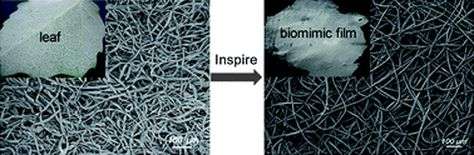
(PhysOrg.com) -- For as long as humans have been able to reason, they have mimicked nature in attempts to derive benefits for themselves; and just because weve become ultra-high tech in many ways, it doesnt mean weve stopped looking to nature to help us solve some of the problems that continue to arise in our paths. As one example Yanlin Song and others on a team doing research for the Chinese Academy of Science, as described in their paper "Highly reflective superhydrophobic white coating inspired by poplar leaf hairs toward an effective 'cool roof'" in Energy & Environmental Science, are copying the way poplar trees protect themselves from harsh sunlight and believe it might lead to new ways to help control the heat that is produced when sunlight beats down on a roof.
The idea is simple, the poplar tree, over eons, has developed micro-fibers on the undersides of its leaves that can reflect both light and heat from the sun; thus, when the sun shines directly on the tree, it turns its leaves upside down to protect the insides of the leaves from extreme heat and the ensuing loss of moisture.
The Chinese team has been working on spinning polymers into long protective hollow fiber coatings that could in theory reflect sunlight, and thus reduce the amount of heat that is absorbed when sunlight shines on a roof. To test their results, they covered a swath of material with diarylethene, a compound that changes color when heated, then covered that with their polymer film, and then let the sun shine. They found that the more closely they could emulate the structure of the natural fibers on the poplar leaves, the less the diarylethene changed color.
And while the results the team has managed to show so far are promising, there is still a pretty serious obstacle standing in the way of developing a commercial product that could help homeowners or businesses cut their summer cooling costs; the polymers are just not resistant enough to stand up to the constant barrage of heat, cold, wind and other weather conditions.
Song says he and his team will continue to work with the polymers to see if they can come up with something stronger but will also continue with what they've developed thus far, perhaps even branching out in to other areas, such as lighting applications or in developing waterproofing substances since their polymer film turned out to be water resistant as well.
More information: Highly reflective superhydrophobic white coating inspired by poplar leaf hairs toward an effective "cool roof", Changqing Ye, Mingzhu Li, Junping Hu, Qunfeng Cheng, Lei Jiang and Yanlin Song, Energy Environ. Sci., 2011, Advance Article. DOI:10.1039/C0EE00686F
© 2010 PhysOrg.com
-
From lemons to lemonade: Reaction uses carbon dioxide to make carbon-based semiconductor,
32 comments
-
Thioridazine kills cancer stem cells in human while avoiding toxic side-effects of conventional cancer treatments,
3 comments
-
SpaceX private rocket blasts off for space station (Update),
42 comments
-
Climate scientists say they have solved riddle of rising sea,
30 comments
-
Research team claims to have found evidence Lake Cheko is impact crater for Tunguska Event,
18 comments
-
Schwartz reagent-- NMR/MS/IR
16 hours ago
-
Inversion temp
20 hours ago
-
High school chemistry EEI
May 25, 2012
-
oxidation of I- by KMnO4
May 25, 2012
-
Invesion temp
May 25, 2012
-
Hybridization of SnCl3 -
May 25, 2012
- More from Physics Forums - Chemistry
More news stories
From lemons to lemonade: Reaction uses carbon dioxide to make carbon-based semiconductor
(Phys.org) -- A materials scientist at Michigan Technological University has discovered a chemical reaction that not only eats up the greenhouse gas carbon dioxide, it also creates something useful. And, by ...
May 21, 2012 |
4.7 / 5 (88) |
32
|
New CO2-removing catalyst can take the heat
(Phys.org) -- The current method of removing the greenhouse gas carbon dioxide (CO2) from the flues of coal-fired power plants uses so much energy that no one bothers to use it. So says Roger Aines, principal ...
May 24, 2012 |
5 / 5 (7) |
7
|
High-speed method to aid search for solar energy storage catalysts
Eons ago, nature solved the problem of converting solar energy to fuels by inventing the process of photosynthesis.
May 25, 2012 |
5 / 5 (3) |
4
|
Researchers demonstrate possible primitive mechanism of chemical info self-replication
(Phys.org) -- When scientists think about the replication of information in chemistry, they usually have in mind something akin to what happens in living organisms when DNA gets copied: a double-stranded molecule ...
May 25, 2012 |
5 / 5 (4) |
2
|
Castor oil: Action mechanism of one of the oldest drugs known to man elucidated
Castor oil is known primarily as an effective laxative; however, it was also used in ancient times with pregnant women to induce labour. Only now have scientists at the Max Planck Institute for Heart and Lung ...
May 21, 2012 |
3 / 5 (2) |
3
|
Scientist: Evolution debate will soon be history
(AP) -- Richard Leakey predicts skepticism over evolution will soon be history. Not that the avowed atheist has any doubts himself.
Dell tablet leak: 10.1-inch display, two-battery choice
(Phys.org) -- Headline after headline talks about vendors tablets in the wings as likely number-one contenders for the iPad. Such claims have justifiably been taken with a grain of salt, considering ...
SpotterRF debuts Radar Backpack Kit (w/ Video)
(Phys.org) -- SpotterRF has announced a special radar backpack kit designed to enhance situational awareness for soldiers on the ground. The company says its special radar is designed for warfighters as part ...
SpaceX capsule has 'new car' smell, astronauts say (Update)
SpaceX's Dragon cargo vessel smells like a new car, said astronauts at the International Space Station after opening the hatches Saturday following the spacecraft's landmark mission to the orbiting lab.
Thousands of shellfish found dead in Peru
Thousands of crustaceans were found dead off the coast of Lima following the mystery mass death of dolphins and pelicans, the Peruvian Navy said Friday.
Keep food safety in mind this memorial day weekend
(HealthDay) -- Picnics, parades and cookouts are as much a part of Memorial Day weekend as tributes to the United States' war veterans.