New science suggests we might soon be able to mix computers and neurons
March 22, 2011 by Bob Yirka report

New science suggests we might soon be able to mix computers and neurons

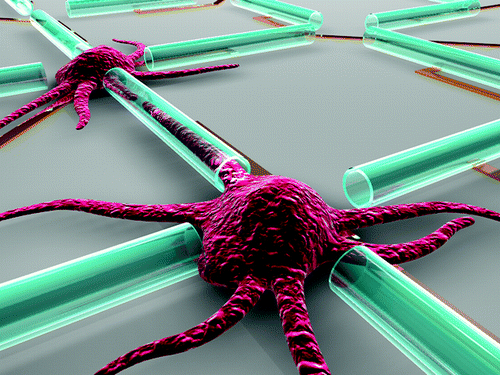
Image credit: ACS Nano, DOI:10.1021/nn103618d

(PhysOrg.com) -- Graduate students at the University of Wisconsin, Madison, led by Minrui Yu and Yu Huang, have published an ACS Nano paper, "Semiconductor Nanomembrane Tubes: Three-Dimensional Confinement for Controlled Neurite Outgrowth," in which they show that they have been able to successfully coax nerve cell tendrils to grow through tiny tubes made of the semi-conductor materials silicon and germanium. While this ground-breaking research may not portend cyborgs or even human brains enmeshed with computer parts, it does open the door to the possibility of regenerating nerve cells damaged due to disease or injury.

The team, led by Justin Williams, a biomedical engineer, created tubes of varying sizes and shapes, small enough for a nerve cell to glam on to, but not so big that it could fit all the way inside. The tubes were then coated with from mice and then watched to see how they would react. Instead of sitting idly, the nerve cells began to send tendrils through the tunnels, as if searching for a path to something or somewhere else. In some instances they actually followed the contours of the tubes, which means, in theory, that the nerves could be grown into structures.

Scientists have known for a while that nerve cells have a seek feature, but aren’t yet sure what it is they are seeking or if it’s just a random thing they do. By setting up nerve cells to follow pre-planned paths through tiny tubes, the research team hopes to find the answer to that by installing listening devices to record electrical emissions from nerves, which could in theory lead to recorded conversations between nerve cells.

The hope of course, in this type of research, is that a way can be found to connect a computer of some sort to a group of nerve cells to reestablish communication that has been disrupted. The computer in this case could serve as a relay of sorts, allowing those who can no longer walk, for example, due to spinal injury or disease, regain their former abilities. In that regard, this particular research is even more revealing than it might at first seem, due to the fact that the tiny tubes that have been created, very closely resemble myelin, the outer insulating sheath that covers parts of normal cells.

More information: Semiconductor Nanomembrane Tubes: Three-Dimensional Confinement for Controlled Neurite Outgrowth, ACS Nano, Article ASAP. DOI:10.1021/nn103618d

© 2010 PhysOrg.com

4.9 /5 (31 votes)  

Filter


Move the slider to adjust rank threshold, so that you can hide some of the comments.


Display comments: newest first

JRDarby
Mar 22, 2011

Rank: 5 / 5 (5)
Fascinating!
HeloMenelo
Mar 22, 2011

Rank: 5 / 5 (3)
I Like it !
fuviss_co_uk
Mar 22, 2011

Rank: 5 / 5 (2)
Great research
Gthedon
Mar 22, 2011

Rank: 5 / 5 (4)
wow my dream neural-electronical integration ... ughhhhhhhh how i long for a day when i have the knowledge of the world (via internet) at my disposal within attoseconds of me thinking the question.. OK i know.. there are other applications that the government can use or anyone for that matter that can potentially be catastrophic/enslaving to the populous but, as with all scientific endeavors risk and reward are a package deal.
jselin
Mar 22, 2011

Rank: 5 / 5 (4)
I know Kung Fu
PinkElephant
Mar 22, 2011

Rank: 5 / 5 (3)
Gives a whole new meaning to "intertubes".

Oh, and there is no spoon.
Birthmark
Mar 22, 2011

Rank: not rated yet
This is beyond exciting :D Can I sign up for the trials before it goes public!?!?
zevkirsh
Mar 23, 2011

Rank: 5 / 5 (2)
this needs to be hooked up to a lab on a chip that can deliver growth factors or neurotransmitters with digital prescion to synapses , axongs and elsewhere to accomplish highly controlled experiments with unprecedented specficity upon neurons.

could open upon a whole new era of neuronal investigation
Kedas
Mar 23, 2011

Rank: 5 / 5 (3)
Were are the day's that we didn't need to upload a firewall update to our brain every morning....
SteveL
Mar 23, 2011

Rank: 5 / 5 (2)
Hm... We are Borg?

It will start with the very justifiable control of dibilitating nerve-centered diseases (of which there are many), and continue to ... what limit?
atwas911
Mar 23, 2011

Rank: 5 / 5 (2)
Wonderful.. But as soon as the nutcase religious freaks catch wind of this all hell is going to break loose. They are gonna be on the floor convulsing and speaking in tongues to display to the world just how evil this tech is...

No offense to this tech, but we really need to find a cure for the above mentioned problem first.. :P
rgwalther
Mar 24, 2011

Rank: not rated yet
Hm... We are Borg?
It will start with the very justifiable control of dibilitating nerve-centered diseases (of which there are many), and continue to ... what limit?


It will continue to assimilate until resistance is futile.
Gthedon
Mar 24, 2011

Rank: not rated yet
lololololol
Hoodoo
Mar 25, 2011

Rank: not rated yet
Awesome stuff. I love that mental image of neurons "seeking" each other down pipes.
Also, I think it's the first instance I've seen of the use of "glam" as verb. There may have been some girls I glammed onto without fitting all the way inside in my time...
whitefang
Mar 26, 2011

Rank: not rated yet
The focus of this article is on possible medical applications of this technology to quadriplegics but it is interesting to wonder about 'Inception' uses.

Fine. But does anyone today know how bio-neural hardware manufactures the interactive model of reality which you use? Current fMRI scans tell you little of the fundamental mechanics or its software. For information input it would seem the only practical methodology at this time would be via retinal and cochlear implants to supply raw percepts which in turn native neural processors would model as they will. But mentally how would you tell the implant modules specifically what it is that you want to access? REM dream picture projections on the retina picked up by sensors? Starts to sound a little too BORG.
GBirch
Mar 26, 2011

Rank: 3 / 5 (1)
Wonderful.. But as soon as the nutcase religious freaks catch wind of this all hell is going to break loose. They are gonna be on the floor convulsing and speaking in tongues to display to the world just how evil this tech is...

No offense to this tech, but we really need to find a cure for the above mentioned problem first.. :P


Some people are never happy! Why the need to denigrate other people out of the clear blue sky? Get over yourself and contribute something positive for a change!
Gthedon
Mar 29, 2011

Rank: not rated yet
Gbirch.. i have alot of respect for that post. alot of people posting think its all about being right and showing that the post before them was less insightful then there own, when really its about engaging a community in scientific conversation to inspire and conduce thought. For a bunch of people belonging to a community such as this i am dumfounded by the amount of ignorance and denigration going on between articles.
GBirch
Mar 29, 2011

Rank: 5 / 5 (1)
Thanks Gthedon... I wasn't trying to make a statement for or against the religious point of view, I would just like us as a community to bring about positive change for everyone through rational discussion.

Gary
Gthedon
Mar 29, 2011

Rank: not rated yet
agreed, it appears tho, unfortunately to many immature minds are aloud to write whatever they want. This site is here for scientific minds to meet share thoughts, constructive criticism, etc, not bash each other.
Rank 4.9 /5 (31 votes)
Relevant PhysicsForums posts

More news stories

Dopant gives graphene solar cells highest efficiency yet

(Phys.org) -- By taking advantage of graphene’s favorable electrical and optical properties, and then adding an organic dopant, researchers have achieved the highest power conversion efficiency yet for ...

Nanotechnology / Nanophysics

created May 21, 2012 | popularity 5 / 5 (10) | comments 14 | with audio podcast feature

Nanomedicine: Quantum dots appear safe in pioneering study on primates

A pioneering study to gauge the toxicity of quantum dots in primates has found the tiny crystals to be safe over a one-year period, a hopeful outcome for doctors and scientists seeking new ways to battle diseases ...

Nanotechnology / Bio & Medicine

created May 20, 2012 | popularity 4.3 / 5 (3) | comments 8 | with audio podcast

In nanorod crystal growth, nanoparticles seen as artificial atoms

In the growth of crystals, do nanoparticles act as "artificial atoms" forming molecular-type building blocks that can assemble into complex structures? This is the contention of a major but controversial theory ...

Nanotechnology / Nanophysics

created May 24, 2012 | popularity 4.8 / 5 (6) | comments 0 | with audio podcast

First direct observation of oriented attachment in nanocrystal growth

Berkeley Lab researchers have reported the first direct observation of nanoparticles undergoing oriented attachment, the critical step in biomineralization and the growth of nanocrystals. A better understanding ...

Nanotechnology / Nanophysics

created May 24, 2012 | popularity 4.7 / 5 (3) | comments 0 | with audio podcast

Synthetic nano-waste does not disappear

(Phys.org) -- Tiny particles of cerium oxide do not burn or change in the heat of a waste incineration plant. They remain intact on combustion residues or in the incineration system, as a new study by Swiss ...

Nanotechnology / Bio & Medicine

created May 25, 2012 | popularity 5 / 5 (2) | comments 1 | with audio podcast


Scientist: Evolution debate will soon be history

(AP) -- Richard Leakey predicts skepticism over evolution will soon be history. Not that the avowed atheist has any doubts himself.

Dell tablet leak: 10.1-inch display, two-battery choice

(Phys.org) -- Headline after headline talks about vendors’ tablets in the wings as likely number-one contenders for the iPad. Such claims have justifiably been taken with a grain of salt, considering ...

SpotterRF debuts Radar Backpack Kit (w/ Video)

(Phys.org) -- SpotterRF has announced a special radar backpack kit designed to enhance situational awareness for soldiers on the ground. The company says its special radar is designed for warfighters as part ...

SpaceX capsule has 'new car' smell, astronauts say (Update)

SpaceX's Dragon cargo vessel smells like a new car, said astronauts at the International Space Station after opening the hatches Saturday following the spacecraft's landmark mission to the orbiting lab.

Thousands of shellfish found dead in Peru

Thousands of crustaceans were found dead off the coast of Lima following the mystery mass death of dolphins and pelicans, the Peruvian Navy said Friday.

Keep food safety in mind this memorial day weekend

(HealthDay) -- Picnics, parades and cookouts are as much a part of Memorial Day weekend as tributes to the United States' war veterans.