Bleaching and resilience: can reefs survive?
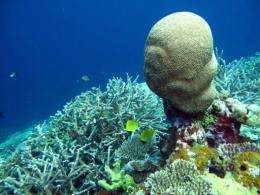
Red anthia fish and rainbow-coloured wrasse dart among the glittering reefs of Indonesia's Wakatobi archipelago, as eagle rays and barracudas cruise past in the blue depths.
It's hard to believe Wakatobi is anything but a thriving marine paradise, packing a bewildering abundance of life that supports 100,000 people and contributes millions of dollars to Indonesia's economy.
But scientists are worried.
Last year, coral bleaching caused by higher sea temperatures wreaked havoc across the Coral Triangle, a region of rich tropical reefs spanning much of Southeast Asia and almost all of Indonesia.
Up to 70 percent of the coral in Wakatobi, off the southeastern tip of Sulawesi island, was totally or partially bleached. In Aceh province, off the northern tip of Sumatra, as much as 90 percent was killed, scientists said.
Experts from environmental groups The Nature Conservancy and WWF, as well as the Indonesian government, returned to Wakatobi last month to see if the marine park's reefs had bounced back.
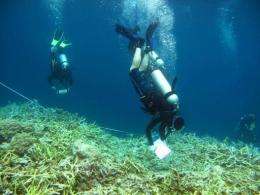
Over two weeks of diving at sites with names like Table Coral City and Blue Hole, the team looked for signs of long-term damage or resilience, in the hope of learning more about how reef systems respond to climate-related stresses.
"In Aceh about 90 percent of the coral bleached, and that included some of the really big varieties that are hundreds of years old and had survived the (2004) tsunami but died because of the bleaching," said Joanne Wilson, deputy director for science in TNC's Indonesia Marine Programme.
"Very fortunately in Wakatobi ... it seems that only about five to 10 percent of the corals actually died. We're very lucky here."
Bleaching occurs when corals respond to stress, such as stronger than normal direct sunlight or elevated sea temperatures, by expelling the algae that live inside them and give them their brilliant colours.
In normal conditions the symbiotic algae provide the corals with nutrients, and without them the corals turn white and can die within days. They may also recover, depending on the circumstances.
Wilson described the "eerie" experience of diving on wintry, frozen-looking reefs during the height of the bleaching at Wakatobi last year, the warmest year on record.
"I saw that a lot of the corals were affected by the bleaching to various stages. Some were completely white but still alive," she said.
Scientists feared a repeat of the 1998-1999 global bleaching that was linked to the El Nino and La Nina weather cycles in the Pacific Ocean.
About 16 percent of the world's reefs died in that crisis, providing a wake-up call to scientists about the dangers posed to reef systems -- and the millions of people who depend on them -- from global warming.
Ove Hoegh-Guldberg, the director of the Global Change Institute at the University of Queensland in Australia, said the effects of El Nino and La Nina were being magnified by "background warming" linked to general climate change.
"Over the next five to 10 years, we will probably return to fairly serious bleaching conditions," he said.
Last year's bleaching event has given scientists a chance to test theories of resilience and see which kinds of reefs, under which circumstances, are best suited to adapt to warmer seas.
The aim is to develop a kind of survival checklist which can be used to identify key reef systems that should be given priority in the designation of marine parks and conservation zones.
TNC's Coral Reef Conservation director Rod Salm, who joined the Wakatobi expedition from his base in Hawaii, said last year's bleaching hit the reefs of Thailand, Malaysia, Myanmar and Indonesia "very hard".
"It was a tragic event but at the same time we can get something from it -- we can learn how the corals respond, and we can relate how they respond back to our original resilience principles," he said.
Wakatobi is the only marine park designed with those principles in mind that has been hit by bleaching, he said.
"What's exciting is the chance to see if we got it right," he told AFP after a dive off Wakatobi's Tomia island.
Other teams are doing similar studies in Aceh and Bali, looking at local characteristics and micro-climates -- perhaps a cooler current or upwell of cooler water -- that may indicate a better chance of surviving global warming.
The researchers will come together at a workshop in April to compare their findings.
"We're trying to come up with the factors that are the real drivers of resilience... The idea is to identify the 10 or 12 factors that are absolutely crucial," Salm said.
Indonesia has introduced penalties for destructive activities like bomb and cyanide fishing, and declared 13 million hectares (32 million acres) of sea as Marine Protected Areas.
The massive archipelago of 17,000 islands hopes to boost this area to 20 million hectares by 2020, a recognition of the importance the government places on reefs as sources of revenue and food for millions of people.
"The question isn't whether 20 million hectares is the right number, the thing is does Indonesia have the resources and skills to manage effectively?" Wilson said.
"I think there's a real recognition within the government that now the hard work begins."
Globally, the value of coral reefs in terms of goods and services has been estimated at $385 billion annually. In Indonesia it's more than $3 billion.
Some 500 million people -- mainly in developing nations in Southeast Asia and around the Indian Ocean -- depend on reefs for their daily livelihoods.
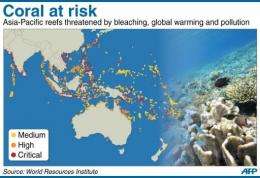
A study by two dozen conservation and research groups led by World Resources International released last month said that without quick action to arrest global warming and reduce other human impacts, the world's reefs could be wiped out by 2050, with grave implications for humanity as a whole.
On Tomia, local fishermen are doing their bit by banding together to protect their precious reefs from bomb and cyanide fishing.
They said they had received death threats and been harassed by police working on behalf of commercial fishing interests.
"Some people are against us. We've been threatened," said 32-year-old fisherman Eliswan, who like many Indonesians goes by only one name.
"Some of our members have been beaten... The bad guys are the businessmen and the politicians."
For information on reef resilience and coral bleaching: www.reefresilience.org/Toolkit_Coral/C1_Intro.html
(c) 2011 AFP


