Rare Andean cat no longer exclusive to the Andes
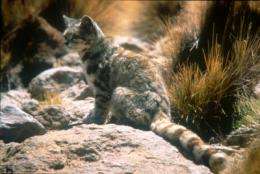
Once thought to live exclusively in the Andes, the Andean cat also occurs on the Patagonian steppe, according to the Wildlife Conservation Society and its partners. Credit: © Jim Sanderson, PhD/Small Wild Cat Conservation Foundation
Once thought to exclusively inhabit its namesake mountain range, the threatened Andean cata house cat-sized feline that resembles a small snow leopard in both appearance and habitatalso frequents the Patagonian steppe at much lower elevations, according to a new study published by the Wildlife Conservation Society and partners.
The finding represents a range extension for the Andean cat, which normally occurs at altitudes above 3,000 meters (approximately 9,800 feet). The new survey presents evidence of the cats occurring at elevations as low as 650 meters (approximately 2,100 feet) on the Patagonian steppe. The species is listed as "Endangered" on the World Conservation Union's Red List and may number only 2,500 individuals throughout its entire range.
The study appears in the recent edition of CATNews. The authors include: Andres Novaro and Lorena Rivas of the Wildlife Conservation Society and CONICET, Argentina; Susan Walker of the Wildlife Conservation Society; Rocio Palacios of Alianza Gato Andino; Sebastian di Martino of Department of Protected Areas of the Province of Neuquén; Martin Monteverde of Centro de Ecología Aplicada del Neuquén; Sebastian Canadell of Universidad Nacional de Cordoba; and Daniel Cossios of Université de Montréal.
"These confirmed records show the lowest elevations ever reported for the Andean cat," said WCS conservationist Andres Novaro, lead author of the study. "According to genetic studies underway led by Daniel Cossios, this new population appears to represent an evolutionary lineage distinct from the highland population."
Prompted by a lone photograph of two Andean cats in the foothills of central Argentina, the research team surveyed approximately 31,000 square kilometers (approximately 12,000 square miles) of Argentina's Mendoza and Neuquén provinces in 2007-2009. The team collected samples from several locations that included scat, skulls, and skin, all of which were confirmed with DNA analysis. In addition, the researchers conducted surveys with inhabitants of the region. The conservationists also found evidence of three other small cat species: Geoffroy's cat, pampas cat, and jaguarundi.
The Andean cat's range extension coincides with the known distribution of the mountain vizcacha, a rabbit-like rodent that inhabits both the Andes Mountains and Patagonian steppe and is the Andean cat's primary prey.
"Discovering a new population of Andean cats is an important finding for this elusive and rare species," said Mariana Varese, Acting Director of WCS's Latin America and Caribbean Program. "Determining the range of the Andean cat in the Patagonian steppe will provide conservationists with a foundation for later conservation plans."
Threats to the newly discovered population of Andean cat include goat herders who assume the felines are preying on their livestock, oil exploration activities that destroy habitat, and new roads that open up formerly inaccessible areas to poachers.
Provided by
Wildlife Conservation Society
-
From lemons to lemonade: Reaction uses carbon dioxide to make carbon-based semiconductor,
32 comments
-
Thioridazine kills cancer stem cells in human while avoiding toxic side-effects of conventional cancer treatments,
3 comments
-
SpaceX private rocket blasts off for space station (Update),
42 comments
-
Climate scientists say they have solved riddle of rising sea,
30 comments
-
Research team claims to have found evidence Lake Cheko is impact crater for Tunguska Event,
18 comments
-
What would stain as translucent on light-coloured fabric?
7 hours ago
-
How do I identify different bacteria on culture plates?
17 hours ago
-
Why Do Dogs do Strange things...
May 25, 2012
-
What does exophillic and endophillic mean in terms of mosquito and their control?
May 24, 2012
-
Semen stains glows under black lights (uv light)?
May 23, 2012
-
Question on Human Chromosome 2
May 23, 2012
- More from Physics Forums - Biology
More news stories
Scientist: Evolution debate will soon be history
(AP) -- Richard Leakey predicts skepticism over evolution will soon be history. Not that the avowed atheist has any doubts himself.
6 hours ago |
3.4 / 5 (8) |
21
Thousands of shellfish found dead in Peru
Thousands of crustaceans were found dead off the coast of Lima following the mystery mass death of dolphins and pelicans, the Peruvian Navy said Friday.
16 hours ago |
4.8 / 5 (4) |
6
More plant species responding to global warming than previously thought
(Phys.org) -- Far more wild plant species may be responding to global warming than previous large-scale estimates have suggested.
May 22, 2012 |
4.6 / 5 (14) |
18
|
Totally rad: Scientists create rewritable digital data storage in DNA
(Phys.org) -- Scientists from Stanford's Department of Bioengineering have devised a method for repeatedly encoding, storing and erasing digital data within the DNA of living cells.
May 21, 2012 |
4.9 / 5 (17) |
11
|
For monogamous sparrows, it doesn't pay to stray (but they do it anyway)
It's quite common for a female song sparrow to stray from her breeding partner and mate with the male next door, but a new study shows that sleeping around can be costly.
May 22, 2012 |
5 / 5 (1) |
7
|
Dell tablet leak: 10.1-inch display, two-battery choice
(Phys.org) -- Headline after headline talks about vendors tablets in the wings as likely number-one contenders for the iPad. Such claims have justifiably been taken with a grain of salt, considering ...
SpotterRF debuts Radar Backpack Kit (w/ Video)
(Phys.org) -- SpotterRF has announced a special radar backpack kit designed to enhance situational awareness for soldiers on the ground. The company says its special radar is designed for warfighters as part ...
SpaceX capsule has 'new car' smell, astronauts say (Update)
SpaceX's Dragon cargo vessel smells like a new car, said astronauts at the International Space Station after opening the hatches Saturday following the spacecraft's landmark mission to the orbiting lab.
Keep food safety in mind this memorial day weekend
(HealthDay) -- Picnics, parades and cookouts are as much a part of Memorial Day weekend as tributes to the United States' war veterans.
Astronomers seize last chance in lifetime for Venus Transit
Astronomers are gearing for one the rarest events in the Solar System: an alignment of Earth, Venus and the Sun that will not be seen for another 105 years.
Australia hails surprise super-telescope decision
Australia has hailed a surprise decision giving it a role in a radio telescope project aimed at revolutionising astronomy, vowing to draw on its decades of experience in space science.
Mar 16, 2011
Rank: not rated yet