Researchers to study positive genetic contributions of viruses
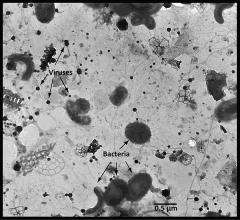
The positive genetic contributions of viruses to life on Earth will be explored by researchers at the University of Delaware and the Delaware Biotechnology Institute through a grant from the Gordon and Betty Moore Foundation Marine Microbiology Initiative.
The two-year, $550,000 grant has been awarded to K. Eric Wommack, professor in UD's Department of Plant and Soil Sciences with appointments in the Department of Biological Sciences and the College of Earth, Ocean, and Environment, and Shawn Polson, research assistant professor in the Center for Bioinformatics and Computational Biology at DBI.
The grant will support the rollout of a computational infrastructure dedicated to the analysis of viral genetic data from environmental samples. The Viral Informatics Resource for Metagenome Exploration (VIROME) is hosted at DBI.
The project will be done in collaboration with researchers at the University of California, San Diego (UCSD), involved with the Community Cyberinfrastructure for Advanced Marine Microbial Ecology Research and Analysis (CAMERA) project, a web-based resource for advancing metagenomic research.
The Marine Microbiology Initiative at the Gordon and Betty Moore Foundation recently expanded to include the study of viruses, and scientists now appreciate that viruses contain perhaps the largest collection of unknown genes on earth. Wommack's research specifically focuses on the positive genetic contributions viruses make to life -- an aspect of viruses that has not yet been widely studied.
“We really don't appreciate the genetic contributions viruses make to life other than the negative ones,” says Wommack. “This grant will allow us to explore this facet of viruses in marine ecosystems -- and we've already begun to find surprising results.”
Through the study of deep sea hydrothermal vents, uranium contaminated groundwater, Chesapeake Bay water and other hotbeds for viruses, Wommack's team has discovered that viruses contain completely novel versions of genes with well-known functions.
These discoveries come from the study of marine ecosystems but allow researchers to learn more about the predominant biological features of viruses overall, which can affect how human conditions - such as cancer - are diagnosed and treated.
“Within some of the virus samples we've collected, we found genes critical to protein folding,” says Polson. “In many cases, protein has to be directed to fold in the proper way. Protein misfolding is a component in the cause of some diseases, so this knowledge can be very important in our understanding of viral infection processes.”
The data aspect of this grant is essential in helping scientists learn more about the genetic makeup of viruses so that they can better understand their positive contributions.
Jaysheel Bhavsar, a master's student in computer and information sciences, has been the lead on the web application interface that translates the genetic information into understandable data. Dan Nasko, a master's student in bioinformatics, will be interfacing with the users of VIROME and working data through the computational pipeline.
Wommack and Polson describe virus genetic sequence data as an unedited book containing sophisticated vocabulary without page numbers, punctuation, or even spaces between sentences or words -- basically a string of letters with no meaning.
But in fact, the strings of letters have significant meaning, as this is the genetic instruction set for how viruses control and ultimately kill the cells they infect.
The database they've created, along with the web application interface, will in essence help scientists punctuate DNA sequence data into “words,” “sentences,” “paragraphs” and even “chapters,” if you will, to aid in the process of understanding the important role viruses play in controlling cellular life on earth.
“What we've created, with the support of the CAMERA technology from UCSD, is a way to translate raw information -- virus genome data -- into useful genetic information,” says Wommack. “And our web application interface provides the 'books' -- just like shopping on Amazon.com -- complete with a picture of the book's 'cover,' the 'price,' the 'authors,' etc. It pulls the translated information about the viruses from the database and presents it in graph and other data formats for consumption.”
The VIROME web application and sequencing libraries are available online for use for free now at this website.
Provided by University of Delaware


