Physics could help financial traders
March 24, 2011 by Deborah Braconnier
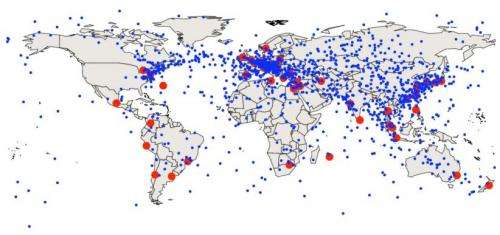
Optimal intermediate trading node locations small circles for all pairs of 52 major securities exchanges large circles. While some nodes are in regions with dense fiber-optic networks, many others are in the ocean or other sparsely connected regions. Image credit: APS, DOI:10.1103/PhysRevE.82.056104
(PhysOrg.com) -- While most people know that the shortest distance between two points is a straight line, this concept is proving even truer in the world of stock trading. In a world where buying low and selling high means all the difference, racing the speed of light between to different financial markets can mean greater profit.
With financial markets being located all over the world, stock trading has become reliant on the speed of fiber optic cables and their ability to process information. While fiber optic cables are currently operating at about 90 percent of the speed of light, Dr. Alexander Wissner-Gross shares how companies might be able to exploit physics and position themselves in locations capable of more competitive speeds and transactions.
In a paper first released in 2010 in the Physical Review E, Dr. Wissner-Gross determined locations that are at the most optimal sites to best compete with the current locations of financial markets. With the idea that the quickest route between two points is a straight line, he determined locations which would essentially be right in the center of that line. This location being ideal in the fact that you then had the shortest distance to cover for both markets, thus better setting your business up to buy low and sell high between the two markets.
For example, should you be a trader working off the New York Stock Exchange and the exchanges in Europe, your ideal location would end up somewhere in the middle of the Atlantic Ocean. However, while this information is valid, there are not many companies ready to construct a floating office.
With this problem in mind, Dr. Wissner-Gross is now looking at determining land points which would approximate these mid-ocean locations. Using the above example of New York and Europe, he would now look at a location such as Nova Scotia.
This physics trick may just be able to provide a very competitive edge to many companies, and over the years, we may just see many financial trading hubs popping up in the least likely locations. No more will they be dependent on buzzing cities and large markets, but they could be springing up in rural areas that provide the best locational advantage to cutting the distance needed to travel the world of fiber optic cables.
More information: Relativistic statistical arbitrage, A. D. Wissner-Gross and C. E. Freer, Phys. Rev. E 82, 056104 (2010) DOI:10.1103/PhysRevE.82.056104
© 2010 PhysOrg.com
-
From lemons to lemonade: Reaction uses carbon dioxide to make carbon-based semiconductor,
32 comments
-
Thioridazine kills cancer stem cells in human while avoiding toxic side-effects of conventional cancer treatments,
3 comments
-
SpaceX private rocket blasts off for space station (Update),
42 comments
-
Climate scientists say they have solved riddle of rising sea,
30 comments
-
Research team claims to have found evidence Lake Cheko is impact crater for Tunguska Event,
18 comments
-
Question about induced E field.
37 minutes ago
-
Charging a capacitor in a tesla coil
38 minutes ago
-
Water Rocket
4 hours ago
-
why do trucks have bigger brakes?
8 hours ago
-
Solar Sail Physics - Do they work on a large scale?
9 hours ago
-
How should I switch an air conditioner off?
9 hours ago
- More from Physics Forums - General Physics
More news stories
Landmark calculation clears the way to answering how matter is formed
(Phys.org) -- An international collaboration of scientists, including Thomas Blum, associate professor of physics, is reporting in landmark detail the decay process of a subatomic particle called a kaon ...
May 25, 2012 |
4.4 / 5 (20) |
46
|
Is a classical electrodynamics law incompatible with special relativity?
(Phys.org) -- The laws of classical electromagnetism that were developed in the 19th century are the same laws that scientists use today. They include Maxwell’s four equations along with the Lorentz la ...
Lying in wait for WIMPs: Researchers seek to dramatically increase sensitivity of Large Underground Xenon detector
Although it's invisible, dark matter accounts for at least 80 percent of the matter in the universe. No one knows what it is, but most scientists would bet on weakly interacting massive particles, or WIMPs.
May 23, 2012 |
4 / 5 (7) |
15
|
Hall effect at the speed of light: How can you demonstrate relativistic effects with your mobile phone?
The relativistic Hall effect describing objects rotating at speeds comparable with the speed of light has been reported.
May 21, 2012 |
4.3 / 5 (3) |
8
Cloak of invisibility: Engineers use plasmonics to create an invisible photodetector
A team of engineers at Stanford and the University of Pennsylvania has for the first time used "plasmonic cloaking" to create a device that can see without being seen - an invisible machine that detects light. It is the first ...
May 21, 2012 |
4.8 / 5 (16) |
7
|
Dell tablet leak: 10.1-inch display, two-battery choice
(Phys.org) -- Headline after headline talks about vendors tablets in the wings as likely number-one contenders for the iPad. Such claims have justifiably been taken with a grain of salt, considering ...
Scientist: Evolution debate will soon be history
(AP) -- Richard Leakey predicts skepticism over evolution will soon be history. Not that the avowed atheist has any doubts himself.
SpotterRF debuts Radar Backpack Kit (w/ Video)
(Phys.org) -- SpotterRF has announced a special radar backpack kit designed to enhance situational awareness for soldiers on the ground. The company says its special radar is designed for warfighters as part ...
SpaceX capsule has 'new car' smell, astronauts say (Update)
SpaceX's Dragon cargo vessel smells like a new car, said astronauts at the International Space Station after opening the hatches Saturday following the spacecraft's landmark mission to the orbiting lab.
Keep food safety in mind this memorial day weekend
(HealthDay) -- Picnics, parades and cookouts are as much a part of Memorial Day weekend as tributes to the United States' war veterans.
Thousands of shellfish found dead in Peru
Thousands of crustaceans were found dead off the coast of Lima following the mystery mass death of dolphins and pelicans, the Peruvian Navy said Friday.
Mar 24, 2011
Rank: 4 / 5 (8)
Mar 24, 2011
Rank: 4.2 / 5 (6)
I was completely with you up until that point.
Trading stocks for the sake of sneaking a profit without actually adding to the would's wealth has always bothered me, but I don't blame anyone. If the system exists for taking wealth and it's open to anyone, you can't blame anyone, especially not citizens of just ONE of the countries participating.
Mar 24, 2011
Rank: 4.8 / 5 (5)
I read stuff like this and it just floors and depresses me. Doesn't it make you just want to pick up your collective ACME mirror and ask "Just what the hell is WRONG with us?" Can't you (collectively) act with more foresight? The Great Depression was also spawned in America...certainly just the size of your economy magnifies the consequences of, lets call them errors. But there's more to it then that. Stuff like the above points to some kind of culturally induced blindness.
Mar 24, 2011
Rank: 5 / 5 (3)
Mar 24, 2011
Rank: 2 / 5 (7)
Its a zero sum game anyways.
I think its a good thing that somehow highly educated people find a way to monetize their intellect at the expense of all the posers playing on the stock market.
Mar 24, 2011
Rank: 5 / 5 (4)
Mar 24, 2011
Rank: 3.8 / 5 (8)
The efficient distribution of risk is one of the critical factors that ENABLES production on ever-larger scales... without it, many enormously productive enterprises would never be undertaken in the first place.
Mar 24, 2011
Rank: 3 / 5 (2)
The desire to exploit this volatility drives traders to create systems that do so, which corrects the imbalances, which reduces volatility which drives production UP, creating more wealth to be enjoyed by more people around the world.
Traders who create these systems will enjoy windfall profits in the short term... but then the system achieves a new equilibrium, and their profits are reduced to a steady flow that reflects the value of the stabilization they continue to bring to the global financial system.
Mar 24, 2011
Rank: 4.2 / 5 (5)
Yeah. Agreed...to an extent, as long as your talking RISK (whether it's reasonable risk or not is another problem given their dealing with other people's money based on a given agreement). But LOOK at this paper. This isn't about RISK anymore. It's a straightforward EXPLOIT.
Mar 24, 2011
Rank: 3.7 / 5 (6)
Mar 24, 2011
Rank: 5 / 5 (5)
Mar 24, 2011
Rank: 3.7 / 5 (6)
Mar 24, 2011
Rank: 5 / 5 (10)
This is a common misconception. Trading stocks is NOT a zero sum game. Trading futures contracts IS a zero sum game (if you want an example of one) and so is plain old gambling.
By definition, a zero sum game means that once you add up all wins and losses, the net result is zero. In a zero sum game, money shifts hands, but the total amount of money doesn't change.
Stocks are not like that. In stock trading, wealth CAN and DOES get created. The price of a stock is not based solely on trades. They're based on perceived performance or perceived potential future profits of the company behind the stock. As a company produces and sells, say, better iPhones, for example, the company becomes more valuable and so does their stock (created wealth).
I'm not making any argument pro or con about stock trading in this post... just clarifying that stocks are NOT a zero sum game.
Further information:
http://www.invest...game.asp
Mar 24, 2011
Rank: 4.8 / 5 (4)
1. That doesn't have anything to do with "optimizing digital shuffling to the photon so those with the edge get richer WITHOUT HAVING TO GENERATE WEALTH to back up their gains."
2. The current financial disaster, though originating in America and also, true, that the people responsible were "American", it was not ALL Americans, nor was it MOST Americans, nor was it anything, generally, about how America is designed to work (generally, about free market capitalism, which is usually what anti-American statements in the context of money relate to). The crisis was caused by the housing collapse, which was caused by 4% of mortgage borrowers not paying their mortgages because they couldn't afford the mortgages they signed up for because the banks were urged by Fannie Mae and Freddie Mac to give loans to high risk
(continued...)
Mar 24, 2011
Rank: 2 / 5 (1)
What makes you suppose that what I have to say is any less true now than for "standard old school stock trading"? Someday what we do now will ALSO be "standard old school stock trading."
By the way, why do you suppose stock tickers were invented? Because the traders who had them gained an advantage over those who did not. Eventually everybody had them and the advantage went away... unless you DIDN'T have one. The result was that the ENTIRE market communicated more efficiently, which was good for everybody.
No termite knows nor cares about the shape of the mound... yet the structure gets built nevertheless. Traders look after their own interests in a FREE and OPEN market... and collectively stabilize a global economy.
People often fear what they do not understand, but some complex things are scary for a reason. The distinction is not obvious.
Mar 24, 2011
Rank: 5 / 5 (3)
to high risk borrowers (which banks are reluctant to do because of the known risk). Fannie Mae and Freddie Mac were pushing political agendas to get more people into owning than renting (a noble goal, but...). Fannie Mae and Freddie Mac promised the banks that they'd reimburse the banks for any losses, so the banks could give the loans, which they did (then got blamed).
Though, a noble intent, pushing through end results that mathematically can't work will end in unexpected consequences (well, unexpected only if they aren't interested in looking at how it's likely to play out, which they were warned about, repeatedly by the Bush administration (like him or hate him), but chose no ignore the warnings). The rest is the burden we live in now.
http://www.uscops...M%5D.cfm
http://www.uscops...s%5D.cfm
GSE = "Government Sponsored Enterprise", BTW
Mar 24, 2011
Rank: 5 / 5 (3)
This is all true. I've done extensive mathematical and trends research into stocks and Forex trading (and have written analytical software that can perform actual trades). When I agreed, in principle with Gawad about traders not adding wealth, it was out of character for my very pro free market capitalism knowledge (I say "knowledge" rather than "belief"). I shouldn't have agreed in the context of stocks so much as futures, but even then, there's still legitimacy in futures trading. My mild agreement with Gawad's premise is narrow, relating to how "speculators" on oil prices drive the price up with no real benefit to us all, but much pain
Mar 24, 2011
Rank: 5 / 5 (2)
When I say "speculators", I'm not talking about airlines or trucking companies that buy oil futures. These are companies that have a real stake in the commodity they're buying futures on and are recipients of the actual product. They're the ones that are SUPPOSED to be in the futures market and buying futures contracts. My narrow hesitation about "speculators" is in relation to moronic, home-based, trading schmucks (like myself, for instance) who perceive an opportunity to make some quick cash by buying a futures contract on say, oil, then selling it later at a higher price. My involvement caused the price of oil to go up and I contributed nothing. The poor schmuck that bought my contract lost.
Mar 24, 2011
Rank: 2.3 / 5 (3)
That's right, blame capitalism first. Just remember that without greed and the capital markets, companies would have had a much harder time financing their operation and growing. Hence we probably wouldn't have Apple, Intel, Star Bucks, etc.
Mar 24, 2011
Rank: 5 / 5 (1)
Not all markets are 0 sum. In some, the profit is extracted indirectly from the populace.
Mar 24, 2011
Rank: 1 / 5 (1)
Anyways, I think that most business activities revolve around taking advantage of some sort of dominant position (information, production, distribution etc.) at the expense of the consumers.
Mar 24, 2011
Rank: 1 / 5 (1)
My apologies, that was an incorrect formulation. What i meant is that for every buyer there is a seller. Someone is going to be at the other end of the trade anyways.
Banks have been taking advantage of localization for years. This is just pushing it to the extreme.
Corporate robbery will always be present. Today i was charged 3.50$ for using an ATM that isnt from my bank.
Mar 24, 2011
Rank: 5 / 5 (2)
Mar 24, 2011
Rank: 3 / 5 (4)
As a consumer, do you feel you are taken advantage of? If so, why do you buy their products?
Mar 24, 2011
Rank: 5 / 5 (3)
Economic gain comes from specialization so we have to rely on others for most of our needs. A firm will always try to maximize its profit at the expense of the consumer and the same goes for traders vs the market.
I'm not saying its a bad thing, I'm merely stating a fact.
Mar 24, 2011
Rank: 5 / 5 (1)
Mar 25, 2011
Rank: 1 / 5 (2)
The world always is dynamic equilibrium of systems of organized lies and robbery. Governments are territorial gangsters. Behind them are the international banksters. Money is based on the power to rob, with the ultimate power to rob being the power to kill. Money and murder systems work together. The power of governments to force people to pay taxes in legal tender drives the fiat money system to become the state religion. The Neolithic social pyramid developed a human ecology with its "top carnivores" becoming the international banksters. We have a privatized fiat money-as-debt system that is almost inconceivably crazy and corrupt. That grew to astronomical size: a quadrillion dollars of global cybercasino fraud, backed by weapons of mass destruction. The problem is electronic money still depends on murder. The books balance with blood: electronic money, backed by atomic bombs, towards psychotic chaos!
Mar 25, 2011
Rank: 1 / 5 (4)
When they "In a world where buying low and selling high means all the difference" it means someone will loose money. So, instead of helping everyone we create schemes to remove more money from those people...
Mar 25, 2011
Rank: 4.5 / 5 (2)
Mar 25, 2011
Rank: 3 / 5 (1)
Not directly, but the 2 fellows who've come up with the exploit (gimmick?) are from Harvard and MIT.
True, but also moot as my comment is not directed at that majority. It's like asking "what is it about Islam that most suicide bombers are Muslim?" The question can be perfectly valid even though only a fraction of 1% of Muslim will ever be suicide bombers and ...
Mar 25, 2011
Rank: 5 / 5 (1)
Another, equally essential piece of the puzzle is the CONVEYANCE of capital from where it currently sits--your pocket, say--to the location where it can be "put to work". This is the primary function of the markets. Capital propagates through the markets from hand to hand, bucket-brigade style, and innovations that enhance the efficiency of this process add real value to the equation.
Yet ANOTHER essential piece of the puzzle is the conveyance of RISK--read "exposure to harmful market dynamics"--from those who have it to those who SEEK it (because one man's risk is another man's opportunity). Derivatives not only convey risk but TRANSFORM it. As the transformed risk may find a buyer whereas the original risk may not, this transformation aids the distribution of risk.
Mar 25, 2011
Rank: 4 / 5 (2)
The notion that speculation increases volatility is just flat-out wrong... UNLESS all the speculators all line up in one direction. But in a free market, they never do, because OTHER speculators are always delighted to jump in and take advantage of the speculative trend, thus driving it back toward the mean.
To point out that volatility exists nonetheless is irrelevant. Volatility is a consequence of price movement... zero volatility can only exist in a "market" where prices do not move, which is no market at all.
Pointing to speculation in unstable markets as evidence that speculation destabilizes markets is like pointing to the employees in a failing business as evidence that coming to work will get you fired. Without speculation, there would BE no markets to experience instability.
Mar 25, 2011
Rank: 2 / 5 (1)
So I actually disagree with you that "it [is not] anything, generally, about how America is designed to work". I mean, I'm really convinced that there's some kind of cultural quirk, some twist on the way you, on the average, are brought up to see the notions of work, money, profit, opportunity, property, value, boundaries, peers vs non-peers, etc., etc. that do contribute to developing a narrow, shortsighted mindset. Sorry, but this impresion isn't gleaned from watching American TV. I have family in Virginia and every time I go to the States it just hits like a ton of bricks. You can really be an awfully friendly bunch but there's this OBSESSION with "bling", brands, check out my plans for making $$, etc. and instead of being something substantial it's invariably some kind get rich quick gimmick. Like in this article. It's uncanny. C, it's an American (& now Chinese) thing. Nowhere else in the world do you find this. And it's bad for you and us.
Mar 25, 2011
Rank: 3 / 5 (2)
Only if they want to take a loss for offset gains for taxes.
No one is forced to sell, or buy, in free market.
Mar 25, 2011
Rank: 2.3 / 5 (4)
The second is that there's only one optimum, that is to say, rational price level for a given commodity. As a market moves towards monopolization, either in fact by having fewer and fewer trading houses to manage financial trade, or in practice by competing trading houses using ever more identical trading methods, the rational price becomes more greatly a function of the nature of the consumption side of the trade. (cont)
Mar 25, 2011
Rank: 1 / 5 (1)
Mar 25, 2011
Rank: 2 / 5 (4)
Consider, for instance, the pricing of a train ride from St, Louis to Chicago. Trains are natural monopolies because it's simply too cost inefficient to build parallel lines of competing track. And costs are fixed as well, it costs the same amount to transport 1 ton of coal as it does 1 ton of people and luggage as it does 1 ton of steel as it does 1 ton of factory parts. Inquire with the train company, however, and you'll find different prices quoted to you depending on what you wanted to transport. Why should this be the case? Simply because the different classes of purchasers have different abilities to purchase the good the train company proffers. (cont)
Mar 25, 2011
Rank: not rated yet
Mar 25, 2011
Rank: 3 / 5 (4)
Insofar as financial markets are trending towards a natural monopoly, and reliance on infrastructure such as high speed connections and secret computer algorithms, together with the consolidation and dominance of trading firms, then the "ticket price" for risk needs to stop being a single price point, and start being more a function of the consumers of that risk.
Mar 25, 2011
Rank: 5 / 5 (1)
Now that was brilliantly put. Goes to show that I should probably stick to fields with which I'm more intimately familiar!
Mar 25, 2011
Rank: not rated yet
Mar 25, 2011
Rank: 1 / 5 (1)
Mar 25, 2011
Rank: not rated yet
But Odie, this whole article's premise is *exactly* "how to use physics to move more cash (into a few pockets)."
Mar 25, 2011
Rank: not rated yet
In the bank example, the fact that the robbery occurred stands as primary evidence that the bank in question was NOT secure. And the events you referred to stand equally as evidence that the markets in question were NOT free.
How so? Market actions that MIGHT have mitigated or prevented those circumstances were hamstrung by regulation... and, more importantly, the market actions that CAUSED those events--actions which would have been money-losers in a free market and would thus not have happened much--were artificially supported and protected by regulation!
This is the tragedy of over-regulation. It's the economic equivalent of a rapist blaming the victim because her dress was just too darned pretty.
Mar 25, 2011
Rank: not rated yet
Fine. While you may need the globally efficient, generally self-regulated economy in a thousand ways you will never credit, the fact of the matter is that the economy does not need YOU in the slightest, and in fact would be considerably healthier if you and your fellow travelers just took up stamp collecting or ham radio or some equally innocuous pursuit.
Meanwhile, we'll be over here turning the crank and building a happier, more productive world, one trade at a time.
Mar 25, 2011
Rank: not rated yet
"Meanwhile, we'll be over here turning the crank and building a happier, more productive world, one trade at a time."
when the national debt grows, poverty increases , crime raises, more people can't pay for their loans, everyday we hear crisis for a several years now....
Mar 25, 2011
Rank: 5 / 5 (1)
Gawad hears me describe the global market system--the movement of capital, risk, etc.--and tells me that "my" system failed. He can say that because, from his perspective, a "system" is something that is IMPOSED from the outside by a [hopefully] benevolent elite who knows better than everybody else.
In Gawad's world, people act as they do because they are FORCED to do so.
But that's not the world I was describing. The "global market system" is a thing that IS, as a consequence of the free, self-interested actions of millions of participants. Effects like the movement of risk and capital are not IMPOSED from the outside... they EMERGE from the collective efforts of those millions, few of whom give a damn (or even a thought!) to these emergent global effects.
The reason why physics CAN be connected to markets is that markets are what IS, not what some ivory elite thinks they SHOULD be.
Mar 25, 2011
Rank: 5 / 5 (1)
It does NOT mean "someone will loose [sic] money". Of course, people DO lose money, but not because of what you say. You're still thinking it's a "zero sum game", and it's not.
It seems there's a general theme amongst the anti-capitalists in this thread (and in general among anti-capitalists anywhere): That misunderstanding being that any system where people could lose investment is a bad system. On the contrary. Risk vs potential gains is needed in a system to optimize capital distribution (or "wealth distribution" for those of you that like to use that term in forced distribution in a non-capitalist system). If you think of the economy as a machine, and each gear and pully in that machine...
(continued)...
Mar 25, 2011
Rank: 5 / 5 (1)
and each gear and pulley in that machine as a company or person that performs some function, each part of the system veers toward optimization because there are rewards in optimizing. Reduce your costs for performing your function (use less oil) and you'll have more profit (or oil for your parts) to the point you can the start performing MORE functions for the whole system by making more parts that further increase the output of the machine. Additionally, there are competing parts that perform the same function. Those that cannot improve their efficiency get less oil (income from customers) and are weeded out and the whole machine becomes more efficient as a result. It's like evolution. The optimization is a natural side effect of the system.
Risk: In a free society, people have the freedom to spend their money as they so choose. They can buy basic needs and if they have enough, they can buy nice things for themselves or others (or even give it away).
continued..
Mar 25, 2011
Rank: 5 / 5 (1)
Mar 25, 2011
Rank: 5 / 5 (1)
Markets, like any other game, are subject to manipulation by the people who make the rules, and it is POLITICIANS who make the rules.
You also might consider revisiting your premises. How do you KNOW that poverty is increasing? Check your source and ask yourself if the calculation they have to run in order to produce that result might not be just a little TOO nuanced to satisfy the demands of common sense.
Anyway, I'm not here to talk religion.
Mar 25, 2011
Rank: 5 / 5 (1)
They can even sacrifice for a while by saving, then choose to take their savings and invest it somewhere, whether it's with their brother-in-laws startup (that's buying stock, BTW) or in a startup through the stock market, or in an existing company that looks like it may grow. That's THEIR decision and they make that investment with the full knowledge that there's risk that they may lose their investment. They're grown ups and they get to make that decision for themselves. Some of those investments will be partially or fully lost, some will grow. But, without the potential for gains, people won't invest. It would be nice if there were a system with no risks but did have gains, but it doesn't work out mathematically.
The desire to improve ones life style benefits MORE than just the individual attempting to achieve the greater life style. To achieve that, the individual must spend money either by purchasing "bling" or by investing into companies.
(continued...)
Mar 25, 2011
Rank: 3 / 5 (2)
I'm more like Scrooge McDuck. I spend my weekends in my giant money warehouse, dodging Richie-Rich sized giant emeralds whilst shifting piles of gold bullion from one side of the building to the other in my gold-plated front-end loader.
Moron.
Mar 25, 2011
Rank: 5 / 5 (1)
I agree, I just think this article should be moved elsewhere. It doesn't contribute to the study of physics in any manner. We know fairly well that the shortest route between any two points is a straight line (mostly...). Unless any physicists are thinking about setting up shop in Nova Scotia for a career change, I can't see how this will benefit them.
But I guess the readers are in charge of allotting merit to the reading material. If this is what readers want to see, I'll leave you in peace and look for physics research articles elsewhere.
Mar 25, 2011
Rank: 5 / 5 (1)
Risk is a necessary side-effect of freedom. Freedom brings innovation and efficiency. Capitalism is a side effect of freedom. Are there winners and losers? Yes, in EVERY system, including socialism and communism.
(continued...)
Mar 25, 2011
Rank: not rated yet
In socialism and communism, the losers are the majority of the populace. They lose multiple freedoms, including the freedom to pursue happiness. The winners are the tiny minority that get to decide where the capital goes (usually in their own pockets). And yes, the one positive side effect is the other tiny minority that would have been poor, even measured against the lower standard of "median" in a socialist and communist economy.
So, socialism and communism force the entire society to suffer so that the few who would have been poor in a capitalist system will not be "poor" (again, with a lowered measuring stick). Hooray! No homeless, but look at what it cost society... their freedom, their innovation, their hope for improving their own lives. In the long run, sure, you squashed a few of the fringe bugs of one system, but replaced them with major flaws in the entire system.
(continued...)
Mar 25, 2011
Rank: 1 / 5 (1)
Mar 25, 2011
Rank: 2.3 / 5 (4)
Moreover, the reliance of the trading industry on individualizing means, such as the speed of communicating transactions or calculating profitable trading points using proprietary algorithms, increases inequality in the trading market, which is bad for freedom.
Mar 25, 2011
Rank: not rated yet
I could buy your theory if there weren't people taking big risks because they can, because they are influenced by others, because their neighbor has more,etc.
If the money was enough for everyone, including the poor and the criminals (which probably wouldn't be criminals because they didn't have to steal). If everyone could have a house, a car and a job even if others had more,i.e, bill gates has loads of money but i don't care, i have my little things and i'm happy with them. If that happened then i wouldn't mind the free market or the stock market. But that is not what happens.
Profit and power are two things people want,mainly because we have always say to our children, you must earn money. And these two corrupts. You are right when you say money can be a good thing, if it's not corrupted by people, which is how we are now....
Mar 25, 2011
Rank: 5 / 5 (1)
To sum it up: Risk is an unstoppable component of investment. Investment is the hope of improving ones lifestyle. Purchases and investments move money. When money moves, activity picks up and jobs are created and innovation is increased to increase efficiency and to reduce waste. Everyone wants "more" regardless of what system they live under. Wanting more is not "greed". Wanting a better life drives almost everyone forward (if they're in a free society that allows them to take action on their desires to improve).
Mar 25, 2011
Rank: 5 / 5 (1)
Mar 25, 2011
Rank: 4 / 5 (1)
No, this is not what brought the world economies down. The world economies responded to the American economy which came down because of the housing collapse which was caused by 4% of borrowers not paying their mortgages because they signed up for loans they couldn't afford because of SOCIALIST agendas of our government (Fannie Mae & Freddie Mac) encourage government policies to get more people into home ownership, despite the fact they can't afford it. Fannie and Freddie promised banks that THEY'D take the risk and reimburse them for losses suffered from lending to high risk, which they reluctantly did and were unjustly blamed by the very people that told them to do it.
Please see my links above to videos showing the actual warnings to congress,
Mar 25, 2011
Rank: 4 / 5 (1)
Mar 25, 2011
Rank: 2.3 / 5 (3)
Mar 25, 2011
Rank: not rated yet
Haha, brilliant! Now compare your taxes against your income and ask yourself if a large piece of THAT amount might not do the trick.
Oh, Lord...
Mar 25, 2011
Rank: not rated yet
Mar 25, 2011
Rank: not rated yet
Mar 25, 2011
Rank: not rated yet
Mar 25, 2011
Rank: not rated yet
Then I'll say it again. It was the government sticking their nose into the private market that messed everything up. This problem didn't exist until that happened. The banks were STRONGLY encouraged... just short of "forced". Government interference.
Mar 25, 2011
Rank: not rated yet
Mar 25, 2011
Rank: not rated yet
Yes. I'm dead serious. If the banks wanted to loan to high risk people, why didn't they before? Because they don't want to lose money. They have whole floors of people analyzing risk all day. I worked for a fortune 500 insurance company for 1/2 a decade and wrote software for them. Risk analysis is a HUGE part of financial business.
Mar 25, 2011
Rank: not rated yet
Mar 25, 2011
Rank: not rated yet
Thanks G.
Mar 25, 2011
Rank: 4 / 5 (1)
Mar 25, 2011
Rank: not rated yet
I changed my text above that you resppnded to, hoping to get the change in before you responded, but you're quick and I was too slow. Be sure to read my mod.
I think we're on the same page, more or less.
Mar 25, 2011
Rank: not rated yet
Credit card companies do the same with promises of low initial rates, so it's not like there's anything unique about the practice Thrasymachus mentions, at least as far as enticing the consumer. And while I firmly believe in every individual's right to dig themselves into a hole (the lendees have their own part of responsibility as far as this mess), I don't have a problem with such practices being outlawed if they begin to put the system itself at risk.
Mar 25, 2011
Rank: 5 / 5 (2)
Anyway, since my last post, I've just learned from my potentially new lender (I'm shopping to refi, BTW) that the government just took over the entire American banking industry and it takes effect next week. So, I've got to make a decision today on which lender to go with to get my refi started before any of that kicks in. I don't know what all it involves, but I do know that when government makes sweeping changes, it's usually more bad than good. We should probably all start to worry (as if we weren't already).
Fannie & Freddie should be dealt with first. :(
Mar 25, 2011
Rank: 3 / 5 (2)
This debt was purchased by the US govt (Freddie and Fannie).
""The securitization of these affordable mortgages allows us to redeploy capital back into our communities and to expand our ability to provide credit to low and moderate income individuals," said Jane Henderson, managing director of First Union's Community Reinvestment and Fair Lending Programs. "
"The $384.6 million in senior certificates are guaranteed by Freddie Mac and have an implied "AAA" rating. First Union Capital Markets Corp. is the investment banking subsidiary of First Union Corporation."
https://www.wacho...1872RCRD
Mar 25, 2011
Rank: 4.5 / 5 (2)
Mar 26, 2011
Rank: 3 / 5 (2)
All with the express approval and assistance of the US government.
Mar 28, 2011
Rank: 4 / 5 (3)
And how would you define "productive"? You seem to place a lot of importance on expanding production, becoming more productive, but is this really all we should be striving for?
Also, why is spreading risk by creating financial markets OK in the "free" market. Shouldn't risky enterprises be allowed to fail because they were too risky? Why should we throw good money after bad? I take few risks with my money because I can't afford it, but these financial markets, as you explain, distribute risk so that my low risk way of life has become extremely hazardous because of OTHER PEOPLE'S EXCESSIVE RISK TAKING! Spreading risk (to those who didn't ask for it) is a BAD thing, not a good thing as you seem to think.
Mar 28, 2011
Rank: 3.7 / 5 (3)
I agree. Let's end government interference in the private markets. Let's start first with corporations. Corporations are granted their existence by the government, so the first thing we'll have to do is get rid of corporations. Then everyone will be able to compete on a fair playing field. Let's see how the system works without government.
p.s. you'll probably want to be locking up all your possessions and stock up on ammo, a truly free and private market can get rather nasty without the meddlesome government...
Mar 28, 2011
Rank: 5 / 5 (1)
No, they are granted their existence by the first amendment right of association.
The spreading of risk via insurance was how the Dutch could afford to take risky sea voyages to the Spice Islands. That's how Lloyds was started, to spread the risk.
The purpose of the govt is to protect the property rights of all on an equal basis.
However, there is no absolute requirement to have a govt perform this function.
Somehow, without a formal govt, businesses function in Somalia. Business functions better when all agree to a govt with limited authority to protect everyones' property rights.
People are doing that now WITH govt 'protections'.
Mar 28, 2011
Rank: not rated yet
We NEED government to protect our basic rights. We need LIMITED government, not ZERO government. If you've ever thought that those of us that want LIMITED government would actually want ZERO government, then you're completely misreading everything about us, or you're trying to falsely lump us into the wacko anarchist groups (who share nothing in common with the limited gov crowd...) Limited government constitutionalists do NOT associate with that crowd and feel absolutely no relationship with them whatsoever, so you can stop with that nonsense forth right.
Mar 28, 2011
Rank: not rated yet
I guess that depends upon your definition of government.
I would be quite pleased if the USA returned to limited govt.
I would define ZERO govt is a society in which people do not govern themselves.
The 80% solution is a limited, constitutional govt. Once that is achieved, I would continue to support more limits upon the state until the individual is sovereign and governs himself. Of course this may be an asymptotic goal, but it is a worthwhile goal as compared to the alternative of the 'progressive'.