NASA's Stardust: Good to the last drop
March 24, 2011 By DC Agle
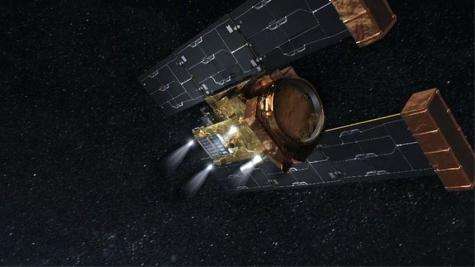
On March 24, at about 4 p.m. PDT, four rocket motors on NASA's Stardust spacecraft, illustrated in this artist's concept, are scheduled to fire until the spacecraft's fuel is depleted. Credit: NASA/JPL-Caltech
(PhysOrg.com) -- On Thursday, March 24 at about 4 p.m. PDT (7 p.m. EDT), NASA's Stardust spacecraft will perform a final burn with its main engines.
At first glance, the burn is something of an insignificant event. After all, the venerable spacecraft has executed 40 major flight path maneuvers since its 1999 launch, and between these main engines and the reaction control system, its rocket motors have collectively fired more than 2 million times. But the March 24 burn will be different from all others. This burn will effectively end the life of NASA's most traveled comet hunter.
"We call it a 'burn to depletion,' and that is pretty much what we're doing firing our rockets until there is nothing left in the tank," said Stardust-NExT project manager Tim Larson of NASA's Jet Propulsion Laboratory in Pasadena, Calif. "It's a unique way for an interplanetary spacecraft to go out. Essentially, Stardust will be providing us useful information to the very end."
Burn to depletion will answer the question about how much fuel Stardust had left in its tank.
"We'll take those data and compare them to what our estimates told us was left," said Allan Cheuvront, Lockheed Martin Space Systems program manager for Stardust-NExT. "That will give us a better idea how valid our fuel consumption models are and make our predictions even more accurate for future missions."
Fuel consumption models are necessary because no one has invented an entirely reliable fuel gauge for spacecraft. Until that day arrives, mission planners can approximate fuel usage by looking at the history of the vehicle's flight and how many times and for how long its rocket motors have fired.
Stardust's burn to depletion is expected to impart valuable information, because the spacecraft has essentially been running on borrowed time -- for some time. Launched on Feb. 7, 1999, Stardust had already flown past an asteroid (Annefrank), flown past and collected particle samples from a comet (Wild 2), and returned those particles to Earth in a sample return capsule in January 2006 and in so doing racked up 4.63 billion kilometers (2.88 billion miles) on its odometer. NASA then re-tasked the still-healthy spacecraft to perform a flyby of comet Tempel 1, a new, low-cost mission that required another five years and 1.04 billion kilometers (646 million miles). After all those milestones and all that time logged on the spacecraft, the Stardust team knew the end was near. They just didn't know exactly how close.
Prior to this final burn, Stardust will point its medium-gain antenna at Earth some 312 million kilometers (194 million miles) away. As there is no tomorrow for Stardust, the spacecraft is expected to downlink information on the burn as it happens. The command from the spacecraft computer ordering the rockets to fire will be sent for 45 minutes, but the burn is expected to last only between a couple of minutes to somewhat above 10 minutes. It is estimated the burn could accelerate the spacecraft anywhere from 2.5 to 35.2 meters per second (6 to 79 mph). ?
"What we think will happen is that when the fuel reaches a critically low level, gaseous helium will enter the thruster chambers," said Larson. "The resulting thrust will be less than 10 percent of what was expected. While Stardust will continue to command its rocket engines to fire until the pre-planned firing time of 45 minutes has elapsed, the burn is essentially over."
Twenty minutes after the engines run dry, the spacecraft's computer will command its transmitters off. They actively shut off their radios to preclude the remote chance that at some point down the road Stardust's transmitter could turn on and broadcast on a frequency being used by other operational spacecraft. Turning off the transmitter ensures that there will be no unintended radio interference in the future.
Without fuel to power the spacecraft's attitude control system, Stardust's solar panels will not remain pointed at the sun. When this occurs, the spacecraft's batteries are expected to drain of power and deplete within hours.
"When we take into account all the possibilities for how long the burn could be and then the possible post-burn trajectories, we project that over the next 100 years, Stardust will not get any closer than 1.7 million miles of Earth's orbit, or within 13 million miles of Mars orbit," said Larson. "That is far enough from protected targets to meet all of NASA's Planetary Protection directives. "
Some planetary spacecraft, like the Galileo mission to Jupiter, are intentionally sent into the planet's atmosphere to make sure it is destroyed in a controlled way. Others have their transmitters shut off or just fade away, said Larson. "I think this is a fitting end for Stardust. It's going down swinging."
Stardust-NExT is a low-cost mission to expand the investigation of comet Tempel 1 initiated by NASA's Deep Impact spacecraft.
More information: Use this link to experience Stardust's final hour before decommissioning, then use Eyes on the Solar System to relieve the entire mission from 1999 to 2011: http://go.usa.gov/2ry . A free software download is required.
Provided by
JPL/NASA
-
From lemons to lemonade: Reaction uses carbon dioxide to make carbon-based semiconductor,
32 comments
-
Thioridazine kills cancer stem cells in human while avoiding toxic side-effects of conventional cancer treatments,
3 comments
-
SpaceX private rocket blasts off for space station (Update),
42 comments
-
Climate scientists say they have solved riddle of rising sea,
30 comments
-
Research team claims to have found evidence Lake Cheko is impact crater for Tunguska Event,
18 comments
-
revamping general concept and cosmological principle
May 25, 2012
-
Transiting Exoplanet Light Curve
May 25, 2012
-
Math behind Theoretical Physics
May 24, 2012
-
Do we know whats at the center of galaxies yet?
May 23, 2012
-
Structure of the Milky Way?
May 20, 2012
-
What would it take to terraform Pluto and Charon?
May 19, 2012
- More from Physics Forums - General Astronomy
More news stories
SpaceX capsule has 'new car' smell, astronauts say (Update)
SpaceX's Dragon cargo vessel smells like a new car, said astronauts at the International Space Station after opening the hatches Saturday following the spacecraft's landmark mission to the orbiting lab.
Space & Earth / Space Exploration
16 hours ago |
4.5 / 5 (19) |
0
Astronomers seize last chance in lifetime for Venus Transit
Astronomers are gearing for one the rarest events in the Solar System: an alignment of Earth, Venus and the Sun that will not be seen for another 105 years.
16 hours ago |
5 / 5 (2) |
2
Australia hails surprise super-telescope decision
Australia has hailed a surprise decision giving it a role in a radio telescope project aimed at revolutionising astronomy, vowing to draw on its decades of experience in space science.
16 hours ago |
5 / 5 (4) |
1
Astronauts enter world's 1st private supply ship
(AP) -- Space station astronauts floated into the Dragon on Saturday, a day after its heralded arrival as the world's first commercial supply ship.
Space & Earth / Space Exploration
16 hours ago |
5 / 5 (5) |
0
Dragon arrives at space station in historic 1st (Update 2)
The privately bankrolled Dragon capsule made a historic arrival at the International Space Station on Friday, triumphantly captured by astronauts wielding a giant robot arm.
Space & Earth / Space Exploration
May 25, 2012 |
5 / 5 (10) |
19
Dell tablet leak: 10.1-inch display, two-battery choice
(Phys.org) -- Headline after headline talks about vendors tablets in the wings as likely number-one contenders for the iPad. Such claims have justifiably been taken with a grain of salt, considering ...
Scientist: Evolution debate will soon be history
(AP) -- Richard Leakey predicts skepticism over evolution will soon be history. Not that the avowed atheist has any doubts himself.
SpotterRF debuts Radar Backpack Kit (w/ Video)
(Phys.org) -- SpotterRF has announced a special radar backpack kit designed to enhance situational awareness for soldiers on the ground. The company says its special radar is designed for warfighters as part ...
Keep food safety in mind this memorial day weekend
(HealthDay) -- Picnics, parades and cookouts are as much a part of Memorial Day weekend as tributes to the United States' war veterans.
Thousands of shellfish found dead in Peru
Thousands of crustaceans were found dead off the coast of Lima following the mystery mass death of dolphins and pelicans, the Peruvian Navy said Friday.
Family history of Alzheimer's affects functional connectivity
(HealthDay) -- Cognitively normal individuals with a family history of late-onset Alzheimer's disease (AD) may display lower resting state functional connectivity in the default mode network (DMN) of the brain, ...
Mar 24, 2011
Rank: 1 / 5 (4)
-um, you guys ever think of installing a meter?
This is crazy, the thing is already out there. KEEP USING IT.
Mar 24, 2011
Rank: 2.3 / 5 (3)
Mar 25, 2011
Rank: 5 / 5 (1)
Mar 25, 2011
Rank: 5 / 5 (2)
That's the whole point. No such meter gas ever been devised, at least not an accurate one. That's what they're trying to refine with this operation.
There isn't enough fuel to do any of that - they said it was on borrowed time as it was. They're trying to refine the fuel consumption calculation by doing this (likely short) burn and to do that, they have to have the comms antenna pointed at Earth. This limits what can be done that's of any other use.
Given that the spacecraft has already performed way over and above its original mission plan, I think this is a good final farewell task.
Mar 25, 2011
Rank: 5 / 5 (1)
"Just prior to the burn, Stardust will turn its medium gain antenna towards Earth and transmit the final telemetry in real time."
"Stardust is being commanded to fire the thrusters for 45 minutes but the team expects that there is only enough fuel to actually fire for up to perhaps around ten minutes."
"With no more fuel available, the probe cannot maintain attitude control, power its solar array or point its antenna. And its far enough away from any targets that there are no issues related to planetary protection requirements."
"As its final act, the transmitters will be turned off (to prevent accidental transmissions to other spacecraft), all communications will cease and that will be the end of Stardusts life."
UT story: http://www.univer...re-83433
(Also new imagery from the Tempel 1 flyby!)