Mapping Japan's changed landscape from space
March 17, 2011

Mapping Japan's changed landscape from space

Enlarge

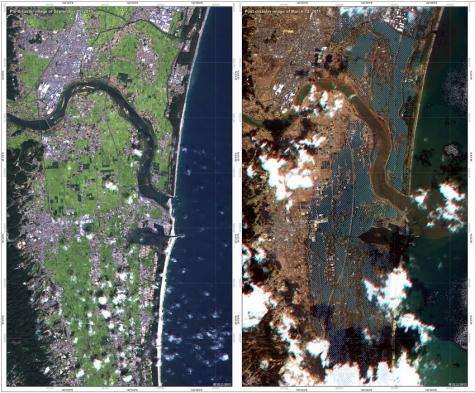
The images were acquired by the German Optical RapidEye and radar TerraSAR-X satellites. They show Torinoumi on the eastern coast of Japan before the disaster on 5 September 2010 and after the tsunami on 12 March 2011. The German Aerospace Center, DLR, is responding to the disaster through its Center for Satellite Based Crisis Information, ZKI, to provide information for the International Charter. Credits: RapidEye AG, DLR, Google Earth. Map produced by ZKI

Following the massive earthquake and tsunami that hit Japan on 11 March, satellite imagery has been vital in providing a clear picture of the extent of devastation to aid the relief effort now underway.

In response to this event, which turned out to be the biggest earthquake has suffered in living memory, the International Charter 'Space and Major Disasters' was triggered by the Cabinet Office of Japan the same day the struck.

As a result, satellite images from several space agencies and operators from around the world are being used to map and assess the stricken areas.

Founded 10 years ago, the International Charter is a unique mechanism to ensure that timely satellite images are made freely available to authorities and aid workers coping with the aftermath of a disaster.
Mapping Japan's changed landscape from space
Enlarge

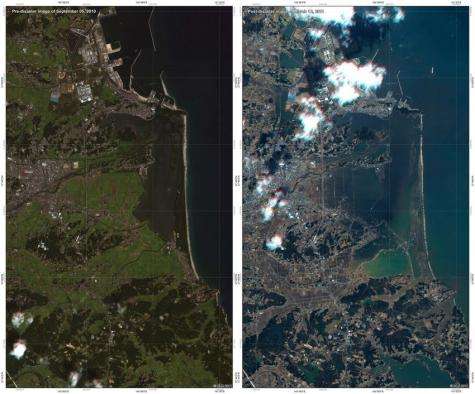
The map shows a comparison of RapidEye pre-disaster data acquired on 5 September 2010 and post-disaster data acquired on 12 March 2011. The images focus on the city of Soma and the surrounding region, which was badly affected by the tsunami. Credits: RapidEye AG, DLR, Google Earth. Map produced by ZKI

By combining Earth observation data from different space agencies, the Charter allows resources and expertise from around the world to be coordinated for rapid response to major disasters.

The value of the initiative lies in the way it has been set up to gather and coordinate a range of different , turn them into usable products and provide a single access point to the products 24 hours a day, 7 days a week, and at no cost to the user.

Demonstrating the incredible power that Earth can unleash, the devastation caused by the 8.9-magnitude quake has left the world stunned.

Japan's northwestern coastline is thought to have shifted by as much as 4 m to the east and whole towns have been washed away by the tsunami, completely changing the landscape.

Satellite maps are providing essential information for search and rescue teams on the ground and for damage assessment. Before-and-after images show how the land has changed and where buildings and roads once stood.

Work is being coordinated by the Japan Aerospace Exploration Agency, JAXA, and the Asian Institute of Technology. Data are being used from a wide range of satellites such as Germany’s TerraSAR-X and RapidEye, France’s SPOT-5 and ESA's Envisat along with high-resolution optical imagery from US satellites.

Over 63 satellite acquisitions were made in the first 48 hours following the event. These are being used by relief teams and decision-makers responding to the disaster.

A large collaboration is at work to exploit data offering value-adding analysis with specialist centres from France (Sertit), Germany (DLR-ZKI) and the United Nations (UNITAR/UNOSAT), while JAXA provide dedicated mapping service to the Japanese authorities.

Over the coming weeks, access to updated satellite products will prove essential for continued crisis response and also to start precise damage assessment for recovery, rehabilitation and reconstruction.

Satellite data will also be used to help further our understanding of these geological threats and ultimately help with future warning systems.

Japan lies on the infamous Ring of Fire, an active zone that almost encircles the Pacific Rim. As such, Japan is listed as a 'supersite', an area known to be at high risk of seismic events.

The Geo-Hazard Supersites initiative, coordinated by the Group on Earth Observations, is exploiting 20 years of satellite radar observations to further our understanding of geological risk.

The aim is to exploit interferometric processing to provide very precise terrain deformation mapping before and during a seismic event to improve our understanding of the tectonic phenomena in Japan.

As another example of different space agencies working together, the initiative promotes research into geohazards by providing the worldwide scientific community with easy access to a full spectrum of datasets.

Provided by European Space Agency search and more info website

2.3 /5 (3 votes)  

Filter


Move the slider to adjust rank threshold, so that you can hide some of the comments.


Display comments: newest first

rwinners
Mar 17, 2011

Rank: not rated yet
Amazing change.
neiorah
Mar 18, 2011

Rank: not rated yet
It mostly looks like the area is flooded instead of moved if you look at it closely. The water has not drained out or the land the water covered is lower than it was before but it does not look like Japan moved to the left.
Mandan
Mar 18, 2011

Rank: 5 / 5 (1)
It mostly looks like the area is flooded instead of moved if you look at it closely. The water has not drained out or the land the water covered is lower than it was before but it does not look like Japan moved to the left.


Of course, "to the left" would be west, as the tsunami hit the east coast of Japan, and therefore east would be to the right. And if you think you could dispute a 4m "shift" with your naked eye from a satelite photo you're delusional.

Anyway, the shift to the east spoken of here is a deep tectonic shift, at the northwest coast and moving Japan east relative to Korea, not a mere shift on the surface caused by the tsunami flowing over the land and affecting topography.
Rank 2.3 /5 (3 votes)
Relevant PhysicsForums posts

More news stories

SpaceX capsule has 'new car' smell, astronauts say (Update)

SpaceX's Dragon cargo vessel smells like a new car, said astronauts at the International Space Station after opening the hatches Saturday following the spacecraft's landmark mission to the orbiting lab.

Space & Earth / Space Exploration

created 17 hours ago | popularity 4.5 / 5 (20) | comments 0

Astronomers seize last chance in lifetime for Venus Transit

Astronomers are gearing for one the rarest events in the Solar System: an alignment of Earth, Venus and the Sun that will not be seen for another 105 years.

Space & Earth / Astronomy

created 17 hours ago | popularity 5 / 5 (3) | comments 2

Australia hails surprise super-telescope decision

Australia has hailed a surprise decision giving it a role in a radio telescope project aimed at revolutionising astronomy, vowing to draw on its decades of experience in space science.

Space & Earth / Astronomy

created 17 hours ago | popularity 5 / 5 (4) | comments 1

Astronauts enter world's 1st private supply ship

(AP) -- Space station astronauts floated into the Dragon on Saturday, a day after its heralded arrival as the world's first commercial supply ship.

Space & Earth / Space Exploration

created 17 hours ago | popularity 5 / 5 (5) | comments 0

Dragon arrives at space station in historic 1st (Update 2)

The privately bankrolled Dragon capsule made a historic arrival at the International Space Station on Friday, triumphantly captured by astronauts wielding a giant robot arm.

Space & Earth / Space Exploration

created May 25, 2012 | popularity 5 / 5 (10) | comments 19


Scientist: Evolution debate will soon be history

(AP) -- Richard Leakey predicts skepticism over evolution will soon be history. Not that the avowed atheist has any doubts himself.

Dell tablet leak: 10.1-inch display, two-battery choice

(Phys.org) -- Headline after headline talks about vendors’ tablets in the wings as likely number-one contenders for the iPad. Such claims have justifiably been taken with a grain of salt, considering ...

SpotterRF debuts Radar Backpack Kit (w/ Video)

(Phys.org) -- SpotterRF has announced a special radar backpack kit designed to enhance situational awareness for soldiers on the ground. The company says its special radar is designed for warfighters as part ...

Thousands of shellfish found dead in Peru

Thousands of crustaceans were found dead off the coast of Lima following the mystery mass death of dolphins and pelicans, the Peruvian Navy said Friday.

Keep food safety in mind this memorial day weekend

(HealthDay) -- Picnics, parades and cookouts are as much a part of Memorial Day weekend as tributes to the United States' war veterans.

Family history of Alzheimer's affects functional connectivity

(HealthDay) -- Cognitively normal individuals with a family history of late-onset Alzheimer's disease (AD) may display lower resting state functional connectivity in the default mode network (DMN) of the brain, ...