Japan brings artificial intelligence to rockets
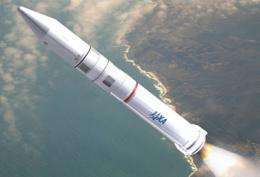
Mar 28, 2011 by Deborah Braconnier report
Image credit: JAXA

(PhysOrg.com) -- In order to look at trimming costs when it comes to rockets, researchers in Japan are looking to create a ‘smart’ rocket. With the use of artificial intelligence, they hope to create a rocket that can diagnose, and in some cases even repair, its own system malfunctions.

As the project manager for the current Epsilon launch and a professor at the Institute of Space and Astronautical Science at , Yasuhiro Morita is leading the push for the artificially intelligent rockets.

Current rockets are equipped with onboard sensors, but these do nothing more than make ground control aware of the problems the rocket may be experiencing. Similar to an automobile’s check engine light, this does nothing more than give an alert to a problem. The goal of artificial intelligence use in rockets will be to not only identify a problem, but to provide solutions and, when possible, fix the problem onboard.

The new Epsilon rocket hopes to use some basic artificial intelligence in its proposed maiden voyage in 2013. The idea being that Epsilon’s sensors will function much like a brain, diagnosing the problem and cause of a malfunction, and implementing a possible solution.

In an example, researchers discuss the electrical currents that work to control a rocket’s main thrusters. These thrusters control the rockets direction, and should there be an electrical surge, the rocket is moved off course. The new Epsilon rocket would be able to protect against these surges, or in the case of a surge, correct for it and maintain the ’s course.

The ability for these ‘smart’ rockets to perform their own tests and needed maintenance also opens the ability to cut current costs and manpower needed to operate a ground control team. Current mission control teams are composed of dozens of people in a large facility. The hope is that by using artificial intelligence and electronic communication, the mission control teams could be reduced to just a handful of people operating on laptops and not the current large computers used.

With many people concerned with the idea of artificially intelligent rockets controlling themselves, ’s researchers are taking the addition of slowly. The idea of possible rockets which are able to control their own guidance and complete flight performance will not be looked at for several years into the program.

Explore further: Field tests in Mojave Desert pave way for human exploration of small bodies

More information: www.jaxa.jp/projects/rockets/epsilon/index_e.html
via Space.com

Related Stories

China to build new rocket series

Oct 31, 2007

China, encouraged by its first lunar orbiter launch, plans to build a new series of bigger rockets to carry heavier satellites, it was reported Wednesday.

NASA to begin developing Ares rockets

Dec 17, 2007

The U.S. space agency said it will begin testing core rocket engine components from the Apollo era this month to help build the Ares rocket.

JOULE II rockets launch with success

Jan 22, 2007

From Poker Flat Research Range north of Fairbanks, four NASA rockets launched into an aurora display over northern Alaska, starting at 3:29 a.m. Alaska Standard Time. Scientists hope to learn more about electrical heating ...

Busy rocket season to launch at Poker Flat Research Range

Jan 12, 2009

A total of eight National Aeronautics and Space Administration sounding rockets will launch from Poker Flat Research Range in 2009. The rocket season is split into two launch windows. The first launch window opens Jan. 10, ...

Recommended for you

Mars rover Opportunity examines clay clues in rock

3 hours ago

(Phys.org) —NASA's senior Mars rover, Opportunity, is driving to a new study area after a dramatic finish to 20 months on "Cape York" with examination of a rock intensely altered by water.

NASA's STEREO detects a CME from the sun

16 hours ago

On 5:24 a.m. EDT on May 17, 2013, the sun erupted with an Earth-directed coronal mass ejection or CME, a solar phenomenon that can send billions of tons of solar particles into space that can reach Earth ...

Nine-year-old Mars rover passes 40-year-old record

May 17, 2013

While Apollo 17 astronauts Eugene Cernan and Harrison Schmitt visited Earth's moon for three days in December 1972, they drove their mission's Lunar Roving Vehicle 19.3 nautical miles (22.210 statute miles ...

Bright explosion on the Moon

May 17, 2013

For the past 8 years, NASA astronomers have been monitoring the Moon for signs of explosions caused by meteoroids hitting the lunar surface. "Lunar meteor showers" have turned out to be more common than anyone ...

User comments : 4

Adjust slider to filter visible comments by rank

Display comments: newest first

soulman
5 / 5 (2) Mar 29, 2011
Hmmm, given the number of glitches and problems JAXA has, and is, having, it would do well to steer away from fuzzy AI systems. Get the basics right and reliable before adding additional unproven complexity.

By coincidence, yesterday I watched the Voyager episode Dreadnought...
plasticpower
5 / 5 (2) Mar 29, 2011
Hmmm, given the number of glitches and problems JAXA has, and is, having, it would do well to steer away from fuzzy AI systems. Get the basics right and reliable before adding additional unproven complexity.


Or if they REALLY want to implement this, slap it on a proven and reliable booster like whatever it is the Russians use or one of the Delta rockets.
GSwift7
not rated yet Mar 29, 2011
The hope is that by using artificial intelligence and electronic communication, the mission control teams could be reduced to just a handful of people operating on laptops and not the current large computers used


Yeah, brilliant. In stead of keeping all the computer equipment on the ground, where it can be used many times with zero risk, let's place a complex computer in each rocket. This is a good example of somebody with zero critical thinking skills. If this guy has a budget, I'm scared. If we're lucky, maybe we can tripple the cost of each launch!! Now we're talking like a government agency! Spend baby spend.
thematrix606
not rated yet Apr 06, 2011
Someone forgot the NOT in "do bomb civilians"...

/sarc

More news stories

Alaska volcano shoots ash 15,000 feet into the air

(AP)—One of Alaska's most restless volcanoes has shot an ash cloud 15,000 feet into the air in an ongoing eruption that has drawn attention from a nearby community but isn't expected to threaten air traffic.

Chinese, Indian airlines face EU pollution fines

Eight Chinese and two Indian airlines face fines of up to several million euros for not paying for their greenhouse gas emissions during flights within the bloc, the European Commission said on Friday.

US seizes Bitcoin operator accounts

US authorities seized the accounts of a Bitcoin digital currency exchange operator, claiming it was functioning as an "unlicensed money service business," court documents showed Friday.

Temporal processing in the olfactory system

The neural machinery underlying our olfactory sense continues to be an enigma for neuroscience. A recent review in Neuron seeks to expand traditional ideas about how neurons in the olfactory bulb might encode information about ...