An Exoplanet with a Potassium-Rich Atmosphere
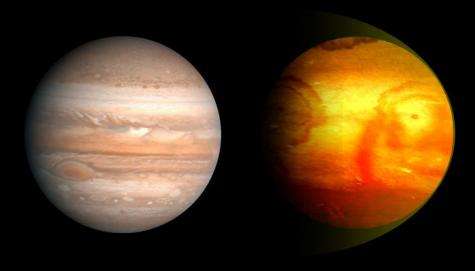
An image of Jupiter next to a artist's conception of the exoplanet XO-2b. Scientists have discovered that the atmosphere of XO-2b contains potassium. Credit: Ignacio González Tapia
(PhysOrg.com) -- A hot Jupiter - a type of celestial object unknown only fifteen years ago - is a Jupiter-sized exoplanet orbiting so close to its host star that its atmospheric temperature is thought to be hundreds of degrees Celsius.
When a hot Jupiter is seen in a transiting system, its passage across the face of the star provides an opportunity to study its atmosphere, as light from the star passes through the thin layer on route to Earth.
The atmospheres of two hot Jupiters have been studied so far, with sodium (but only sodium) detected.
The constituents and their properties are interesting in and of themselves, and also shed light on global parameters of the planet such as atmospheric circulation, thermal inversion layers, and the possible presence of clouds.
CfA astronomer Jean-Michel Desert has teamed up with ten colleagues to use the 10.4-meter telescope in the Canary Islands to study the atmospheres of transiting hot Jupiters.
The astronomers have just announced their results on the object known as XO-2b, a hot Jupiter whose radius is the same as Jupiter's, whose mass is about half, and which orbits its star in only 2.6 days.
They discovered that the atmosphere contains potassium, one of the elements that had been predicted to exist in current models but which had not been seen in the other two cases.
The new results help to substantiate and improve the current theory of exoplanetary atmospheres, and illustrate the dramatic advances underway in detecting and modeling the atmospheres around strange distant worlds that were unknown not long ago.
Provided by
Harvard-Smithsonian Center for Astrophysics
-
From lemons to lemonade: Reaction uses carbon dioxide to make carbon-based semiconductor,
32 comments
-
Thioridazine kills cancer stem cells in human while avoiding toxic side-effects of conventional cancer treatments,
3 comments
-
SpaceX private rocket blasts off for space station (Update),
42 comments
-
Climate scientists say they have solved riddle of rising sea,
30 comments
-
Research team claims to have found evidence Lake Cheko is impact crater for Tunguska Event,
18 comments
-
revamping general concept and cosmological principle
May 25, 2012
-
Transiting Exoplanet Light Curve
May 25, 2012
-
Math behind Theoretical Physics
May 24, 2012
-
Do we know whats at the center of galaxies yet?
May 23, 2012
-
Structure of the Milky Way?
May 20, 2012
-
What would it take to terraform Pluto and Charon?
May 19, 2012
- More from Physics Forums - General Astronomy
More news stories
SpaceX capsule has 'new car' smell, astronauts say (Update)
SpaceX's Dragon cargo vessel smells like a new car, said astronauts at the International Space Station after opening the hatches Saturday following the spacecraft's landmark mission to the orbiting lab.
Space & Earth / Space Exploration
15 hours ago |
4.5 / 5 (19) |
0
Australia hails surprise super-telescope decision
Australia has hailed a surprise decision giving it a role in a radio telescope project aimed at revolutionising astronomy, vowing to draw on its decades of experience in space science.
15 hours ago |
5 / 5 (3) |
1
Astronomers seize last chance in lifetime for Venus Transit
Astronomers are gearing for one the rarest events in the Solar System: an alignment of Earth, Venus and the Sun that will not be seen for another 105 years.
15 hours ago |
5 / 5 (1) |
1
Astronauts enter world's 1st private supply ship
(AP) -- Space station astronauts floated into the Dragon on Saturday, a day after its heralded arrival as the world's first commercial supply ship.
Space & Earth / Space Exploration
15 hours ago |
5 / 5 (5) |
0
Dragon arrives at space station in historic 1st (Update 2)
The privately bankrolled Dragon capsule made a historic arrival at the International Space Station on Friday, triumphantly captured by astronauts wielding a giant robot arm.
Space & Earth / Space Exploration
May 25, 2012 |
5 / 5 (10) |
19
Dell tablet leak: 10.1-inch display, two-battery choice
(Phys.org) -- Headline after headline talks about vendors tablets in the wings as likely number-one contenders for the iPad. Such claims have justifiably been taken with a grain of salt, considering ...
Scientist: Evolution debate will soon be history
(AP) -- Richard Leakey predicts skepticism over evolution will soon be history. Not that the avowed atheist has any doubts himself.
SpotterRF debuts Radar Backpack Kit (w/ Video)
(Phys.org) -- SpotterRF has announced a special radar backpack kit designed to enhance situational awareness for soldiers on the ground. The company says its special radar is designed for warfighters as part ...
Thousands of shellfish found dead in Peru
Thousands of crustaceans were found dead off the coast of Lima following the mystery mass death of dolphins and pelicans, the Peruvian Navy said Friday.
Keep food safety in mind this memorial day weekend
(HealthDay) -- Picnics, parades and cookouts are as much a part of Memorial Day weekend as tributes to the United States' war veterans.
Family history of Alzheimer's affects functional connectivity
(HealthDay) -- Cognitively normal individuals with a family history of late-onset Alzheimer's disease (AD) may display lower resting state functional connectivity in the default mode network (DMN) of the brain, ...
Mar 05, 2011
Rank: 1.7 / 5 (3)
Potassium [K, element #19] is not an abundant element.
In 1917 Harkins* reported that seven elements with even atomic numbers (Fe, O, Ni, Si, Mg, S and Ca) comprise 99% of the material in ordinary meteorites.
He correctly concluded ... in the evolution of elements much more material has gone into the even-numbered elements than into those which are odd... [Harkins, p. 869].
*Harkins, W. D. The evolution of the elements and the stability of complex atoms, Journal of the American Chemical Society, vol. 39, 1917, pp. 856-879.
With kind regards,
Oliver K. Manuel
Former NASA Principal
Investigator for Apollo
Mar 07, 2011
Rank: not rated yet
Mar 08, 2011
Rank: 1 / 5 (2)
Yes, He-fusion produced C-12, O-16, Ne-20, Mg-24, Si-28, S-32, Ar-36 etc.
These elements with even atomic numbers (6, 8, 10, 12, 14, 16, 18) generally have greater nuclear stability and more isotopes than elements with odd atomic number (e.g., 7, 9, 11, 13, 15 and 17) for N, F, Na, Al, P, and Cl.
This subject is discussed in more detail here [1,2]:
1. "Why the model of a a Hydrogen-filled Sun is obsolete"
arxiv.org/pdf/astro-ph/0410569v1
2. "Neutron Repulsion," The APEIRON Journal in press (2011), 19 pages
arxiv.org/pdf/1102.1499v1