Bid to ban cloned foods in Europe collapses
Mar 29, 2011 by Laurent Thomet
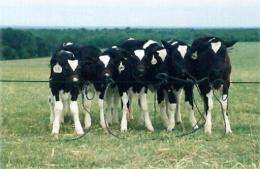
Handout photo of six cows produced through cloning by US researchers at Advanced Cell Technology in Worcester, Massachusetts. An effort to ban cloned foods from reaching supermarket shelves in Europe collapsed on Tuesday after EU states and the parliament failed to agree a law to control the industry.

An effort to ban cloned foods from supermarket shelves in Europe collapsed on Tuesday after EU states and the parliament failed to agree a law to control the industry.

Although both sides agree on banning meat directly derived from cloned animals, government officials and Euro MPs clashed over regulating foods produced from the offspring of clones.

Hungary, chair of the rotating European Union presidency, accused MPs of "political grandstanding" after a 12-hour round of all-night talks broke down without agreement, sending the rules back to the drawing board.

Parliament members wanted strict labels to be slapped on meat from offspring of clones, but the two sides were unable to agree on labelling all foods, with governments only willing to put them on fresh beef.

EU states argue that the labelling proposal was unrealistic and would lead to a "full-blown trade war" with nations that produce clone-derived meat and , such as Argentina, Brazil or the United States.

Hungarian rural development minister Sandor Fazekas said the parliament proposal was a "misleading, unfeasible 'solution' that in practice would have required drawing a family tree for each slice of cheese or salami."

It could take "several years" for the EU's executive Commission to come up with a new proposal, the Hungarian presidency said.

The breakdown effectively leaves in place 14-year-old rules that do not prevent the sale of food from clones.

"It is deeply frustrating that (the European) Council (of governments) would not listen to public opinion and support urgently needed measures to protect consumer and interests," Euro MPs said in a statement.

"We made a huge effort to compromise but we were not willing to betray consumers on their right to know whether food comes from animals bred using clones," said lawmakers Gianni Pittella and Kartika Liotard.

"Since European is overwhelmingly against for food, a commitment to label all food products from cloned offspring is a bare minimum."
Cows file in to be milked at a farm in rural France. An effort to ban cloned foods from reaching supermarket shelves in Europe collapsed on Tuesday after EU states and the parliament failed to agree a law to control the industry.

Euro MPs originally wanted a total ban on food from the offspring of clones, but they later proposed a labelling system to show consumers the animal's history.

French Euro MP Corine Lepage said some states, including Britain, were willing to allow a breakdown in talks "because it is in their interest to be able to import cloned semen without any controls."

The European consumers group BEUC said the failure to reach an agreement was "shameful."

"The choice made by Europeans is clear: they do not want cloning to be used for food production, and they were clearly ignored," said BEUC director general Monique Goyens.

European health commissioner John Dalli, who had presented the so-called "novel foods" regulation, said the negotiations breakdown was a "pity" and that he would "reflect on the disappointing outcome in view of assessing the next steps."

Asked whether he would eat cloned meat, Dalli said scientific assessments on cattle found "absolutely no risk to health as there is no differentiation at all between cloned animals and normally-bred animals."

"Yes, I would eat cloned meat," he said.

Explore further: 'Whodunnit' of Irish potato famine solved

add to favorites email to friend print save as pdf

Related Stories

No cloned steaks on EU plates

Oct 19, 2010

The European Union on Tuesday announced plans for a five-year ban on animal cloning for food production as well as a traceability system for imports of semen and embryos of clones.

EU committee rejects clone food plan

May 04, 2010

An EU parliamentary committee on Tuesday rejected a controversial proposal to allow food from cloned animals and their offspring onto the European market.

Food agency probes cloned cow milk claim

Aug 02, 2010

Food safety officials in Britain are to investigate a claim that milk from the offspring of a cloned cow was on sale for public consumption, they said Monday.

Recommended for you

'Whodunnit' of Irish potato famine solved

4 hours ago

An international team of scientists reveals that a unique strain of potato blight they call HERB-1 triggered the Irish potato famine of the mid-19th century.

Engineered microbes grow in the dark

May 20, 2013

Scientists at the University of California, Davis have engineered a strain of photosynthetic cyanobacteria to grow without the need for light. They report their findings today at the 113th General Meeting of the American ...

Turning up the heat on biofuels

May 16, 2013

(Phys.org) —The production of biofuels from lignocellulosic biomass would benefit on several levels if carried out at temperatures between 65 and 70 degrees Celsius. Researchers with the Energy Biosciences ...

User comments : 4

Adjust slider to filter visible comments by rank

Display comments: newest first

_ilbud
2.3 / 5 (3) Mar 29, 2011
Let the lesser peoples of the Americas eat synthetic garbage laced with chemicals. It's what the like and what they're used to. EU citizens (apart from the UK) prefer their food untainted. Perhaps in a few decades when studies on the test subjects can be made it might be possible to allow some cloning and some EU GMO products. Certainly Monsanto should be banned. The clear side effects of High Fructose Corn Syrup are a perfect example of the problems with "unnatural" food.
Djincss
not rated yet Mar 29, 2011
"It is deeply frustrating that (the European) Council (of governments) would not listen to public opinion and support urgently needed measures to protect consumer and animal welfare interests," Euro MPs said in a statement.

Some people lack basic logic and knowledge, nothing more I can say......
frajo
5 / 5 (2) Mar 30, 2011
Thus, consumers won't have freedom of choice anymore because the necessary information will be withheld.
Meat industries and their wilful helpers in politics don't need informed consumers. They only need their money.

Here we see Western "democracy" at work. Let's see how "undemocratic" countries like China handle this matter.

Let the lesser peoples of the Americas eat synthetic garbage laced with chemicals.
Generalized insults are of no help.
Better study American history in order to understand that US "democracy" is nothing else than a lackered form of plutocracy.
Egnite
not rated yet Mar 30, 2011
News like this makes organic, homegrown and hunted foodstuffs even more appealing.

I don't believe a country or continent can be labelled as unnatural food lovers, there are many people who prefer natural foods in all countries mentioned above. As you all know, a governments decision does not reflect it's peoples opinions/wishes.

More news stories

Child maltreatment increases risk of adult obesity

Children who have suffered maltreatment are 36% more likely to be obese in adulthood compared to non-maltreated children, according to a new study by King's College London. The authors estimate that the prevention or effective ...

New immune system discovered

(Medical Xpress)—A research team, led by Jeremy Barr, a biology post-doctoral fellow, unveils a new immune system that protects humans and animals from infection.

Lab sets a new record for creating heralded photons

(Phys.org) —Entanglement, by general consensus of physicists, is the weirdest part of quantum science. To say that two particles, A and B, are entangled means that they are actually two parts of an inseparable ...