Double strike to fight cancer
Mar 01, 2011

(PhysOrg.com) -- Diagnosis and treatment form the basis of modern medicine. Traditionally, they are two separate steps; however, it doesn’t have to be that way. The term “theranostic” refers to the combination of a diagnostic test with a specific treatment based on the result of the test. This integrated approach should be particularly helpful in providing more targeted treatment for cancer patients.

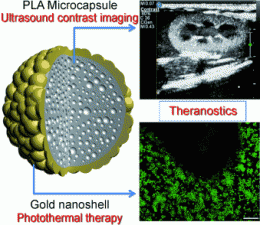
In the journal Angewandte Chemie, a research team headed by Zhifei Dai at the Harbin Institute of Technology (China) has now introduced a new theranostic agent that simultaneously serves as a contrast agent for ultrasound imaging and as a drug for the photothermic treatment of tumors.

Ultrasound imaging is a safe and inexpensive diagnostic tool that delivers images in real time. A probe sends out short, directional bursts of sound waves, which are reflected and diffracted differently in the different layers of tissue. Suitable , such as tiny gas bubbles, can significantly improve the sensitivity and resolution of the images.

The Chinese researchers wished to develop a new contrast agent that simultaneously acts as a drug for photothermic treatment. In this method of treatment, an agent, such as gold , is selectively introduced into a tumor, and this region is then irradiated. This causes the gold particles to become very hot, overheating the diseased tissue and causing it to die off. Gold nanostructures can be made to specifically absorb near-infrared light, a wavelength that can penetrate deep into tissues without causing damage.

For their new theranostic agent, the scientists used a biocompatible polymer to produce nanocapsules containing tiny drops of water. They coated the capsules with gold and removed the water through freeze-drying. This produced tiny air-filled cavities within the microcapsules. These are the contrast agent for the ultrasound; the gold shell acts as the photothermically activated drug.

In animal trials, the new multifunctional agent proved to be nontoxic and demonstrated very good contrast enhancement in ultrasound examinations. When cultures of tumor cells were treated with the microcapsules, the cells could be killed off through irradiation.

“With our new therapeutic contrast agent, we were able to locate the tumor by ultrasound imaging and determine its size,” explains Dai. “With real time monitoring, the tumor could then be irradiated, successful treatment confirmed, and healthy tissue protected.”

Explore further: Single-cell transfection tool enables added control for biological studies

More information: Zhifei Dai, Gold Nanoshelled Microcapsules Operate as Theranostic Agent for Ultrasound Contrast Imaging and Photothermal Therapy, Angewandte Chemie International Edition, dx.doi.org/10.1002/anie.201008286

Related Stories

Contrast Agent Trials in Swine

Oct 15, 2007

Mammography continues to be the method of choice for the early detection of breast cancer. However, because this technique is not as selective or specific as one would wish, and does not deliver reliable results for every ...

Better Insight into Brain Anatomical Structures

May 29, 2007

Magnetic resonance imaging is a very effective method for revealing anatomical details of soft tissues. Contrast agents can help to make these images even clearer and allow physiological processes to be followed in real time. ...

Better insight into brain anatomical structures

Jun 15, 2007

Magnetic resonance imaging is a very effective method for revealing anatomical details of soft tissues. Contrast agents can help to make these images even clearer and allow physiological processes to be followed in real time. ...

Gold Nanobeacons Detect Sentinel Lymph Nodes

Mar 25, 2010

(PhysOrg.com) -- Virtually every patient diagnosed with breast cancer or melanoma undergoes lymph node biopsy to determine if their cancer has begun spreading in the body. Taking this biopsy involves an invasive and uncomfortable ...

Multifunctional Nanoparticles Image and Treat Brain Tumors

Dec 04, 2006

Combining two promising approaches to diagnosing and treating cancer, a multidisciplinary research team at the University of Michigan has created a targeted multifunctional polymer nanoparticle that successfully images and ...

Recommended for you

Radioactive nanoparticles target cancer cells

19 hours ago

Cancers of all types become most deadly when they metastasize and spread tumors throughout the body. Once cancer has reached this stage, it becomes very difficult for doctors to locate and treat the numerous tumors that can ...

How gold nanoparticles can help fight ovarian cancer

20 hours ago

Positively charged gold nanoparticles are usually toxic to cells, but cancer cells somehow manage to avoid nanoparticle toxicity. Mayo Clinic researchers found out why, and determined how to make the nanoparticles effective ...

Advance in nanotech gene sequencing technique

May 20, 2013

(Phys.org) —The allure of personalized medicine has made new, more efficient ways of sequencing genes a top research priority. One promising technique involves reading DNA bases using changes in electrical ...

User comments : 0

More news stories

How gold nanoparticles can help fight ovarian cancer

Positively charged gold nanoparticles are usually toxic to cells, but cancer cells somehow manage to avoid nanoparticle toxicity. Mayo Clinic researchers found out why, and determined how to make the nanoparticles effective ...

Theorists weigh in on where to hunt dark matter

(Phys.org) —Now that it looks like the hunt for the Higgs boson is over, particles of dark matter are at the top of the physics "Most Wanted" list. Dozens of experiments have been searching for them, but ...

Coral reefs 'ruled by earthquakes and volcanoes'

(Phys.org) —Titanic forces in the Earth's crust explain why the abundance and richness of corals varies dramatically across the vast expanse of the Indian and Pacific Oceans, a world-first study from the ...

Coccoliths thrive despite ocean acidification

Ocean acidification is damaging some marine species while others thrive, say scientists. An international team studied the effect of ocean acidification on plankton in the North Sea over the past forty years, ...