Bones conjure Yellowstone's ecological ghosts
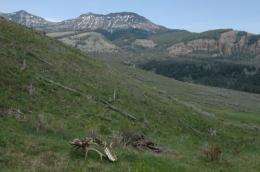
A partial elk carcass sits on a hillside of the Northern Range, Yellowstone National Park. Miller's research at Yellowstone demonstrates how bone surveys can provide valuable historical ecological data to evaluate modern biodiversity in a broader context. Credit: Joshua Miller
By taking a closer look at animal bones scattered across the wilderness landscape, a researcher at the University of Chicago has found a powerful tool for showing how species' populations have changed over decades or even a century.
"The skeletons of long-dead animals lying on landscapes provide critical insight into our understanding of ecosystem history, especially how populations have changed," said the study's author, University of Chicago alumnus Joshua H. Miller, S.M.'05, PhD'09, a postdoctoral research fellow in biological sciences at Wright State University in Dayton, Ohio.
The study, published in the March 28 issue of PLoS ONE, presents data that Miller collected for his UChicago doctoral dissertation. His study provides a deeper context for the many disturbances that are altering ecosystems around the world, including global warming, overharvesting and habitat destruction.
"These changes result in population reductions and extinctions of some species, while others expand and invade new habitats and regions," Miller explained. "Most ecosystems have not been studied over long time spans many decades at least which hampers the ability of wildlife managers and other scientists to properly document or mediate these dramatic ecological changes."
Surveying the bones of Yellowstone
In research funded by the National Science Foundation, Miller surveyed bones from the skeletons of hoofed mammals (ungulates) in Yellowstone National Park. The bones ranged in age from newly dead to approximately 200 years old.
Then he compared the numbers of specimens from each species documented in bones to surveys of the living populations.
Miller found that all the native species in the living community were recovered and that the order of species from most abundant to least abundant was similar for the bones and the living community. Species whose populations significantly diminished or expanded over the last 20 to 80 years were predictably over- or under-represented in the bones relative to the living community.
"Live elk were much more abundant in the 1990s than they are today," Miller said, "and the bones of Yellowstone feature far more elk than one would predict based on the current Yellowstone community."
Horses, which were replaced by cars as the dominant mode of transportation in Yellowstone in the early 1900s, also are readily found as skeletal remains. Radiocarbon dating confirmed that horse bones were generally remnants from when the cavalry controlled Yellowstone in the late 1800s to early 1900s.
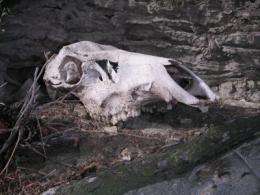
This elk skull and other remains recovered during Joshua Miller's study of Yellowstone National Park are revealing details about the region’s ecological history. Miller published his findings in the March 28 issue of PLoS ONE. Credit: Scott Rose
In contrast to these ghosts of larger past populations, species that have recently increased in abundance (bison and the recently arrived mountain goat) are less common in the skeletal record than current living populations would predict. Overall, the bones of Yellowstone correlate well with the area's historical ecosystem and provide more detailed information about the historical community than can be acquired from only studying the ecosystem today."Bones provide a great tool for uncovering historical ecological data that allow us to put modern biodiversity in a broader temporal context," Miller said. "The living populations of Yellowstone have been studied for a long time and provide a great opportunity to test how well bones record species' histories. Now we can go the next step and use bone accumulations in regions we have only recently begun studying to obtain critical historical data and establish how ecosystems have changed over the last decades, century or even longer."
Miller's research also suggests that the ecological information contained in the fossil record may provide more biological details on extinct ecosystems than previously thought.
"Josh has shown that the bones of Yellowstone accurately track recent and not-so-recent history of the large mammal populations in this famous North American ecosystem," said Kay Behrensmeyer, curator of vertebrate paleontology of the Smithsonian Institution's National Museum of Natural History. "This should be a wake-up call for ecologists interested in the movements, increases and declines of large mammal populations anywhere bones are a relatively untapped and valuable source of ecological data about animals when they were alive."
Provided by
University of Chicago
-
From lemons to lemonade: Reaction uses carbon dioxide to make carbon-based semiconductor,
32 comments
-
Thioridazine kills cancer stem cells in human while avoiding toxic side-effects of conventional cancer treatments,
3 comments
-
SpaceX private rocket blasts off for space station (Update),
42 comments
-
Climate scientists say they have solved riddle of rising sea,
30 comments
-
Research team claims to have found evidence Lake Cheko is impact crater for Tunguska Event,
18 comments
-
What would stain as translucent on light-coloured fabric?
7 hours ago
-
How do I identify different bacteria on culture plates?
17 hours ago
-
Why Do Dogs do Strange things...
May 25, 2012
-
What does exophillic and endophillic mean in terms of mosquito and their control?
May 24, 2012
-
Semen stains glows under black lights (uv light)?
May 23, 2012
-
Question on Human Chromosome 2
May 23, 2012
- More from Physics Forums - Biology
More news stories
Social welfare cuts ultimately come with heavy price, researchers say
(Phys.org) -- Slashing government funding for Medicaid, food stamps and other programs that serve the poor while politically popular with some lawmakers and many conservatives may do more harm ...
Other Sciences / Social Sciences
May 24, 2012 |
4.1 / 5 (14) |
123
Ancient Bethlehem seal unearthed in Jerusalem
Israeli archaeologists have discovered a 2,700-year-old seal that bears the inscription "Bethlehem," the Israel Antiquities Authority announced Wednesday, in what experts believe to be the oldest artifact ...
Other Sciences / Archaeology & Fossils
May 23, 2012 |
3.5 / 5 (14) |
23
Oldest Jewish archaeological evidence on the Iberian Peninsula
German archaeologists of the Friedrich Schiller University Jena found one of the oldest archaeological evidence so far of Jewish Culture on the Iberian Peninsula at an excavation site in the south of Portugal, ...
Other Sciences / Archaeology & Fossils
May 25, 2012 |
4.3 / 5 (4) |
12
Dollars and sense: Why are some people morally against tax?
As the U.S. presidential election campaigns heat up, the economic debate is dominated by bailouts, austerity and, inevitably, taxation. Now a new study published in Symbolic Interaction asks why tax is such an important issue ...
Other Sciences / Social Sciences
May 23, 2012 |
3 / 5 (2) |
12
Oldest art even older
New dates from Geißenklösterle Cave in Southwest Germany document the early arrival of modern humans and early appearance of art and music.
Other Sciences / Archaeology & Fossils
May 24, 2012 |
5 / 5 (2) |
6
Dell tablet leak: 10.1-inch display, two-battery choice
(Phys.org) -- Headline after headline talks about vendors tablets in the wings as likely number-one contenders for the iPad. Such claims have justifiably been taken with a grain of salt, considering ...
Scientist: Evolution debate will soon be history
(AP) -- Richard Leakey predicts skepticism over evolution will soon be history. Not that the avowed atheist has any doubts himself.
SpotterRF debuts Radar Backpack Kit (w/ Video)
(Phys.org) -- SpotterRF has announced a special radar backpack kit designed to enhance situational awareness for soldiers on the ground. The company says its special radar is designed for warfighters as part ...
SpaceX capsule has 'new car' smell, astronauts say (Update)
SpaceX's Dragon cargo vessel smells like a new car, said astronauts at the International Space Station after opening the hatches Saturday following the spacecraft's landmark mission to the orbiting lab.
Thousands of shellfish found dead in Peru
Thousands of crustaceans were found dead off the coast of Lima following the mystery mass death of dolphins and pelicans, the Peruvian Navy said Friday.
Keep food safety in mind this memorial day weekend
(HealthDay) -- Picnics, parades and cookouts are as much a part of Memorial Day weekend as tributes to the United States' war veterans.

Mar 29, 2011
Rank: 1 / 5 (3)
There's a small problem with this thought in that the bone distribution for modern animals differs radically from the bone distributions for fossils.
Fossils exist predominantly because of rapid burial during catastrophic environmental conditions which is very different from finding bones currently just lying around on hillsides and valleys. I do hope the researchers take this into account before making the extension of the theory from modern conditions to ancient fossil environments.
Mar 29, 2011
Rank: 5 / 5 (2)
I am sure they understand it much better than you do. Since you think the catastrophe was very recent Flood that never actually occurred.
Just when do you think that Flood occurred Kevin?
Ethelred