New Zealand quake region as seen by NASA spacecraft
February 25, 2011 By Alan Buis

New Zealand quake region as seen by NASA spacecraft

Enlarge

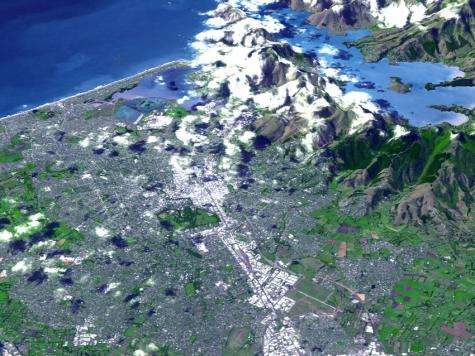
Perspective view of Christchurch, New Zealand, acquired Feb. 23, 2011 by the Advanced Spaceborne Thermal Emission and Reflection Radiometer (ASTER) instrument on NASA's Terra spacecraft. The image shows the city of 377,000 as well as the adjacent Banks Peninsula, location of the epicenter of the Feb. 22, 2011, magnitude 6.3 earthquake. Credit: NASA/GSFC/METI/ERSDAC/JAROS, and U.S./Japan ASTER Science Team

(PhysOrg.com) -- A day after a powerful magnitude 6.3 earthquake rocked Christchurch, a city of 377,000 on New Zealand's South Island, on Feb. 22, 2011, the Advanced Spaceborne Thermal Emission and Reflection Radiometer (ASTER) instrument on NASA's Terra spacecraft imaged the Christchurch region. The imaging was done at the request of the International Charter, Space and Major Disasters, which provides emergency satellite data to federal agencies in disaster-stricken regions.

Two images are presented here. The first is a perspective view showing the city of Christchurch and the Banks Peninsula at upper right, location of the quake's in Lyttelton. The Banks Peninsula is composed of two overlapping extinct volcanoes. The perspective view was created by draping the ASTER natural color image over the 3-D ASTER topographic data. The second image is a nadir view pointing straight down to the ground. The images cover an area of 19 by 26 kilometers (12 by 16 miles), and are located near 43.5 degrees south latitude, 172.6 degrees east longitude. The resolution of ASTER is not sufficient to spot damage to individual buildings.

The quake-the worst natural disaster to hit New Zealand in 80 years-struck at 12:51 p.m. local time on Feb. 22. It was centered in Lyttelton, just 10 kilometers (6.2 miles) southeast of Christchurch, at a shallow depth of just 5 kilometers (3.1 miles). It is considered to be part of the aftershock sequence of the much larger magnitude 7.0 earthquake of Sept. 4, 2010, which was centered 45 kilometers (30 miles) west of Christchurch. That quake, while larger, resulted in injuries and damage but no fatalities.

According to the U.S. Geological Survey, the Feb. 22 involved faulting at the eastern edge of the aftershock zone from the Sept. 2010 event. The earthquake is broadly associated with deformation occurring at the boundary of the Pacific and Australia .

Provided by JPL/NASA search and more info website

2.3 /5 (3 votes)  

Rank 2.3 /5 (3 votes)
Relevant PhysicsForums posts

More news stories

SpaceX capsule has 'new car' smell, astronauts say (Update)

SpaceX's Dragon cargo vessel smells like a new car, said astronauts at the International Space Station after opening the hatches Saturday following the spacecraft's landmark mission to the orbiting lab.

Space & Earth / Space Exploration

created 12 hours ago | popularity 4.6 / 5 (16) | comments 0

Australia hails surprise super-telescope decision

Australia has hailed a surprise decision giving it a role in a radio telescope project aimed at revolutionising astronomy, vowing to draw on its decades of experience in space science.

Space & Earth / Astronomy

created 12 hours ago | popularity 5 / 5 (2) | comments 0

Astronomers seize last chance in lifetime for Venus Transit

Astronomers are gearing for one the rarest events in the Solar System: an alignment of Earth, Venus and the Sun that will not be seen for another 105 years.

Space & Earth / Astronomy

created 12 hours ago | popularity 5 / 5 (1) | comments 0

Astronauts enter world's 1st private supply ship

(AP) -- Space station astronauts floated into the Dragon on Saturday, a day after its heralded arrival as the world's first commercial supply ship.

Space & Earth / Space Exploration

created 12 hours ago | popularity 5 / 5 (5) | comments 0

Dragon arrives at space station in historic 1st (Update 2)

The privately bankrolled Dragon capsule made a historic arrival at the International Space Station on Friday, triumphantly captured by astronauts wielding a giant robot arm.

Space & Earth / Space Exploration

created May 25, 2012 | popularity 5 / 5 (10) | comments 19


Dell tablet leak: 10.1-inch display, two-battery choice

(Phys.org) -- Headline after headline talks about vendors’ tablets in the wings as likely number-one contenders for the iPad. Such claims have justifiably been taken with a grain of salt, considering ...

Scientist: Evolution debate will soon be history

(AP) -- Richard Leakey predicts skepticism over evolution will soon be history. Not that the avowed atheist has any doubts himself.

Keep food safety in mind this memorial day weekend

(HealthDay) -- Picnics, parades and cookouts are as much a part of Memorial Day weekend as tributes to the United States' war veterans.

SpotterRF debuts Radar Backpack Kit (w/ Video)

(Phys.org) -- SpotterRF has announced a special radar backpack kit designed to enhance situational awareness for soldiers on the ground. The company says its special radar is designed for warfighters as part ...

Thousands of shellfish found dead in Peru

Thousands of crustaceans were found dead off the coast of Lima following the mystery mass death of dolphins and pelicans, the Peruvian Navy said Friday.

Family history of Alzheimer's affects functional connectivity

(HealthDay) -- Cognitively normal individuals with a family history of late-onset Alzheimer's disease (AD) may display lower resting state functional connectivity in the default mode network (DMN) of the brain, ...