Can WISE find the hypothetical 'Tyche'?
Feb 22, 2011
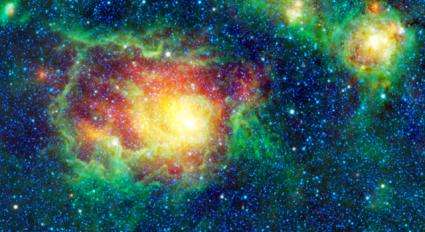
This colorful picture is a mosaic of the Lagoon nebula taken by NASA’s Wide-field Infrared Survey Explorer, or WISE. Image credit: NASA/JPL-Caltech/UCLA

(PhysOrg.com) -- In November 2010, the scientific journal Icarus published a paper by astrophysicists John Matese and Daniel Whitmire, who proposed the existence of a binary companion to our sun, larger than Jupiter, in the long-hypothesized "Oort cloud" -- a faraway repository of small icy bodies at the edge of our solar system. The researchers use the name "Tyche" for the hypothetical planet. Their paper argues that evidence for the planet would have been recorded by the Wide-field Infrared Survey Explorer (WISE).

WISE is a NASA mission, launched in December 2009, which scanned the entire celestial sky at four about 1.5 times. It captured more than 2.7 million images of objects in space, ranging from faraway galaxies to asteroids and comets relatively close to Earth. Recently, WISE completed an extended mission, allowing it to finish a complete scan of the , and two complete scans of the more distant universe, in two infrared bands. So far, the mission's discoveries of previously unknown objects include an ultra-cold star or brown dwarf, 20 comets, 134 near-Earth objects (NEOs), and more than 33,000 asteroids in the main belt between Mars and Jupiter.

Following its successful survey, WISE was put into hibernation in February 2011. Analysis of WISE data continues. A preliminary public release of the first 14 weeks of data is planned for April 2011, and the final release of the full survey is planned for March 2012.

Frequently Asked Questions

Q: When could data from WISE confirm or rule out the existence of the hypothesized planet Tyche?

A: It is too early to know whether WISE data confirms or rules out a large object in the Oort cloud. Analysis over the next couple of years will be needed to determine if WISE has actually detected such a world or not. The first 14 weeks of data, being released in April 2011, are unlikely to be sufficient. The full survey, scheduled for release in March 2012, should provide greater insight. Once the WISE data are fully processed, released and analyzed, the Tyche hypothesis that Matese and Whitmire propose will be tested.

Q: Is it a certainty that WISE would have observed such a planet if it exists?

A: It is likely but not a foregone conclusion that WISE could confirm whether or not Tyche exists. Since WISE surveyed the whole sky once, then covered the entire sky again in two of its infrared bands six months later, WISE would see a change in the apparent position of a large planet body in the Oort cloud over the six-month period. The two bands used in the second sky coverage were designed to identify very small, cold stars (or ) -- which are much like planets larger than Jupiter, as Tyche is hypothesized to be.

Q: If Tyche does exist, why would it have taken so long to find another planet in our solar system?

A: Tyche would be too cold and faint for a visible light telescope to identify. Sensitive infrared telescopes could pick up the glow from such an object, if they looked in the right direction. WISE is a sensitive infrared telescope that looks in all directions.

Q: Why is the hypothesized object dubbed "Tyche," and why choose a Greek name when the names of other planets derive from Roman mythology?

A: In the 1980s, a different companion to the sun was hypothesized. That object, named for the Greek goddess "Nemesis," was proposed to explain periodic mass extinctions on the Earth. Nemesis would have followed a highly elliptical orbit, perturbing comets in the Oort Cloud roughly every 26 million years and sending a shower of comets toward the inner solar system. Some of these comets would have slammed into Earth, causing catastrophic results to life. Recent scientific analysis no longer supports the idea that extinctions on Earth happen at regular, repeating intervals. Thus, the Nemesis hypothesis is no longer needed. However, it is still possible that the sun could have a distant, unseen companion in a more circular orbit with a period of a few million years -- one that would not cause devastating effects to terrestrial life. To distinguish this object from the malevolent "Nemesis," astronomers chose the name of Nemesis's benevolent sister in Greek mythology, "Tyche."

Explore further: Hubble reveals the ring nebula's true shape

Related Stories

Getting WISE About Nemesis

Mar 11, 2010

Is our Sun part of a binary star system? An unseen companion star, nicknamed 'Nemesis,' may be sending comets towards Earth. If Nemesis exists, NASA's new WISE telescope should be able to spot it.

NASA's NEOWISE completes scan for asteroids and comets

Feb 01, 2011

(PhysOrg.com) -- NASA's NEOWISE mission has completed its survey of small bodies, asteroids and comets, in our solar system. The mission's discoveries of previously unknown objects include 20 comets, more ...

WISE mission warms up but keeps chugging along

Oct 04, 2010

After completing its primary mission to map the infrared sky, NASA's Wide-field Infrared Survey Explorer, or WISE, has reached the expected end of its onboard supply of frozen coolant. Although WISE has 'warmed ...

The First of Many Asteroid Finds for WISE

Jan 25, 2010

(PhysOrg.com) -- NASA's Wide-field Infrared Survey Explorer, or WISE, has spotted its first never-before-seen near-Earth asteroid, the first of hundreds it is expected to find during its mission to map the ...

The Coolest Stars Come Out of the Dark

Jun 24, 2010

(PhysOrg.com) -- Astronomers have uncovered what appear to be 14 of the coldest stars known in our universe. These failed stars, called brown dwarfs, are so cold and faint that they'd be impossible to see ...

Recommended for you

Galaxies fed by funnels of fuel

1 hour ago

(Phys.org) —Computer simulations of galaxies growing over billions of years have revealed a likely scenario for how they feed: a cosmic version of swirly straws.

Hubble reveals the ring nebula's true shape

May 23, 2013

(Phys.org) —The Ring Nebula's distinctive shape makes it a popular illustration for astronomy books. But new observations by NASA's Hubble Space Telescope of the glowing gas shroud around an old, dying, ...

User comments : 16

Adjust slider to filter visible comments by rank

Display comments: newest first

d_robison
4.5 / 5 (4) Feb 22, 2011
This would be quite and interesting find, but I am a little skeptical of the presence of a jovian planet/brown dwarf in the outer solar system. One would think something as large as a Jovian planet all the way up to a brown dwarf would perturb the orbits of quite a few objects since there could be billions-trillions of objects in this region (though I suppose the size of the objects and the number in the region is largely comprised of guesses).
omatumr
1.4 / 5 (11) Feb 22, 2011
I appreciate the scientific attitude in this report and the absence of arrogant certainty.

Careful nuclear and space age measurements on material in the solar system and quiet reflection on the findings led to these conclusions about the origin of the solar system:

youtube.com/watch?v=AQZe_Qk-q7M

youtube.com/watch?v=sXNyLYSiPO0

With kind regards,
Oliver K. Manuel
Former NASA Principal
Investigator for Apollo
El_Nose
4.6 / 5 (5) Feb 22, 2011
@robison

well think about it this way... outside of the Sun, Jupiter contributes heavily to almost all planetary movements... and sturn wihile big barely effects the earth and moon because of distance... and Uranus' impact is negligable enough to be ignored in all but the most stringent calculations. This object if it exists would be so distant that its not even effecting the outer planets --- pluto has an revolutionary period of like waht 200yrs -- this one would have a period of like a few million years, its really really far away and the effect of gravity decreases eponentially with distance
Johannes414
1.3 / 5 (12) Feb 22, 2011
If we find it, evolution is correct. If we dont find it, evolution is correct. Why do we keep op funding these guys I wonder?
seb
5 / 5 (8) Feb 22, 2011
If we find it, evolution is correct. If we dont find it, evolution is correct. Why do we keep op funding these guys I wonder?


What, in any way, has this to do with evolution?

Anyway, a planet waaaay out there on the edge of the System? That could come in handy in the distant future as a base of operations for interstellar exploration heh.. Or something.

Pyle
4.5 / 5 (8) Feb 22, 2011
Very large planet as a base? I don't think so. Maybe if it has a satellite. It might be better used as a sling shot for more precise trajectories leaving the solar system. I don't think we want to waste fuel landing in and escaping from a large gravity well.
omatumr
4.9 / 5 (8) Feb 22, 2011
If we find it, evolution is correct. If we dont find it, evolution is correct. Why do we keep up funding these guys I wonder?


I don't understand how the article relates to evolution.
geokstr
3.5 / 5 (11) Feb 22, 2011
...a Jovian planet all the way up to a brown dwarf would perturb the orbits of quite a few objects since there could be billions-trillions of objects in this region...

Even if there were trillions of minor objects in the Oort Cloud, space is REALLY BIG. It would probably be as crowded as having several bees in the Rose Bowl. In addition, any large body out there isn't aiming objects it dislodges at us, but is basically just nudging them in every possible direction, with only a very tiny percent going anywhere near the sun. Nearly all of them just assume slightly different orbits at a thousand astronomical units and out, and others are eventually ejected from the Oort Cloud in every direction.

There's probably millions of new minor bodies entering our Oort Cloud from every direction every year after being ejected from the Oort Clouds of other stars.
AtomThick
4.2 / 5 (5) Feb 23, 2011
...the effect of gravity decreases eponentially with distance


it decreses more like with the inverse square of the distance.
vidyunmaya
1 / 5 (6) Feb 23, 2011
HUMAN BEING IN-DEPTH-Milkyway Sensex-ADITYA LINKS
1.ENVIRONMENT SENSEX-EARTH'S GLOW-SUN-LIFE SIGNIFICANCE VIDYARDHI NANDURI...PPT-27 [2009-10]
2.SUN TO ADITYA-COSMOLOGY VEDAS INTERLINKS ..PPT-27[2010]
3.COSMOLOGICAL INDEX-MILKYWAY SENSEX-VISIBLE -INVISIBLE MATRIX By VIDYARDI NANDURI 2010 .PPT-33
See Cosmology Vedas Interlinks
d_robison
5 / 5 (2) Feb 23, 2011
@Geokstr

This is true, and even if it did clear a path it probably would have done so long ago. I was thinking about it as a very large Jupiter like planet careening through this vast collection of comets and asteroids and gas launching them into or out of the solar system or gathering them as small moons or perhaps even adding to rings it may have. Though after re-thinking the distances we are dealing with that desciption doesn't seem to match.

One question I do have is wouldn't we be able to detect this object through radial velocity techniques(looking at the "wobble" of our Sun)? I know the effect would be miniscule given its distance but would there be a device sensitive enough to detect this?
geokstr
1.7 / 5 (6) Feb 23, 2011
One question I do have is wouldn't we be able to detect this object through radial velocity techniques(looking at the "wobble" of our Sun)? I know the effect would be miniscule given its distance but would there be a device sensitive enough to detect this?

Doubtful we'd have anything nearly that sensitive yet, to orders of magnitude. We can barely find planets around other stars with the wobble method unless they're hot Jupiters and larger orbiting so close that their year is a couple days long or even less.

Remember, our Oort Cloud basically extends at least 2 light years, much more in some directions, or half way to the next star, where that star's own cloud ends. If a brown or even red dwarf was out there, it would be nearly impossible to detect, unless we knew exactly where to look.

The WISE is going to be comparing photos of the sky in every direction taken over a year apart. That might detect the movement of a Tyche, if it exists.

We shall see.
knowjuan
not rated yet Feb 27, 2011
I'm surprised that no-one has mentioned The Binary Research Institute. The idea that the sun has a dark [brown dwarf or possibly even a black hole] companion explains a whole raft of questions about precession of the equinox, etc. It's been around for at least a decade. It even explains why the Gravity B probe failed.

binaryresearchinstitute.org/index.shtml
omatumr
1 / 5 (3) Feb 27, 2011
What we call the Sun is actually a brightly glowing sphere of waste products (91% H and 9% He) from the neutron star at the center of the solar globe.

"Neutron Repulsion", The APEIRON Journal, in press (2011), 19 pages

arxiv.org/pdf/1102.1499v1

If there is a binary companion, it is the binary companion of a neutron star.

With kind regards,
Oliver K. Manuel

d_robison
5 / 5 (1) Feb 28, 2011
What we call the Sun is actually a brightly glowing sphere of waste products (91% H and 9% He) from the neutron star at the center of the solar globe.

"Neutron Repulsion", The APEIRON Journal, in press (2011), 19 pages

arxiv.org/pdf/1102.1499v1

If there is a binary companion, it is the binary companion of a neutron star.

With kind regards,
Oliver K. Manuel


It is interesting to see this written from the man who, in another post, said something like, 'modern scientists have become as dogmatic and irrational as 16th century religious zealots.' You cling to this theory with every ounce of strength yet close your mind to other possibilities. Is this not similar to what you claim modern scientists have become? In my own opinion the very scientists who make these claims about the world of science today, are the very ones that fit under that category. Irony is a beautiful thing.
d_robison
5 / 5 (1) Feb 28, 2011
Clarification of my post above.

Anyways, I have not closed my mind to other theories (including your own), but I find that in science often the simplest explanation is often the correct explanation (e.g. when certain scientists attempt to keep their models or theories by patching it up). 19th century theories on light/ the ether is a great example, or pre-Copernicus(sp?) geocentric models of the solar system. Becoming too emotionally involved in a theory or experiment can often jeopardize the integrity of the results.

More news stories

Galaxies fed by funnels of fuel

(Phys.org) —Computer simulations of galaxies growing over billions of years have revealed a likely scenario for how they feed: a cosmic version of swirly straws.

Dark, massive asteroid to fly by Earth on May 31

It's 1.7 miles long. Its surface is covered in a sticky black substance similar to the gunk at the bottom of a barbecue. If it impacted Earth it would probably result in global extinction. Good thing it is ...

Source of life running out: water scientists

The majority of people on Earth people will face severe water shortages within a generation or two if pollution and waste continues unabated, scientists warned at a conference in Bonn Friday.

Google eyes emerging markets networks

Google has become deeply involved in a series of projects to build and operate wireless networks in emerging markets including sub-Saharan Africa and Southeast Asia, a report said Friday.

Facial-recognition technology proves its mettle

(Phys.org) —In a study that evaluated some of the latest in automatic facial recognition technology, researchers at Michigan State University were able to quickly identify one of the Boston Marathon bombing ...