Unique new probe of proton spin structure at Relativistic Heavy Ion Collider
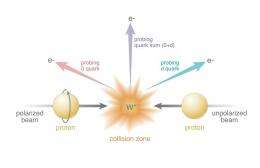
Scientists hoping to unravel the mystery of proton spin at the Relativistic Heavy Ion Collider (RHIC), a 2.4-mile-circumference particle accelerator at the U.S. Department of Energy’s (DOE) Brookhaven National Laboratory, have a new tool at their disposal — the first to directly explore how quarks of different types, or “flavors,” contribute to the overall spin of the proton. The technique, described in papers just published by RHIC’s STAR and PHENIX collaborations in Physical Review Letters, relies on the measurement of particles called W bosons, the mediators of the weak force responsible for the decay of radioactive nuclei.
“Exploring the mystery of proton spin has been one of the key scientific research goals at RHIC,” said Steven Vigdor, Brookhaven’s Associate Laboratory Director for Nuclear and Particle Physics. “Like many scientific mysteries, this one turns out to be more complex the more we learn about it. The W boson measurements were enabled by new detection techniques at RHIC’s STAR and PHENIX experiments and by extending RHIC’s world-record energies for the acceleration of proton beams with a distinct spin orientation preference. The results will allow us to tease apart subtle details that were previously inaccessible, and should move the field closer to a quantitative understanding of proton spin structure and dynamics.”
Spin is a quantum property that describes a particle’s intrinsic angular momentum. Like charge and mass, it’s part of a particle’s identity, whose magnitude is the same for all particles of a given type. But unlike charge and mass, spin has a direction that can be oriented differently for individual particles of a given species. The interactions among particles inside atoms, nuclei, and protons depend critically on their relative spin orientations, with influence on a wide range of electrical, magnetic, optical, and other properties of matter. Yet despite the fact that proton spin is used in everyday applications like magnetic resonance imaging (MRI), exactly how — and how much — the individual particles that make up protons contribute to spin remains a mystery.
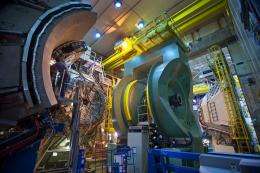
Scientists know that the quarks inside a proton each have their own intrinsic spin. But numerous experiments have confirmed that a directional preference among all these quark spins can account for only about 25 percent of the proton’s total spin. RHIC was built with the ability to collide polarized protons — protons whose spins could be aligned in a controlled way — so scientists could probe other factors that might account for the “missing” spin. Much of the equipment needed to realize this unique capability was provided by the RIKEN Institute of Physical and Chemical Research of Japan, whose researchers form a critical part of the international collaborations carrying out this work.
After beginning polarized proton collisions at RHIC late in 2001, the first place the scientists looked for the missing spin was the gluons, the particles that hold a proton’s quarks together via the strong force.
“The shock so far has been that we haven’t found gluons carrying much of the spin,” said PHENIX spokesperson Barbara Jacak, a physicist at Stony Brook University. Measurements from the STAR detector agree. After several polarized proton runs at various energies, RHIC data suggest with more and more certainty that gluons contribute much less than originally speculated to proton spin, so the source of the spin still remains a mystery.
The scientists acknowledge that they haven’t been able to look at all the gluons, particularly those that carry tiny fractions of the proton’s overall momentum. “It’s like we’re looking for missing keys under a narrow-focus street lamp, and we’d like a lamp with broader illumination,” Jacak said.
But as they continue to work on that part of the puzzle, they also have a new way to look at spin.
Thanks to new detection techniques and the ability to run polarized proton collisions at very high energies — 500 GeV, or 500 billion electron volts — RHIC scientists at both PHENIX and STAR are able to directly probe the polarization contributions from different flavored quarks (known by the names “up” and “down”) inside protons for the first time.
“All of the earlier measurements that attempted to separate quark spin contributions according to flavor were done indirectly, and they looked primarily at the contribution of the three leading, or valence, quarks in the proton,” said Bernd Surrow, a Massachusetts Institute of Technology physicist and deputy spokesperson of the STAR collaboration. “This new method of measuring W bosons gives us direct access to quarks known as ‘sea quarks,’ which wink in and out of existence as gluons split and reform within the protons.”
Sea quarks are always produced in quark/antiquark pairs and have exceedingly short lifetimes. But at the very high energies achieved in RHIC’s colliding proton beams, these fleeting quarks and antiquarks can collide, or interact, to produce relatively heavy W bosons. So far, RHIC’s experiments have detected Ws by looking for electrons and positrons (positively charged electrons) that form as the Ws decay. The charge of the decay products — whether electrons or positrons — directly reflects the charge of the Ws, which in turn tells what flavor of antiquarks were involved in the collision — whether anti-up or anti-down.
By comparing the number of Ws produced when bunches of RHIC’s colliding protons are polarized in the direction of the beam’s motion with the number produced when the protons are polarized in the opposite direction, the scientists can directly measure the degree to which the antiquark spins point in a preferred direction with respect to the overall proton spin. This robust measurement technique relies on a fundamental, and very well understood, property of the weak interaction by which the Ws are produced, namely, its extreme violation of mirror symmetry.
“Observation of this extreme effect in weak interactions for the first time in polarized proton-proton collisions at RHIC is itself a major milestone,” said Hideto En’yo, director of the RIKEN Nishina Center for Accelerator-Based Science, which established the RIKEN-BNL Research Center (RBRC) to nurture a new generation of physicists interested in studying the strong force and spin physics at RHIC. “It is gratifying to see our large investments in polarization equipment pay off with such large and cleanly interpretable spin effects.”
“You would think you would get equal numbers of anti-up and anti-down quarks inside a proton. But previous experiments have shown that they are very different,” Surrow said. “That means there is a lot of uncertainty about the underlying mechanism of how these sea quarks pop in and out of existence. It also indicates that the different flavors may behave differently in terms of how they contribute to spin.”
Added Jacak, “Understanding these differences won’t by itself solve the spin mystery, but it will give us a clearer picture of one piece of the puzzle, the sea quark contribution.”
More information:
PHENIX paper, Phys. Rev. Lett. 106, 062001 (2011)
STAR paper, Phys. Rev. Lett. 106, 062002 (2011)
Provided by Brookhaven National Laboratory


