Tiny 'microworms' could be implanted under the skin for continuous medical monitoring
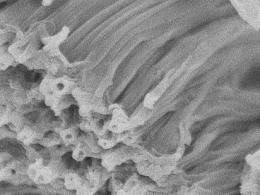
Researchers at MIT and Northeastern have come up with a new system for monitoring biomedical indicators -- such as levels of sodium or glucose in the blood -- that could someday lead to implantable devices that would allow, for example, people with diabetes to check their blood sugar just by glancing at an area of skin.
A number of researchers have developed microparticle-based systems — hollow, microscopic particles filled with specific chemicals — for monitoring biomedical conditions or for the selective delivery of drugs to certain organs or areas of the body. But one drawback of these systems is that the particles are small enough to be swept away from the initial site over time. The new system involves a different kind of microparticle that can avoid this problem.
While traditional particles are spherical, the new particles are shaped like long tubes. The tubes’ narrow width, which is comparable to that of the previously studied microparticles, keeps the tubes’ contents in close proximity to blood or body tissue, making it easy for the particles to sense and respond to chemical or other conditions in their surroundings. The tubes’ relatively greater length keeps the tubes very well anchored in place for long-term monitoring, perhaps for months on end.
The particles eventually could be used to monitor the glucose levels of diabetics or the salt levels of those with a condition that can cause swings in blood salt concentrations.
The new findings are being reported in the journal Proceedings of the National Academy of Sciences, in a paper published online in January and soon to appear in the print version. It was co-authored by Karen Gleason, the Alexander and I. Michael Kasser Professor of Chemical Engineering at MIT; Heather Clark, professor of pharmaceutical science at Northeastern University; MIT postdoctoral researcher Gozde Ozaydin-Ince; and Northeastern doctoral student J. Matthew Dubach.
The process of creating the new nanoparticles is an offshoot of Gleason’s work on a method of coating materials by vaporizing the coating material and letting it deposit on a surface to be coated. In work published last month, she and her co-workers had shown that this technique — called chemical vapor deposition (CVD) — could be used to coat a material containing microscopic pores, thus making the pores even smaller and giving them a surface that could respond to the chemical properties of materials passing through them.
This new work uses CVD to coat an aluminum oxide layer that has been etched to contain tiny pores, and, as in the previous work, the coating extends down onto the walls of these pores. But then the coated material itself is dissolved away, leaving just a series of hollow tubes where the pores used to be. Before that, though, another material can be added — something that responds to the environment, or a drug to be delivered, for example. The tubes are then capped at either end.
Gleason explains that these “microworms,” as she calls them, can then be injected under the skin to form a fluorescent “tattoo.” By filling the tiny hollow tubes with a material that fluoresces — that is, emits light of a particular color — in response to the presence of a specific chemical, “the degree of fluorescence provides continuous physiological monitoring of a specific chemical” in the body, and can be monitored right through the skin. The light emitted by the fluorescing chemical “is visible to the human eye, and thus can be directly interpreted by the patient without the need for bulky monitors,” she says.
While the initial microworms were made to detect salt levels, and were successfully tested in mice, there are a variety of potential applications, Gleason says. One significant possibility is measuring glucose levels: “Tight control over glucose levels can help individuals stave off the devastating side-effects of diabetes, the number one cause of kidney failure, blindness in adults, nervous system damage, and amputations and also a major risk factor for heart failure, stroke and birth defects,” she says. Diabetes currently affects more than 20 million people in the U.S., and that is expected to double in 25 years.
The tubes are so tiny — about 200 nanometers across, or less than one-hundredth the width of a human hair — that “the body doesn’t even think they’re there,” Gleason says, allowing them to operate in “stealth mode” without triggering any physical response.
Raoul Kopelman, the Richard Smalley Distinguished University Professor of Chemistry, Physics and Applied Physics and Research Professor of Biomedical Engineering at the University of Michigan, calls this “high quality work by an expert team,” and says, “In principle, this could open the way for avoiding blood tests, which need a central lab, expert nurses, extra time and extra costs. It could be done in a doctor's office, or even at home. It will also avoid complications for patients with ‘difficult,’ or ‘used-up’ veins, patients on blood thinners, etc.” However, he cautioned that “The biggest stumbling block is the safety factor, i.e. FDA approval. FDA might not only worry about long-term chemical toxicity and bio-elimination, but also about complications — i.e., could it trigger blood clots?”
In addition to the fact that these microworms stay in place when injected into the body, their manufacturing process itself provides a significant advantage, Gleason says. Because CVD is a standard manufacturing method used in the semiconductor industry, the manufacture of these devices should be relatively easy and inexpensive.
Gleason says, “One can imagine using these kinds of tubes to shrink-wrap just about anything,” including drugs that could be delivered slowly over time through small openings in the tubes.
Provided by Massachusetts Institute of Technology


