First ever STEREO images of the entire Sun (w/ Video)
February 7, 2011 By Dr. Tony Phillips

First ever STEREO images of the entire sun

Enlarge

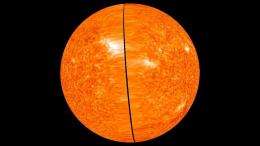
Latest image of the far side of the Sun based on high resolution STEREO data, taken on February 2, 2011 at 23:56 UT when there was still a small gap between the STEREO Ahead and Behind data. This gap will start to close on February 6, 2011, when the spacecraft achieve 180 degree separation, and will completely close over the next several days. Credit: NASA

(PhysOrg.com) -- It's official: The sun is a sphere.

On Feb. 6th, NASA's twin STEREO probes moved into position on opposite sides of the sun, and they are now beaming back uninterrupted images of the entire star -- front and back.

"For the first time ever, we can watch solar activity in its full 3-dimensional glory," says Angelos Vourlidas, a member of the STEREO science team at the Naval Research Lab in Washington, DC.

NASA released a 'first light' 3D movie on, naturally, Super Bowl Sunday.

This video is not supported by your browser at this time.

The solar sphere as observed by STEREO and the Solar Dynamics Observatory on January 31, 2011. Because the STEREO separation was still slightly less than 180o at that time, a narrow gap on the far side of the Sun has been interpolated to simulate the full 360o view. The gap and quality of farside imaging will improve even more in the days and weeks ahead. (NASA)

"This is a big moment in solar physics," says Vourlidas. "STEREO has revealed the sun as it really is--a sphere of hot plasma and intricately woven magnetic fields."

Each STEREO probe photographs half of the star and beams the images to Earth. Researchers combine the two views to create a sphere. These aren't just regular pictures, however. STEREO's telescopes are tuned to four wavelengths of extreme ultraviolet radiation selected to trace key aspects of solar activity such as flares, tsunamis and magnetic filaments. Nothing escapes their attention.
First ever STEREO images of the entire sun
Enlarge

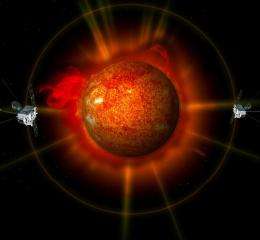
An artist's concept of STEREO surrounding the sun. Credit: NASA

"With data like these, we can fly around the sun to see what's happening over the horizon—without ever leaving our desks," says STEREO program scientist Lika Guhathakurta at NASA headquarters. "I expect great advances in theoretical and space weather forecasting."

Consider the following: In the past, an active sunspot could emerge on the far side of the sun completely hidden from Earth. Then, the sun's rotation could turn that region toward our planet, spitting flares and clouds of plasma, with little warning.

This video is not supported by your browser at this time.

Observing solar storms from two points of view has allowed forecasters to made 3D models of advancing coronal mass ejections (CMEs), improving predictions of Earth impacts. Credit: NOAA/SWPC

"Not anymore," says Bill Murtagh, a senior forecaster at NOAA's Space Weather Prediction Center in Boulder, Colorado. "Farside active regions can no longer take us by surprise. Thanks to STEREO, we know they're coming."

NOAA is already using 3D STEREO models of CMEs (billion-ton clouds of ejected by the sun) to improve space weather forecasts for airlines, power companies, satellite operators, and other customers. The full sun view should improve those forecasts even more.

The forecasting benefits aren't limited to Earth.

"With this nice global model, we can now track solar storms heading toward other planets, too," points out Guhathakurta. "This is important for NASA missions to Mercury, Mars, asteroids … you name it."

has been building toward this moment since Oct. 2006 when the STEREO probes left Earth, split up, and headed for positions on opposite sides of the sun (movie). Feb. 6, 2011, was the date of "opposition"—i.e., when STEREO-A and -B were 180 degrees apart, each looking down on a different hemisphere. NASA's Earth-orbiting Solar Dynamics Observatory is also monitoring the sun 24/7. Working together, the STEREO-SDO fleet should be able to image the entire globe for the next 8 years.

This video is not supported by your browser at this time.

The STEREO mission consists of two spacecraft orbiting the Sun, one moving a bit faster than Earth and the other a little slower. In the time since the STEREO spacecraft entered these orbits near the beginning of 2007 they have been slowly separating. In Feb. 2011 they reach the point at which they are on opposite sides of the Sun and can observe the entire far side of the Sun.

The new view could reveal connections previously overlooked. For instance, researchers have long suspected that solar activity can "go global," with eruptions on opposite sides of the sun triggering and feeding off of one another. Now they can actually study the phenomenon. The Great Eruption of August 2010 engulfed about 2/3rd of the stellar surface with dozens of mutually interacting flares, shock waves, and reverberating filaments. Much of the action was hidden from Earth, but plainly visible to the STEREO-SDO fleet.

"There are many fundamental puzzles underlying ," says Vourlidas. "By monitoring the whole sun, we can find missing pieces."

Researchers say these first-look whole images are just a hint of what's to come. Movies with even higher resolution and more action will be released in the days and weeks ahead as more data are processed. Stay tuned!

Provided by JPL/NASA search and more info website

4.7 /5 (17 votes)  

Filter


Move the slider to adjust rank threshold, so that you can hide some of the comments.


Display comments: newest first

PS3
Feb 08, 2011

Rank: 1 / 5 (4)
seems like a huge waste of money as the sun rotates.
thermodynamics
Feb 08, 2011

Rank: 3.7 / 5 (3)
PS3: How could anyone who even thinks they are interested in science see this as a waste of money. Solar storms can cause problems throughout the solar system and can disrupt communications and power transmission on earth. Why in the world would think that the ability to better predict those storms could be a waste of money? You really either need to read some science books or find another blog.
PS3
Feb 09, 2011

Rank: 1 / 5 (1)
I would put it towards something else like searching for deadly asteroids.
Rank 4.7 /5 (17 votes)
Relevant PhysicsForums posts
  • revamping general concept and cosmological principle
    createdMay 25, 2012
  • Transiting Exoplanet Light Curve
    createdMay 25, 2012
  • Math behind Theoretical Physics
    createdMay 24, 2012
  • Do we know whats at the center of galaxies yet?
    createdMay 23, 2012
  • Structure of the Milky Way?
    createdMay 20, 2012
  • What would it take to terraform Pluto and Charon?
    createdMay 19, 2012
  • More from Physics Forums - General Astronomy

More news stories

SpaceX capsule has 'new car' smell, astronauts say (Update)

SpaceX's Dragon cargo vessel smells like a new car, said astronauts at the International Space Station after opening the hatches Saturday following the spacecraft's landmark mission to the orbiting lab.

Space & Earth / Space Exploration

created 13 hours ago | popularity 4.6 / 5 (18) | comments 0

Australia hails surprise super-telescope decision

Australia has hailed a surprise decision giving it a role in a radio telescope project aimed at revolutionising astronomy, vowing to draw on its decades of experience in space science.

Space & Earth / Astronomy

created 13 hours ago | popularity 5 / 5 (3) | comments 0

Astronomers seize last chance in lifetime for Venus Transit

Astronomers are gearing for one the rarest events in the Solar System: an alignment of Earth, Venus and the Sun that will not be seen for another 105 years.

Space & Earth / Astronomy

created 13 hours ago | popularity 5 / 5 (1) | comments 0

Astronauts enter world's 1st private supply ship

(AP) -- Space station astronauts floated into the Dragon on Saturday, a day after its heralded arrival as the world's first commercial supply ship.

Space & Earth / Space Exploration

created 13 hours ago | popularity 5 / 5 (5) | comments 0

Dragon arrives at space station in historic 1st (Update 2)

The privately bankrolled Dragon capsule made a historic arrival at the International Space Station on Friday, triumphantly captured by astronauts wielding a giant robot arm.

Space & Earth / Space Exploration

created May 25, 2012 | popularity 5 / 5 (10) | comments 19


Dell tablet leak: 10.1-inch display, two-battery choice

(Phys.org) -- Headline after headline talks about vendors’ tablets in the wings as likely number-one contenders for the iPad. Such claims have justifiably been taken with a grain of salt, considering ...

Scientist: Evolution debate will soon be history

(AP) -- Richard Leakey predicts skepticism over evolution will soon be history. Not that the avowed atheist has any doubts himself.

SpotterRF debuts Radar Backpack Kit (w/ Video)

(Phys.org) -- SpotterRF has announced a special radar backpack kit designed to enhance situational awareness for soldiers on the ground. The company says its special radar is designed for warfighters as part ...

Keep food safety in mind this memorial day weekend

(HealthDay) -- Picnics, parades and cookouts are as much a part of Memorial Day weekend as tributes to the United States' war veterans.

Thousands of shellfish found dead in Peru

Thousands of crustaceans were found dead off the coast of Lima following the mystery mass death of dolphins and pelicans, the Peruvian Navy said Friday.

Family history of Alzheimer's affects functional connectivity

(HealthDay) -- Cognitively normal individuals with a family history of late-onset Alzheimer's disease (AD) may display lower resting state functional connectivity in the default mode network (DMN) of the brain, ...