Could smartphones go stupid?

Smartphones are rapidly becoming ubiquitous, but they risk becoming a victim of their own success, so clogging networks they are unable to do many of the smart applications that fuelled their sales.
Analysts warn that the mobile industry soon faces growing pains, with congestion choking service at peak times and locations, and operators forced to hike prices and capping or slowing data use.
In either case many popular services that have driven smartphone sales could suffer.
Mobile industry leaders recognise this threat and it will be one of the key questions they address this coming week at their annual gathering.
More than 50,000 people from over 1,300 companies are set to attend the four-day Mobile World Congress opening Monday in Barcelona, including executives from dozens of top firms.
Sales of smartphones have rocketed over the past few years -- nearly 470 million of them sold in the past two years according to Gartner market research firm -- and developing nifty applications for them has become a major industry in itself.
But with each smartphone generating as much as 24 times as much data traffic as a regular mobile phone the volume of network traffic has exploded, with the network firm Cisco forecasting it to grow 26-fold by 2015.
Mobile operators have been hard pressed to keep up.
"The explosion in data traffic and the strain on networks is beginning to show with service quality already suffering," Torbjoern Sandberg, chief executive of Birdstep mobile connectivity firm, said in a recent statement.
While spectacular overloading of networks such as with AT&T in the United States and 02 in Britain in December 2009 -- which the carrier linked to smartphone use -- is rare, users more often encounter dropped calls and slower service at rush hour or in crowded public transport.
"Bandwidth congestion will continue to be a serious problem for operators, especially in the most populated areas during peak usage times," said Merav Bahat of Flash Networks, a company which helps operators improve network performance.
"It will not render smartphones dumb, but it will frustrate users who expect a wireline-like experience on their mobile device," she added.
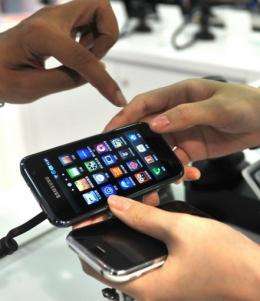
Congestion hits first the bandwith-hogging and most popular smartphone application -- video.
Video streaming already accounts for 37 percent of mobile data traffic, according to the latest Mobile Trends Report by Allot Communication, and Cisco expects video to account for two-thirds of traffic by 2015.
But frequent interruptions would render video streaming nearly unusable at peak traffic times.
Video calls on mobiles, which may finally take off this year, would also suffer, as would voice calls on alternative services such as Skype.
E-mail and web browsing would continue to function, but at slower speeds.
Operators have already begun put smartphone users on a data diet, either limiting use or slowing data speeds after a certain volume has been reached.
"Unlimited data has already come to an end because most operators realise there isn't sufficient capacity available in the network," said Coleago Consulting CEO Stefan Zehle.
But expensive data diets stunt the development of the market, Magnus Rehle of Greenwich Consulting noted, leaving operators with the early adopters which are heavy data users rather than a mass subscriber base with different usage patterns.
Mobile operators are also scrambling to add more capacity, but according to recent calculations by network optimization firm Tellabs, they could run themselves into the red in three years trying to build to meet forecast data growth.
"Carriers can spend themselves bankrupt well before users run out of hunger for capacity," said Tellabs chief executive Rob Pullen.
A recent report by the A.T. Kearney consulting firm calculated that at current trends mobile operators will end up 21 billion euros ($28.5 billion) short of the amount needed over the next four years to expand their networks to keep up with forecast data growth.
A number of firms such as Tellabs say that the problem is not smart phones but dumb networks, and offer technology that promises to create intelligent networks that optimize the flow of data, allowing operators to do more with less.
But as the A.T. Kearney report noted, improving networks and hiking fees for consumers is unlikely to be sufficient without addressing the video streaming sites who are paying almost nothing to pump huge amounts of data across networks to consumers and have few incentives to compress data.
The consultancy concluded there are "clear structural problems in the economic model" of the fixed and mobile Internet "making it increasingly inefficient and ultimately unsustainable as traffic growth continues..."
(c) 2011 AFP


