A sculpture you can't see: the chemistry behind the art
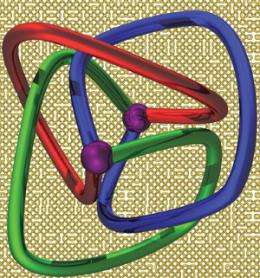
The "universal 3-ravel motif."
A University of Sydney professor is at the forefront of cutting edge work creating complex and beautiful molecular structures that, until recently, could only be made at a life-sized scale.
"Throughout human history aesthetically pleasing objects have been universally created and admired," said the University of Sydney's Leonard Lindoy, Professor of Chemistry and lead author of a paper featured in the latest issue of the prestigious Nature publication.
"We are just beginning to learn how to mimic this aspect of everyday life, building intricate structures that display artistic nuances at the molecular level, effectively spanning art and science," he said.
The Nature paper outlines Professor Lindoy's team's work creating a sculptural form of three interlinked arms, the shape of which could be described as a cross between an architecturally-designed piece of children's playground equipment and an attachment from a futuristic kitchen mixer.
The structure was formed in the lab over three months, when an iron solution plus other molecular building blocks was left to stand in a flask, resulting in deep red-colored crystals.
Initially the molecule's structure was football-shaped, with each of the arms attached to a point at both ends, with a void in the middle. But Professor Lindoy and colleagues found, "in an apparent demonstration of Aristotle's maxim that 'Nature abhors a vacuum'", that over time the arms became knotted and interlinked.
The resulting shape is known as a 'universal 3-ravel motif'. "The structure exhibits both remarkable intricacy and unusual beauty in its molecular form. There are only three or four previous examples of molecular structures in this particular kind of exotic formation," Professor Lindoy said.
While still in its infancy, Professor Lindoy said that his team's research into how molecules assemble could ultimately be applied in several areas including industrial processes, energy production and the development of molecular electronics. The work could also contribute to the development of tiny "molecular machines" that, for example, might mimic the role of a natural enzyme.
Provided by University of Sydney
-
From lemons to lemonade: Reaction uses carbon dioxide to make carbon-based semiconductor,
30 comments
-
Thioridazine kills cancer stem cells in human while avoiding toxic side-effects of conventional cancer treatments,
3 comments
-
SpaceX private rocket blasts off for space station (Update),
42 comments
-
Climate scientists say they have solved riddle of rising sea,
30 comments
-
Research team claims to have found evidence Lake Cheko is impact crater for Tunguska Event,
18 comments
-
Schwartz reagent-- NMR/MS/IR
11 hours ago
-
Inversion temp
15 hours ago
-
High school chemistry EEI
22 hours ago
-
oxidation of I- by KMnO4
May 25, 2012
-
Invesion temp
May 25, 2012
-
Hybridization of SnCl3 -
May 25, 2012
- More from Physics Forums - Chemistry
More news stories
From lemons to lemonade: Reaction uses carbon dioxide to make carbon-based semiconductor
(Phys.org) -- A materials scientist at Michigan Technological University has discovered a chemical reaction that not only eats up the greenhouse gas carbon dioxide, it also creates something useful. And, by ...
May 21, 2012 |
4.7 / 5 (88) |
30
|
New CO2-removing catalyst can take the heat
(Phys.org) -- The current method of removing the greenhouse gas carbon dioxide (CO2) from the flues of coal-fired power plants uses so much energy that no one bothers to use it. So says Roger Aines, principal ...
May 24, 2012 |
5 / 5 (7) |
7
|
High-speed method to aid search for solar energy storage catalysts
Eons ago, nature solved the problem of converting solar energy to fuels by inventing the process of photosynthesis.
May 25, 2012 |
5 / 5 (3) |
4
|
Researchers demonstrate possible primitive mechanism of chemical info self-replication
(Phys.org) -- When scientists think about the replication of information in chemistry, they usually have in mind something akin to what happens in living organisms when DNA gets copied: a double-stranded molecule ...
May 25, 2012 |
5 / 5 (4) |
2
|
Castor oil: Action mechanism of one of the oldest drugs known to man elucidated
Castor oil is known primarily as an effective laxative; however, it was also used in ancient times with pregnant women to induce labour. Only now have scientists at the Max Planck Institute for Heart and Lung ...
May 21, 2012 |
3 / 5 (2) |
3
|
Dell tablet leak: 10.1-inch display, two-battery choice
(Phys.org) -- Headline after headline talks about vendors tablets in the wings as likely number-one contenders for the iPad. Such claims have justifiably been taken with a grain of salt, considering ...
Scientist: Evolution debate will soon be history
(AP) -- Richard Leakey predicts skepticism over evolution will soon be history. Not that the avowed atheist has any doubts himself.
SpaceX capsule has 'new car' smell, astronauts say (Update)
SpaceX's Dragon cargo vessel smells like a new car, said astronauts at the International Space Station after opening the hatches Saturday following the spacecraft's landmark mission to the orbiting lab.
SpotterRF debuts Radar Backpack Kit (w/ Video)
(Phys.org) -- SpotterRF has announced a special radar backpack kit designed to enhance situational awareness for soldiers on the ground. The company says its special radar is designed for warfighters as part ...
Keep food safety in mind this memorial day weekend
(HealthDay) -- Picnics, parades and cookouts are as much a part of Memorial Day weekend as tributes to the United States' war veterans.
Thousands of shellfish found dead in Peru
Thousands of crustaceans were found dead off the coast of Lima following the mystery mass death of dolphins and pelicans, the Peruvian Navy said Friday.