Scientists warn of water woes
February 28, 2011 by Michel Comte
Demand for water in agriculture and energy production could spike in the coming decades while catastrophic floods and droughts strike more often, a water conference in Canada is to hear this week.
"At unpredictable times, too much water will arrive in some places and too little in others," said Zafar Adeel, chair of UN Water which coordinates water-related efforts of 28 United Nations organizations and agencies.
Within a generation, water demand in many countries is forecast to exceed supply by an estimated 40 percent.
In other parts of the world prone to flooding, catastrophic floods normally expected once a century could occur every 20 years instead.
Meanwhile, spending on technologies and services to discover, manage, filter, disinfect and desalinate water, improve infrastructure and distribution, mitigate flood damage and reduce water consumption by households, industry and agriculture is expected to rise to a trillion dollars annually by 2020.
Some 300 scientists, policy-makers and economists will release these and other research findings as well as proven new tools, ideas and best practices for optimizing water management at a Canadian Water Network international conference in Ottawa.
The event kicks off on February 28 and runs through March 3.
Conference speaker Hans Schreier of the University of British Columbia in Vancouver will present research buttressing the need for flood-prone areas to brace for more frequent disasters.
He pointed to Canadian insurance data showing claims resulting from extreme weather increased 20-fold in the past 30 years and flood-related claims now exceeding fire and wind insurance claims every year.
Schreier called for improved road and street designs to minimize rainwater runoff.
"Until now, all we've ever done in urban environments is to drain everything into rivers and lakes," he told AFP.
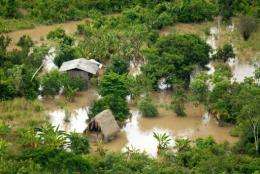
Aerial view during floods in the Chapare region, Bolivia on February 22, 2011. In parts of the world prone to flooding, catastrophic floods normally expected once a century could occur every 20 years instead, a water conference in Canada is to hear this week.
But curbs, drains and impermeable surfaces could be replaced where possible with grassy shoulder depressions that collect and absorb rainwater while directing excess runoff into constructed wetlands or storm water retention ponds.
This would mitigate flood damage, but also polluted runoff normally drained via pipes into lakes and rivers would be instead filtered and cleaned as it sinks through the ground, helping compensate the extensive loss of wetlands to development.
Other low-cost innovations might include home driveway designs and materials that allow most precipitation to be absorbed instead of running onto streets and roads, he said.
Another topic to be discussed at the conference is the impact of water shortages on businesses that rely on "virtual water" or the amount of water used in production of items.
A desktop computer, for example, requires 1.5 tons (1,500 liters) of water; a pair of denim jeans up to 6 tons; a kilogram of wheat 1 ton; a kilo of chicken 3 to 4 tons; a kilo of beef 15 to 30 tons.
Nicholas Parker, chairman of the Cleantech Group, said: "What people don't often realize is how much water there is in everything we make and buy, from t-shirts to wine."
One proposal is to list water used on product package labels to inform consumers and encourage conservation, said Adeel, noting that annual global trade in "virtual water" now exceeds 800 billion tons, the equivalent of 10 Nile Rivers.
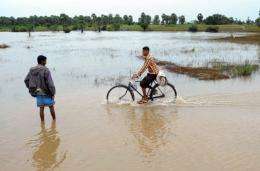
At least 21 people have died and over 1.2 million affected by heavy monsoon showers that have flooded most parts of the Sri Lanka's north, north central and eastern regions. Flooding in the same areas last month left 43 dead and drove over a million people from their homes.
As developing countries gain wealth, their citizens' demands for food and energy, which both require a lot of water to produce, will skyrocket, Adeel warned."We have to be prepared for the security challenges that will arise from this," he said.
Policy innovations to be discussed include helping farmers reuse water or tap into municipal waste water to "get a lot more bang out of your buck for the same volume of water."
Agriculture is the biggest water user by far at 71 percent worldwide.
Similarly, coupling industries so that runoff from one plant can be used as an input for another would go a long way to reduce shortages, Adeel said.
On the social front, he said it is important to get local entrepreneurs engaged.
He pointed to India where an estimated 500 million people have cell phones but only 350 million have access to toilets.
"That says there is something in their marketing approach that the cell phone companies have got right. We just need to duplicate that (business acumen) to bring clean water and sanitation to all," he said.
(c) 2011 AFP
-
From lemons to lemonade: Reaction uses carbon dioxide to make carbon-based semiconductor,
30 comments
-
Thioridazine kills cancer stem cells in human while avoiding toxic side-effects of conventional cancer treatments,
3 comments
-
SpaceX private rocket blasts off for space station (Update),
42 comments
-
Climate scientists say they have solved riddle of rising sea,
30 comments
-
Research team claims to have found evidence Lake Cheko is impact crater for Tunguska Event,
18 comments
-
More human population = greater mass?
May 25, 2012
-
Conversion from aircraft bearing to normal degrees
May 23, 2012
-
Interpretation/Analysis of the Lab results(HEPA filter)
May 22, 2012
-
Has anyone here attended the The Urbino Summer School in Paleoclimatology?
May 22, 2012
-
Earthquakes: Mag 6 N. Italy and Mag 5.6 W. Bulgaria
May 21, 2012
-
determining time frame for most recent geological layers
May 17, 2012
- More from Physics Forums - Earth
More news stories
SpaceX capsule has 'new car' smell, astronauts say (Update)
SpaceX's Dragon cargo vessel smells like a new car, said astronauts at the International Space Station after opening the hatches Saturday following the spacecraft's landmark mission to the orbiting lab.
Space & Earth / Space Exploration
12 hours ago |
4.6 / 5 (18) |
0
Australia hails surprise super-telescope decision
Australia has hailed a surprise decision giving it a role in a radio telescope project aimed at revolutionising astronomy, vowing to draw on its decades of experience in space science.
12 hours ago |
5 / 5 (2) |
0
Astronomers seize last chance in lifetime for Venus Transit
Astronomers are gearing for one the rarest events in the Solar System: an alignment of Earth, Venus and the Sun that will not be seen for another 105 years.
12 hours ago |
5 / 5 (1) |
0
Astronauts enter world's 1st private supply ship
(AP) -- Space station astronauts floated into the Dragon on Saturday, a day after its heralded arrival as the world's first commercial supply ship.
Space & Earth / Space Exploration
12 hours ago |
5 / 5 (5) |
0
Dragon arrives at space station in historic 1st (Update 2)
The privately bankrolled Dragon capsule made a historic arrival at the International Space Station on Friday, triumphantly captured by astronauts wielding a giant robot arm.
Space & Earth / Space Exploration
May 25, 2012 |
5 / 5 (10) |
19
Dell tablet leak: 10.1-inch display, two-battery choice
(Phys.org) -- Headline after headline talks about vendors tablets in the wings as likely number-one contenders for the iPad. Such claims have justifiably been taken with a grain of salt, considering ...
Scientist: Evolution debate will soon be history
(AP) -- Richard Leakey predicts skepticism over evolution will soon be history. Not that the avowed atheist has any doubts himself.
SpotterRF debuts Radar Backpack Kit (w/ Video)
(Phys.org) -- SpotterRF has announced a special radar backpack kit designed to enhance situational awareness for soldiers on the ground. The company says its special radar is designed for warfighters as part ...
Keep food safety in mind this memorial day weekend
(HealthDay) -- Picnics, parades and cookouts are as much a part of Memorial Day weekend as tributes to the United States' war veterans.
Thousands of shellfish found dead in Peru
Thousands of crustaceans were found dead off the coast of Lima following the mystery mass death of dolphins and pelicans, the Peruvian Navy said Friday.
Family history of Alzheimer's affects functional connectivity
(HealthDay) -- Cognitively normal individuals with a family history of late-onset Alzheimer's disease (AD) may display lower resting state functional connectivity in the default mode network (DMN) of the brain, ...


Feb 28, 2011
Rank: not rated yet
That's a very interesting way of looking at it.