Proteins from male insects affect female behavior
February 23, 2011 By Lauren Gold
Research by Mariana Wolfner and colleagues shows that male and female insects continue to influence each other on molecular, cellular and physiological levels - even after the partners go their separate ways.
(PhysOrg.com) -- For insects, as for humans, mating can involve complicated interactions between males and females, with each partner engaging in rituals or behaviors that influence the other.
Those behaviors often end once the mating is complete. But research by Mariana Wolfner, Cornell professor of molecular biology and genetics, and colleagues shows that male and female insects continue to influence each other on molecular, cellular and physiological levels -- even after the partners go their separate ways.
Wolfner spoke on "Seminal influences: How Proteins Transferred by Mating Males Affect Reproduction and Behavior of Female Fruit Flies," at the annual meeting of the American Association for the Advancement of Science Feb. 21 in Washington, D.C.
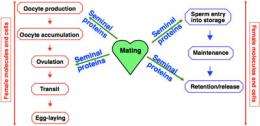
Molecules transferred from male to female fruit flies (Drosophila melanogaster) during mating cause a variety of changes in the female long after the male has left the scene, Wolfner said -- in some cases working in a kind of cooperative molecular ballet; and in other ways boosting the male's competitive advantage against rivals in a microscopic battle among the sexes.
Understanding each of those interactions better, she said, could lead to new ways of curtailing reproduction in harmful insects, or boosting it in beneficial ones. The research could also help answer key questions about chemical communication and evolution across species.
After a male and female fruit fly mate, the female undergoes a series of changes that not only improve her chances of reproductive success, but also boost the male's chances of out-propagating his potential competitors. Among these changes: mated females have increased appetites and produce more antimicrobial peptides, which kill microbial and fungal invaders; their reproductive tracts open to allow entry and storage of sperm; and they show more resistance to mating attempts by other males.
To pinpoint the causes, Wolfner and colleagues removed individual elements in the mating process and tested the females' reactions. They first narrowed the cause down to seminal fluid proteins manufactured in the male flies' accessory gland; then removed individual proteins one by one to match specific molecules and responses.
The intermolecular dialogue is vital for reproduction in general; but it also serves functions that benefit the male and female individually, Wolfner said, sometimes at the potential expense of the other. A mated female that resists mating with other males is more likely to propagate her first partner's genes, for example; but she may lose out by having fewer offspring overall. The same could happen if the interaction causes her to produce more eggs, increasing progeny for the male but potentially shortening the female's lifespan.
Ultimately, Wolfner said, knowledge gained by studying Drosophila could help researchers find ways to control insects that transmit devastating diseases, including dengue fever, West Nile encephalitis or malaria.
"One way to address the spread of these diseases is to impede the ability of their insect vectors to reproduce. By understanding the molecules that enhance or impede reproduction in Drosophila fruit flies, we gain information that can help to do that," she said.
Provided by
Cornell University
-
From lemons to lemonade: Reaction uses carbon dioxide to make carbon-based semiconductor,
30 comments
-
Thioridazine kills cancer stem cells in human while avoiding toxic side-effects of conventional cancer treatments,
3 comments
-
SpaceX private rocket blasts off for space station (Update),
42 comments
-
Climate scientists say they have solved riddle of rising sea,
30 comments
-
Research team claims to have found evidence Lake Cheko is impact crater for Tunguska Event,
18 comments
-
What would stain as translucent on light-coloured fabric?
3 hours ago
-
How do I identify different bacteria on culture plates?
13 hours ago
-
Why Do Dogs do Strange things...
May 25, 2012
-
What does exophillic and endophillic mean in terms of mosquito and their control?
May 24, 2012
-
Semen stains glows under black lights (uv light)?
May 23, 2012
-
Question on Human Chromosome 2
May 23, 2012
- More from Physics Forums - Biology
More news stories
Scientist: Evolution debate will soon be history
(AP) -- Richard Leakey predicts skepticism over evolution will soon be history. Not that the avowed atheist has any doubts himself.
2 hours ago |
3.5 / 5 (4) |
3
Thousands of shellfish found dead in Peru
Thousands of crustaceans were found dead off the coast of Lima following the mystery mass death of dolphins and pelicans, the Peruvian Navy said Friday.
12 hours ago |
4.8 / 5 (4) |
5
More plant species responding to global warming than previously thought
(Phys.org) -- Far more wild plant species may be responding to global warming than previous large-scale estimates have suggested.
May 22, 2012 |
4.6 / 5 (14) |
18
|
Totally rad: Scientists create rewritable digital data storage in DNA
(Phys.org) -- Scientists from Stanford's Department of Bioengineering have devised a method for repeatedly encoding, storing and erasing digital data within the DNA of living cells.
May 21, 2012 |
4.9 / 5 (17) |
11
|
For monogamous sparrows, it doesn't pay to stray (but they do it anyway)
It's quite common for a female song sparrow to stray from her breeding partner and mate with the male next door, but a new study shows that sleeping around can be costly.
May 22, 2012 |
5 / 5 (1) |
7
|
Dell tablet leak: 10.1-inch display, two-battery choice
(Phys.org) -- Headline after headline talks about vendors tablets in the wings as likely number-one contenders for the iPad. Such claims have justifiably been taken with a grain of salt, considering ...
SpaceX capsule has 'new car' smell, astronauts say (Update)
SpaceX's Dragon cargo vessel smells like a new car, said astronauts at the International Space Station after opening the hatches Saturday following the spacecraft's landmark mission to the orbiting lab.
SpotterRF debuts Radar Backpack Kit (w/ Video)
(Phys.org) -- SpotterRF has announced a special radar backpack kit designed to enhance situational awareness for soldiers on the ground. The company says its special radar is designed for warfighters as part ...
Keep food safety in mind this memorial day weekend
(HealthDay) -- Picnics, parades and cookouts are as much a part of Memorial Day weekend as tributes to the United States' war veterans.
Australia hails surprise super-telescope decision
Australia has hailed a surprise decision giving it a role in a radio telescope project aimed at revolutionising astronomy, vowing to draw on its decades of experience in space science.
Astronomers seize last chance in lifetime for Venus Transit
Astronomers are gearing for one the rarest events in the Solar System: an alignment of Earth, Venus and the Sun that will not be seen for another 105 years.