Tick population plummets in absence of lizard hosts
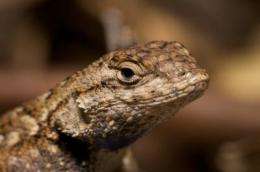
The Western fence lizard's reputation for helping to reduce the threat of Lyme disease is in jeopardy. A new study led by researchers at the University of California, Berkeley, found that areas where the lizard had been removed saw a subsequent drop in the population of the ticks that transmit Lyme disease.
"Our expectation going into this study was that removing the lizards would increase the risk of Lyme disease, so we were surprised by these findings," said study lead author Andrea Swei, who conducted the study while she was a Ph.D. student in integrative biology at UC Berkeley. "Our experiment found that the net result of lizard removal was a decrease in the density of infected ticks, and therefore decreased Lyme disease risk to humans."
The study, to be published online Tuesday, Feb. 15, in the journal Proceedings of The Royal Society B, illustrates the complex role the Western fence lizard (Sceloporus occidentalis) plays in the abundance of disease-spreading ticks.
Lyme disease – characterized by fever, headache, fatigue and a bullseye rash – is spread through the bite of ticks infected with spirochete bacteria called Borrelia burgdorferi. In the Western region of the United States, the Western black legged tick (Ixodes pacificus) is the primary vector for Lyme disease bacteria.
In 1998, a pioneering study led by UC Berkeley entomologist Robert Lane found that a protein in the Western fence lizard's blood killed Borrelia bacteria, and as a result, Lyme-infected ticks that feed on the lizard's blood are cleansed of the disease-causing pathogen. Moreover, research has found that up to 90 percent of the juvenile ticks in this species feed on the Western fence lizard, which is prevalent throughout California and neighboring states.
The lizard is thus often credited for the relatively low incidence of Lyme disease in the Western United States. The new UC Berkeley-led study put that assumption to the test experimentally.
"When you have an animal like the Western fence lizard that supports such a huge population of ticks, you can't assume that all those juvenile ticks will go to another host if the lizard population drops," said Lane, UC Berkeley Professor of the Graduate School and co-author of this study.
For their field test, the researchers selected 14 plots, each measuring 10,000 square meters and spread out over two sites in Marin County, Calif. Half the plots were located at China Camp State Park, and the other half were at the Marin Municipal Water District Sky Oaks headquarters. The researchers had already been extensively surveying tick density in those plots over the course of two years, so they had detailed data on tick and vertebrate populations before this experimental field trial.
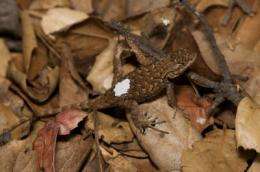
From March to April 2008, before tick season went into full swing, the researchers captured and removed 447 lizards from six plots – three at each site – and left the remaining plots unaltered as controls. The lizards that had been captured were marked before being relocated so the researchers could determine whether any wandered back into their old haunts.
After the lizards were removed, the researchers spent the following month trapping other mammals known to harbor ticks – particularly woodrats (Neotoma fuscipes) and deer mice (Peromyscus maniculatus) – to determine whether they bore an uptick in ticks as a result of the lizards' absence. The researchers also checked for differences between control and experimental plots in the abundance of host-seeking ticks by systematically dragging a large white flannel cloth over the ground.
The researchers found that in plots where the lizards had been removed, ticks turned to the female woodrat as their next favorite host. On average, each female woodrat got an extra five ticks for company when the lizards disappeared.
However, the researchers found that 95 percent of the ticks that no longer had lizard blood to feast on failed to latch on to another host.
"One of the goals of our study is to tease apart the role these lizards play in Lyme disease ecology," said Swei, who is now a post-doctoral associate at the Cary Institute of Ecosystem Studies in New York. "It was assumed that these lizards played an important role in reducing Lyme disease risk. Our study shows that it's more complicated than that."
Lane pointed out that this new study only focused on juvenile ticks, so the impact of lizard removal on adult ticks is unclear. "Previous research indicates that adult ticks have lower Lyme disease infection rates because they get their infections cleared after they feed on the lizards during the nymphal stage," he said. "It would be important to find out how removing lizards impacts tick density for both juvenile and adults over the long term."
"In attempting to decrease infectious disease risk, we need to remember the law of unexpected consequences," said Sam Scheiner, program director in the National Science Foundation Division of Environmental Biology, which funded the research through the joint NSF-NIH (National Institutes of Health) Ecology of Infectious Diseases Program. "This study demonstrates the complexity of infectious disease systems."
Provided by University of California - Berkeley


