NASA's Nautilus-X: Reusable deep manned spacecraft
February 15, 2011 by John Messina
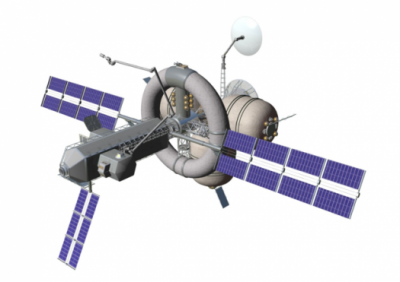
NASA's dream spacecraft would be assembled from expandable structures and hold a crew of 6 with enough supplies for a 2 year mission.
(PhysOrg.com) -- NASA is currently examining several key technologies that can advance space exploration. Dubbed Nautilus-X this tubular spacecraft can be used as a reusable vehicle for lunar and deep-space missions, holding a crew of six with enough supplies for a two-year voyage.
Mark Holderman and Edward Henderson of NASA JSC listed six technology applications in their latest presentation to the Future in Space Operations group. The six technologies include: satellite servicing, ISRU on the Moon, a SBSP demo, solar electric propulsion vehicle, propellant depots, and the Multi-Mission Space Exploration Vehicle (MMSEV).
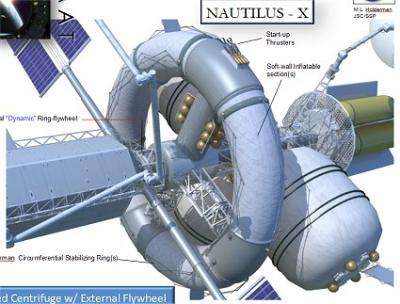
The Nautilus-X (Non-Atmospheric Universal Transport Intended for Lengthy United States eXploration) would be assembled from expandable structures, such as the inflatable living quarters proposed by Bigelow Aerospace. It would also contain a ring centrifuge to provide partial gravity, and radiation-mitigation systems that may also include tanks of water or liquid hydrogen slush, according to an article published on HobbySpaces website.
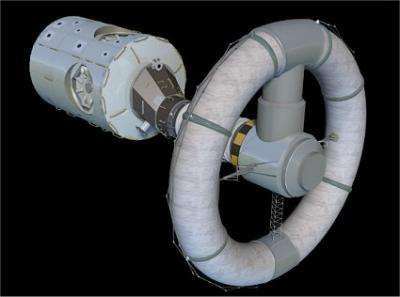
A ring centrifuge would provide partial gravity for crew’s health.
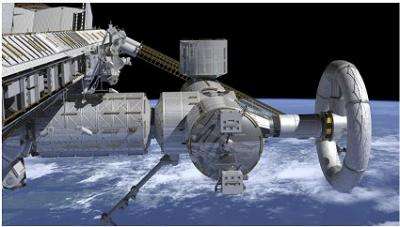
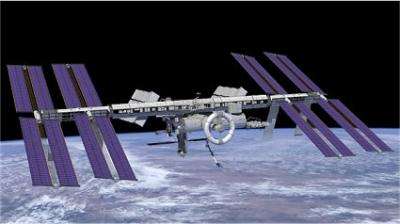
HobbySpace also mentioned that the centrifuge includes both inflatable and deployed structures and may utilize Hoberman-Sphere expandable structures. The rotational hardware would be derived from Hughes 376 spin-stabilized ComSats.The goal is to deliver the centrifuge to the International Space Station (ISS), using a single Delta-IV/Atlas-V launch, where it will be tested.
Other views of the ISS centrifuge:
Enlarge
According to Edward Henderson of NASAs Johnson Space Center the Nautilus-X will be designed as a multi-mission space exploration vehicle and could incorporate mission-specific propulsion units. In theory the engines and fuel can be swapped out depending on the mission. This all-purpose system would make it much simpler than using heavy-lift rockets for specific missions to the moon or other planets.
Its estimated that construction would take at least five years and require two or three rocket launches and cost about $3.7 billion. By using existing technologies, like Bigelow's modules and the adaptability of a multi-purpose crew transporter, could mean a system like Nautilus can play a very important role in NASA's future.
More information: via HobbySpace
© 2010 PhysOrg.com
-
From lemons to lemonade: Reaction uses carbon dioxide to make carbon-based semiconductor,
31 comments
-
Thioridazine kills cancer stem cells in human while avoiding toxic side-effects of conventional cancer treatments,
3 comments
-
SpaceX private rocket blasts off for space station (Update),
42 comments
-
Climate scientists say they have solved riddle of rising sea,
30 comments
-
Research team claims to have found evidence Lake Cheko is impact crater for Tunguska Event,
18 comments
-
revamping general concept and cosmological principle
May 25, 2012
-
Transiting Exoplanet Light Curve
May 25, 2012
-
Math behind Theoretical Physics
May 24, 2012
-
Do we know whats at the center of galaxies yet?
May 23, 2012
-
Structure of the Milky Way?
May 20, 2012
-
What would it take to terraform Pluto and Charon?
May 19, 2012
- More from Physics Forums - General Astronomy
More news stories
SpaceX capsule has 'new car' smell, astronauts say (Update)
SpaceX's Dragon cargo vessel smells like a new car, said astronauts at the International Space Station after opening the hatches Saturday following the spacecraft's landmark mission to the orbiting lab.
Space & Earth / Space Exploration
14 hours ago |
4.5 / 5 (19) |
0
Australia hails surprise super-telescope decision
Australia has hailed a surprise decision giving it a role in a radio telescope project aimed at revolutionising astronomy, vowing to draw on its decades of experience in space science.
14 hours ago |
5 / 5 (3) |
1
Astronomers seize last chance in lifetime for Venus Transit
Astronomers are gearing for one the rarest events in the Solar System: an alignment of Earth, Venus and the Sun that will not be seen for another 105 years.
14 hours ago |
5 / 5 (1) |
0
Astronauts enter world's 1st private supply ship
(AP) -- Space station astronauts floated into the Dragon on Saturday, a day after its heralded arrival as the world's first commercial supply ship.
Space & Earth / Space Exploration
14 hours ago |
5 / 5 (5) |
0
Dragon arrives at space station in historic 1st (Update 2)
The privately bankrolled Dragon capsule made a historic arrival at the International Space Station on Friday, triumphantly captured by astronauts wielding a giant robot arm.
Space & Earth / Space Exploration
May 25, 2012 |
5 / 5 (10) |
19
Dell tablet leak: 10.1-inch display, two-battery choice
(Phys.org) -- Headline after headline talks about vendors tablets in the wings as likely number-one contenders for the iPad. Such claims have justifiably been taken with a grain of salt, considering ...
Scientist: Evolution debate will soon be history
(AP) -- Richard Leakey predicts skepticism over evolution will soon be history. Not that the avowed atheist has any doubts himself.
SpotterRF debuts Radar Backpack Kit (w/ Video)
(Phys.org) -- SpotterRF has announced a special radar backpack kit designed to enhance situational awareness for soldiers on the ground. The company says its special radar is designed for warfighters as part ...
Thousands of shellfish found dead in Peru
Thousands of crustaceans were found dead off the coast of Lima following the mystery mass death of dolphins and pelicans, the Peruvian Navy said Friday.
Keep food safety in mind this memorial day weekend
(HealthDay) -- Picnics, parades and cookouts are as much a part of Memorial Day weekend as tributes to the United States' war veterans.
Family history of Alzheimer's affects functional connectivity
(HealthDay) -- Cognitively normal individuals with a family history of late-onset Alzheimer's disease (AD) may display lower resting state functional connectivity in the default mode network (DMN) of the brain, ...


Feb 15, 2011
Rank: 1.4 / 5 (16)
Feb 15, 2011
Rank: 4.5 / 5 (2)
Feb 15, 2011
Rank: 2.6 / 5 (19)
Feb 15, 2011
Rank: 4.9 / 5 (9)
Feb 15, 2011
Rank: 2.3 / 5 (8)
advanced space travel will happen when the mass of a vehicle is not constrained by the mass of the fuel that vehicle must carry in order for that vehicle to accelerate.
Feb 15, 2011
Rank: 5 / 5 (4)
Feb 15, 2011
Rank: 2.5 / 5 (6)
At 2 rpm, the minimum diameter to produce 1 G of artifical gravity would be nearly half a kilometer.
Feb 15, 2011
Rank: 4 / 5 (1)
Doesn't take that much fuel, I'm afraid. Look at the tiny size of an Apollo Service module. Coming back to Earth, now that's altogether different - but we have a nice big atmosphere that will slow you down for free (if it doesn't fry you first).
Feb 15, 2011
Rank: not rated yet
That was part of the Constellation plan, but with Constellation cancelled, ISS was extended at least until 2020.
That centrifuge looks indeed very small to me, and rotating bearings could be a potential source of problems. It would be better to shape the vehicle as a big stick and let it rotate, as in previous NASA concept.
Feb 15, 2011
Rank: 2 / 5 (3)
I'm not sure that would work.
"Rotation" requires a reference point.
Having an elongated object rotate end over end isn't very useful and only would provide a few feet of useful area with simulated gravity on either end.
Having a ring rotate gives a "relatively" high surface area with gravity, while still maintaining some of the benefits of tube shapes. Though honestly, I think they should have concentric rings to maximize the surfaces. Those near the center would have less simulated gravity, but still better than nothing.
I think they should send up like a small chest sized model of this to the ISS, with some lab mice or something similar, so that they can test in space before making the real one. This way we can make sure the principles work and the components don't experience any freaky, unforeseen failures or side effects.
Feb 15, 2011
Rank: not rated yet
The stick would rotate around short axis.
The stick will be long, maybe up to about a hundred meters. That provides plenty of useful area or volume. You can put whole transhab or large bigelow inflatable at one end, with comfortable 1g gravity and small Coriolis force.
For rotational artificial gravity, it is important to keep the radius large and rotation slow, or the astronauts will get sick. With large radius, you dont need to build circular contraptions, just a standard cylindrical module is enough. It also has much higher volume to surface (and thus, mass) ratio than circular centrifuge.
Feb 15, 2011
Rank: not rated yet
Here is rotating stick NASA study about spaceship with artificial gravity:
Feb 15, 2011
Rank: not rated yet
The "stick" in that detail is the counter weight. The habitation is the conical thing at the bottom, which to me must undoubtedly be less practical than just using a cylinder.
Feb 15, 2011
Rank: 1 / 5 (2)
Feb 16, 2011
Rank: not rated yet
Feb 16, 2011
Rank: not rated yet
Figure 4. is where the ship is depicted. It is a stick with cylindrical inflatable habitat at left end, fuel tanks and high ISP engine in the middle, and nuclear reactor with radiators at right end. Figures 1. and 2. depict previous concepts from older studies.
Feb 16, 2011
Rank: 4 / 5 (4)
We are tring do cut down the tree with a dull axe, instead we should spend some time sharpening the axe.
Feb 16, 2011
Rank: 5 / 5 (4)
The module and the counterweight will spin around the center of mass for the system. Fine tuning the spin rate is a simple matter of reeling the cable in or out once you get it spinning. For docking with another ship, you stop the spin and reel the counterweight in so it doesn't float about.
With a ring shape centrifuge, you have to deal with mass distribution because the system tends to wobble if it isn't perfectly balanced. You'd need something like a pumped water ballast to counter the fact that people might move around inside it.
With a counterweight system with the hab module at the other end, you don't.
Feb 16, 2011
Rank: 1 / 5 (2)
I noticed some issues that are going to be very hard to solve, such as the fact that after the landing vehicle is on mars, the main spacecraft will be out of balance due to the loss of mass. Also, even when the lander comes back, it is missing the descent stage and all the fuel, so the main craft will be out of balance anyway.
For the return trip, you could have an ejectable mass, preferably something with an actual use, like a probe or satellite, on the other side of the counter weight to offset the loss of mass. This would not work completely during the landing part of the mission, because your only options are to do nothing, or to over compensate, (since some of the "lost" mass of the lander actually is coming back later,) and overcompensating is just as bad as doing nothing.
Feb 16, 2011
Rank: 1 / 5 (1)
This is brilliant, because it would allow two sets of seismometers to be installed, as well as two weather stations, and it would allow you to do core sample geology at two very different, yet "relatively close" locations...on one mission.
====
Otherwise, I think the landing vehicle needs to be attached at the axis of rotation in order to help avoid "most" of these complications, but as they discussed in the paper, this approach causes more complications, such as the need to either de-spin the vehicle, or match it's spin on docking, not to mention balance and center of mass issues, etc.
Feb 16, 2011
Rank: 5 / 5 (1)
Why not skip the "counterweight" completely, and replace it with another crew habitat?
This would give 2 landers and 2 crews, with one large enging system and power plant in the center between the habitats, and so it solves any symetry or center of gravity issues automatically. It allows two seperate lander missions, which also solves the fuel mass/decent stage mass loss issue, because the losses are equal. This avoids the need to bring along any sort of ejectable ballast, and it avoids the issues of docking in the center axis.
Feb 16, 2011
Rank: 1 / 5 (4)
Feb 16, 2011
Rank: 5 / 5 (3)
Inflatable does not in any way imply weak. Look at transhab and bigelow habitats. The wall is tens of centimeters thick, with many layers, and is supposed to be safer than current ISS modules. Shielding against micrometeoroids included.
Feb 16, 2011
Rank: 4.2 / 5 (6)
Feb 17, 2011
Rank: 5 / 5 (1)
umm, testing scaled down model = duh. That's engineering.
Balance issues - could be minimized or eliminated with good design. Presumably the landing craft would not be on the spinning part...
Why are you such a debbie downer? Did mars beat you up when you were a kid?
Feb 19, 2011
Rank: 5 / 5 (1)
Feb 21, 2011
Rank: not rated yet
In that movie one of the astronauts was jogging around a cyclindrical track. I thought his personal center of gravity was "given" tangential inertia by pushing off and picking up speed jogging around the track.. eventually his mass experienced the centrifugal force and thus the track did not rotate.
This has always seemd "safer" to me, human coordination controls the amount of gravity, balance corrections in the inner ear would prevent them from running into things.. of course over coming the vomit comet effect was something I never thought about at six years old.
For medicinal purposes, or gravity requiring work.. they could get on an electric racetrack running around the inside of the drum.. seems a magnet linear levitator could impel a person or work module to any speed necessary.
As for the vomit comet effect.. years later in college it occurred to me that neuralmagnetic damping
Feb 21, 2011
Rank: not rated yet
Feb 21, 2011
Rank: 5 / 5 (2)
tinyurl.com/nuclear-fusion-starship
Feb 25, 2011
Rank: 5 / 5 (1)
Better yet, use an electrodynamic space thruster on the Nautilus-X.