Nanofabrication tools may make silicon optical chips more accessible
February 25, 2011 By Maria Callier
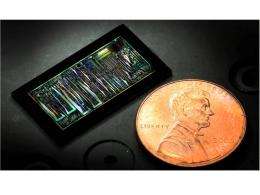
A dark-field optical image of a silicon photonic chip is shown in comparison to the size of a penny. Credit: Elijah Douglas Christenson
In an effort to make it easier to build inexpensive, next-generation silicon-based electro-optical chips, which allow computers to move information with light and electricity, a University of Washington photonics professor, Dr. Michael Hochberg and his research team are developing design tools and using commercial nanofabrication tools.
Silicon optical chips are critical to the Air Force because of their size, weight, power, rapid cycle time, program risk reduction and the improvements they can offer in data communications, lasers and detectors.
The Air Force Office of Scientific Research is funding this effort in silicon photonics called "Optoelectronic Systems Integration in Silicon" at UW's Nanophotonics Lab in Seattle. OpSIS is hosted by UW's Institute for Photonic Integration. Hochberg is in charge of the OpSIS research program, the Nanophotonics Lab and the Institute for Photonic Integration.
Hochberg emphasizes that the funding from the Air Force Research Laboratory and AFOSR is a critical component in getting the effort off the ground because it provides both a strong technical validation, and the resources to get started on the project.
Unlike most research groups that are designing, building and testing silicon photonic devices or optical chips in-house rather than by using commercial chip fabrication facilities, the UW researchers are using shared infrastructure at the foundry at BAE Systems in Manassas, Virginia. There they are working toward creating high-end, on-shore manufacturing capabilities that will be ultimately made available to the wider community. In the past few years, complex photonic circuitry has not been accessible to researchers because of the expense and a lack of standard processes.
The UW researchers are working on system design and validation so they can imitate what's been done in electronics by stabilizing and characterizing some processes so that the transition from photonics to systems can be smooth.
"The OpSIS program will help advance the field of silicon photonics by bringing prototyping capability within reach of startup companies and researchers," said Hochberg. "They will provide design rules, device design support and design-flow development so that even non-experts will be able to design and integrate photonics and electronics."
Silicon photonics has developed over the last decade, and the transition from using devices to systems is something that has only recently occurred.
"The digital electronics revolution over the past 40 years has had a transformative effect on how the Air Force systems are built, and we're hoping to have a similar impact on photonic systems," he said.
The researchers' current goal is to work first on test runs for the new optical chips for commercial uses and on developing some software tools that will make the design process easier.
AFOSR program manager, Dr. Gernot S. Pomrenke, agrees with Prof. Hochberg. "Integrating silicon photonics will impact Air Force, DoD and commercial avionics," he said. "AFRL has been a leader in developing and supporting this technology over the last two decades and the OpSIS program will help in transitioning silicon photonics into new system capabilities."
Provided by Air Force Office of Scientific Research
-
From lemons to lemonade: Reaction uses carbon dioxide to make carbon-based semiconductor,
30 comments
-
Thioridazine kills cancer stem cells in human while avoiding toxic side-effects of conventional cancer treatments,
3 comments
-
SpaceX private rocket blasts off for space station (Update),
42 comments
-
Climate scientists say they have solved riddle of rising sea,
30 comments
-
Research team claims to have found evidence Lake Cheko is impact crater for Tunguska Event,
18 comments
-
magnets or EMF in car bumpers to protect from fender bender
17 hours ago
-
length of wire in a coil of known dimensions?
May 25, 2012
-
India Engineering Powerhouse
May 25, 2012
-
electromagnet core dereference between hard and soft iron
May 25, 2012
-
Measuring water pressure in an open tank
May 24, 2012
-
Question from a non-engineer: Pulley Systems
May 24, 2012
- More from Physics Forums - General Engineering
More news stories
SpotterRF debuts Radar Backpack Kit (w/ Video)
(Phys.org) -- SpotterRF has announced a special radar backpack kit designed to enhance situational awareness for soldiers on the ground. The company says its special radar is designed for warfighters as part ...
Probability of contamination from severe nuclear reactor accidents is higher than expected: study
Catastrophic nuclear accidents such as the core meltdowns in Chernobyl and Fukushima are more likely to happen than previously assumed. Based on the operating hours of all civil nuclear reactors and the number ...
Technology / Energy & Green Tech
May 22, 2012 |
3.6 / 5 (21) |
52
|
Delphi gasoline-injection engine technique rivals hybrid's edge
(Phys.org) -- Running a diesel like engine on gasoline is something Delphi is doing in notable fashion. They claim they are on to a promising way to enjoy an engine that gives the vehicle owner high efficiency ...
HyperSolar shows dirty water no barrier to power world
(Phys.org) -- The Santa Barbara, California, company, HyperSolar, is set to transparently share the ups and downs of its research experiences toward the companys ultimate vision, successfully producing ...
Tesla to launch electric sedan in US on June 22
Tesla Motors said Tuesday it would begin deliveries of "the world's first premium electric sedan" on June 22, slightly ahead of schedule.
Technology / Energy & Green Tech
May 22, 2012 |
4.5 / 5 (11) |
18
Dell tablet leak: 10.1-inch display, two-battery choice
(Phys.org) -- Headline after headline talks about vendors tablets in the wings as likely number-one contenders for the iPad. Such claims have justifiably been taken with a grain of salt, considering ...
Scientist: Evolution debate will soon be history
(AP) -- Richard Leakey predicts skepticism over evolution will soon be history. Not that the avowed atheist has any doubts himself.
SpaceX capsule has 'new car' smell, astronauts say (Update)
SpaceX's Dragon cargo vessel smells like a new car, said astronauts at the International Space Station after opening the hatches Saturday following the spacecraft's landmark mission to the orbiting lab.
Thousands of shellfish found dead in Peru
Thousands of crustaceans were found dead off the coast of Lima following the mystery mass death of dolphins and pelicans, the Peruvian Navy said Friday.
Keep food safety in mind this memorial day weekend
(HealthDay) -- Picnics, parades and cookouts are as much a part of Memorial Day weekend as tributes to the United States' war veterans.
Australia hails surprise super-telescope decision
Australia has hailed a surprise decision giving it a role in a radio telescope project aimed at revolutionising astronomy, vowing to draw on its decades of experience in space science.