New marker found for Sanfilippo disease
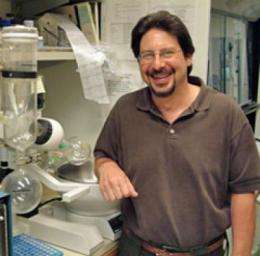
This is Jeffrey D. Esko, Ph.D., of University of California - San Diego. Credit: UC San Diego School of Medicine
Sanfilippo disease is a rare disorder caused by the failure of enzymes to break down specific kinds of complex carbohydrates, resulting in their accumulation in cells and often severe physical and neurological problems and sometimes early death.
In a paper published in the March 4 issue of the Journal of Biological Chemistry, researchers at the University of California, San Diego School of Medicine, led by Jeffrey D. Esko, PhD, professor in the Department of Cellular and Molecular Medicine, describe the build-up of a novel secondary metabolite in Sanfilippo disease, a discovery that could improve understanding of the disease's pathology and refine diagnostic techniques.
Sanfilippo is one of a group of genetically inherited metabolic disorders called mucopolysaccharidoses, all of which involve the inability of different lysosomal enzymes to catabolize or break down glycosaminoglycans complex sugar carbohydrates that help cells build skin, bone, cartilage, tendons and connective tissues.
"It's a very ordered sequence of degradation," said Esko, co-director of the Glycobiology Research and Training Center at UC San Diego. "Interference with any of the steps in the enzymatic process results in an accumulation of metabolites, which causes lyosomal dysfunction. Cells become constipated, leading to internal changes and dysfunction."
For patients with severe mucopolysaccharidosis, the consequences can be catastrophic. As incompletely degraded glycosaminoglycans accumulate in cells and tissues, they cause permanent, progressive damage that affects appearance, physical abilities, organ function and, most profoundly, mental development. Children with the disease can experience severe neuropathology and significant early mortality. It's estimated that 1 in 25,000 children in the United States have one of several forms of the disease. Some mucopolysaccharidoses can be temporarily treated with enzyme replacement therapies, but the body's blood-brain barrier blocks neurological benefit. There is no current cure.
"The three approved drugs on the market mask the genetic defect by supplementing the missing enzymes," said Esko. "They can help resolve storage in many organs, but not the brain because the enzymes do not cross the barrier. And they are very, very expensive."
In the new research, Esko and colleague William C. Lamanna, PhD, studied enzymatic activity in Sanfilippo patient fibroblasts, a type of cell most commonly found in connective tissues. They noted that defective enzymatic activity resulted in the accumulation of not just a glycosaminoglycan called heparan sulfate, but also a secondary metabolite called dermatan sulfate. Sanfilippo cells had levels of dermatan sulfate two- to five-fold higher than normal.
The combined accumulation of heparan sulfate with dermatan sulfate, researchers said, may explain some of the distinct pathological features of Sanfilippo disease. The emergence of dermatan sulfate as an additional biomarker for Sanfilippo disease could be useful in detection and diagnosis, though Esko said studies using patient tissue biopsies or blood or urine samples remain to be conducted.
"Right now, this discovery probably won't change the current therapy for Sanfilippo" said Lamanna, "but it does improve what we know about how the disease works and how to diagnose it."
Provided by
University of California - San Diego
-
From lemons to lemonade: Reaction uses carbon dioxide to make carbon-based semiconductor,
30 comments
-
Thioridazine kills cancer stem cells in human while avoiding toxic side-effects of conventional cancer treatments,
3 comments
-
SpaceX private rocket blasts off for space station (Update),
42 comments
-
Climate scientists say they have solved riddle of rising sea,
30 comments
-
Research team claims to have found evidence Lake Cheko is impact crater for Tunguska Event,
18 comments
-
Schwartz reagent-- NMR/MS/IR
12 hours ago
-
Inversion temp
17 hours ago
-
High school chemistry EEI
May 25, 2012
-
oxidation of I- by KMnO4
May 25, 2012
-
Invesion temp
May 25, 2012
-
Hybridization of SnCl3 -
May 25, 2012
- More from Physics Forums - Chemistry
More news stories
From lemons to lemonade: Reaction uses carbon dioxide to make carbon-based semiconductor
(Phys.org) -- A materials scientist at Michigan Technological University has discovered a chemical reaction that not only eats up the greenhouse gas carbon dioxide, it also creates something useful. And, by ...
May 21, 2012 |
4.7 / 5 (88) |
30
|
New CO2-removing catalyst can take the heat
(Phys.org) -- The current method of removing the greenhouse gas carbon dioxide (CO2) from the flues of coal-fired power plants uses so much energy that no one bothers to use it. So says Roger Aines, principal ...
May 24, 2012 |
5 / 5 (7) |
7
|
High-speed method to aid search for solar energy storage catalysts
Eons ago, nature solved the problem of converting solar energy to fuels by inventing the process of photosynthesis.
May 25, 2012 |
5 / 5 (3) |
4
|
Researchers demonstrate possible primitive mechanism of chemical info self-replication
(Phys.org) -- When scientists think about the replication of information in chemistry, they usually have in mind something akin to what happens in living organisms when DNA gets copied: a double-stranded molecule ...
May 25, 2012 |
5 / 5 (4) |
2
|
Castor oil: Action mechanism of one of the oldest drugs known to man elucidated
Castor oil is known primarily as an effective laxative; however, it was also used in ancient times with pregnant women to induce labour. Only now have scientists at the Max Planck Institute for Heart and Lung ...
May 21, 2012 |
3 / 5 (2) |
3
|
Dell tablet leak: 10.1-inch display, two-battery choice
(Phys.org) -- Headline after headline talks about vendors tablets in the wings as likely number-one contenders for the iPad. Such claims have justifiably been taken with a grain of salt, considering ...
Scientist: Evolution debate will soon be history
(AP) -- Richard Leakey predicts skepticism over evolution will soon be history. Not that the avowed atheist has any doubts himself.
SpotterRF debuts Radar Backpack Kit (w/ Video)
(Phys.org) -- SpotterRF has announced a special radar backpack kit designed to enhance situational awareness for soldiers on the ground. The company says its special radar is designed for warfighters as part ...
SpaceX capsule has 'new car' smell, astronauts say (Update)
SpaceX's Dragon cargo vessel smells like a new car, said astronauts at the International Space Station after opening the hatches Saturday following the spacecraft's landmark mission to the orbiting lab.
Thousands of shellfish found dead in Peru
Thousands of crustaceans were found dead off the coast of Lima following the mystery mass death of dolphins and pelicans, the Peruvian Navy said Friday.
Keep food safety in mind this memorial day weekend
(HealthDay) -- Picnics, parades and cookouts are as much a part of Memorial Day weekend as tributes to the United States' war veterans.