Lake-effect theory sinks, but quake timing questions go on
(PhysOrg.com) -- A chronology of 1,000 years of earthquakes at the southern end of the San Andreas Fault nixes the idea that lake changes in the now-dry region caused past quakes. However, researchers say, the timeline pulled from sediment in three deep trenches confirms that this portion of the fault is long past the expected time for a major temblor that would strongly shake the Los Angeles Basin.
The new study, appearing in the February issue of the Bulletin of the Seismological Society of America, doesn't change existing thinking about the threat of a major quake -- potentially measuring 7.0 to 8.0 on the Richter scale -- for southern California. It does, however, provide the first published documentation of much-discussed data that have emerged in the last three decades from an area that is now rapidly being built up and populated, just north of the Salton Sea.
Projections of such a quake in recent years led to the nation's largest-ever drill, the Great Southern California ShakeOut, last year. The 2011 ShakeOut is set for Oct. 20. There's even a video projection of the quake's probable route created by the Southern California Earthquake Center. The last earthquake to originate from the area occurred in about 1690.
The new study, said co-author Ray Weldon, professor and head of the department of geological sciences at the University of Oregon, documents that the south end of the San Andreas fault has gone perhaps 140 years longer than the average 180 years between quakes.
"We have dated the last five to seven prehistoric earthquakes of the southernmost 100 kilometers (about 60 miles) of the San Andreas Fault, which is the only piece of the fault that hasn't ruptured in historical times," Weldon said. "If you were there in about 1690, when the last earthquake occurred, the odds of getting to 2010 without an earthquake would have been 20 percent or less."
Weldon stopped short of concluding that a major earthquake is due or overdue, saying that data from this study and other recent work may just as well point to unknowns in current earthquake-modeling techniques.
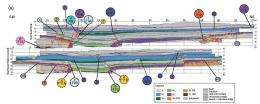
The seven earthquake events, including the two possible temblors, were placed between 905-961 AD, 959-1015 (possible), 1090-1152, 1275-1347, 1320-1489 (possible), 1588-1662 and 1657-1713, based on analyses of seismic structures preserved in the sediment in the three trenches and 82 radiocarbon dates drawn from 61 samples of organic material.
Weldon and co-authors -- former UO graduate student Belle Philibosian, now pursuing a doctorate at the California Institute of Technology (Cal Tech), and Thomas Fumal of the U.S. Geological Survey, who died in December -- concluded there is a high probability of rupture in the fault because of a likely buildup of tectonic stress.
The study area is in the dry bed of prehistoric Lake Cahuilla at Coachella, Calif. The lake has been dry since about 1715, according to timelines found in early travelers' descriptions of the area. Researchers found that the lakebed was full of water six times in the study period.
"We now have the best chronology of these lakes that has ever existed," said Weldon, who knows the area well from previous work.
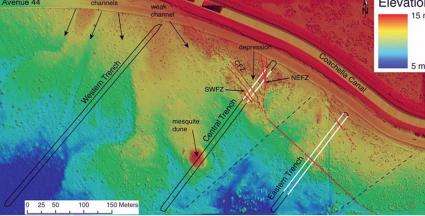
As a doctoral student, he was part of a Cal Tech team led by Kerry Sieh that studied a nearby site in the late 1970s and early 1980s. Seismologists have cited the team's never-fully published findings often. Weldon's return to the region began when researchers were granted access to three 26-foot-deep trenches dug to determine Alquist-Priolo earthquake fault zones as required under California law to assure that human dwellings are not built on fault lines. The trenches, two of which exposed the fault, provide direct access to layers of lake sediments and alluvial deposits.
The Lake Cahuilla Basin, 132 miles from downtown Los Angeles, is separated from the Gulf of California to the south by the expansive, ever-changing delta of the Colorado River. The current body of water in the lake's southern basin, called the Salton Sea, was born in 1905, when heavy rain and snowmelt in the Colorado River drainage led to the collapse of an intake canal built for irrigation purposes just south of Yuma, Ariz. The river then poured into the sink.
The observation that the last lake and last quake were at about 1700 AD and that there have been seven earthquakes and seven lakes during the approximately past 1,000 years have led to the hypothesis that the filling or emptying of each lake triggered earthquake events by changing the pressure on the fault plane below. The new study, Weldon said, shoots down that idea.
The data show that earthquakes occurred in all scenarios: when the lake was filling, while it was full, when it was draining and even when it had long been dried up. In fact, researchers found, the last quake in about 1690 occurred when the lake was full, just before it drained. Calculations of how long the lake would take to dry, if shut off from its Colorado River source coupled with travelers' journals, cited in the study, actually provide witness to the lake's disappearance. "If anything, the earthquake made the lake go away," Weldon said.
"The most popular hypothesis has been that the filling of the lake causes an earthquake, or the draining of the lake causes a quake," he said. "Neither can be true based on where we've found. There's probably no relationship, but if you want to say there is a relationship, it could be that the quakes make or unmake the lakes."
That scenario, he added, could mean that earthquakes have at times shifted the Colorado River's pathway into or away from Lake Cahuilla's bed, perhaps by shaken driven lateral spreading and collapse of its riverbanks
Seismic activity has been common in the Imperial Valley south of the Salton Sea, which is the continuation of the plate boundary to the south but not part of the actual fault, Weldon noted.
"At some point, this area will get kicked by shaking from one of the many quakes that happen south of the San Andreas Fault," he said. "It will rupture northward along the fault. When it comes into the San Bernardino Valley, seismic energy will be directed by a series of basins, including the Los Angeles Basin, into the most highly populated part of Southern California"
Provided by University of Oregon


