Japanese stem cell researcher wins top award
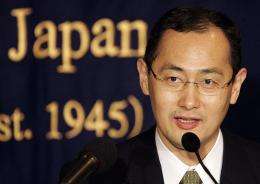
Professor Shinya Yamanaka of the Institute for Frontier Medical Science, Kyoto University, attends a press conference at the Foreign Correspondents' Club of Japan in Tokyo 2008. Yamanaka was Friday honoured with a Spanish award worth 400,000 euros ($544,000) for his pioneering work on cell reprogramming.
Japanese scientist Shinya Yamanaka was Friday honoured with a Spanish award worth 400,000 euros ($544,000) for his pioneering work on cell reprogramming.
Yamanaka won the BBVA Foundation Frontiers of Knowledge Award in Biomedicine, the foundation announced.
The former orthopedic surgeon made his breakthrough discovery in 2006 when he succeeded in generating "induced pluripotent stem (iPS) cells", or those capable of growing into other tissues in the body.
Until Yamanaka proved differently, scientists believed that this could only be achieved with stem cells harvested from embyros, the foundation said in a statement.
"The jury emphasised the exciting new vistas these cells open up for both basic and clinical research, with personalised therapies and more precisely targeted drugs," it added.
"The possibility of working with iPS cells derived from patients themselves will avoid treating patients as guinea pigs. It will allow novel cell-based screening methods to be used to search for small molecule drugs to treat a wide range of diseases.
"And, ultimately, it may also allow novel and even patient-specific cell-based treatments, in particular for degenerative disease."
Yamanaka said the idea of reversing the fate of already specialised cells, then a "no-can-do" in biology, came to him when studying the experiments that produced the first cloned frogs, in the 1970s, and Dolly the sheep in 1996, according to the foundation statement.
"From their work I learned that we should be able to convert somatic cells back into their embryonic state. That is what inspired me to start my project," said Yamanaka, 48, the director of the Centre for iPS Cell Research and Application at Japan's Kyoto University.
The BBVA Foundation Frontiers of Knowledge Awards, established in 2008, recognise research and artistic creation in eight categories.
(c) 2011 AFP
-
From lemons to lemonade: Reaction uses carbon dioxide to make carbon-based semiconductor,
30 comments
-
Thioridazine kills cancer stem cells in human while avoiding toxic side-effects of conventional cancer treatments,
3 comments
-
SpaceX private rocket blasts off for space station (Update),
42 comments
-
Climate scientists say they have solved riddle of rising sea,
30 comments
-
Research team claims to have found evidence Lake Cheko is impact crater for Tunguska Event,
18 comments
-
What would stain as translucent on light-coloured fabric?
4 hours ago
-
How do I identify different bacteria on culture plates?
14 hours ago
-
Why Do Dogs do Strange things...
May 25, 2012
-
What does exophillic and endophillic mean in terms of mosquito and their control?
May 24, 2012
-
Semen stains glows under black lights (uv light)?
May 23, 2012
-
Question on Human Chromosome 2
May 23, 2012
- More from Physics Forums - Biology
More news stories
Scientist: Evolution debate will soon be history
(AP) -- Richard Leakey predicts skepticism over evolution will soon be history. Not that the avowed atheist has any doubts himself.
3 hours ago |
3 / 5 (5) |
8
Thousands of shellfish found dead in Peru
Thousands of crustaceans were found dead off the coast of Lima following the mystery mass death of dolphins and pelicans, the Peruvian Navy said Friday.
13 hours ago |
4.8 / 5 (4) |
5
More plant species responding to global warming than previously thought
(Phys.org) -- Far more wild plant species may be responding to global warming than previous large-scale estimates have suggested.
May 22, 2012 |
4.6 / 5 (14) |
18
|
Totally rad: Scientists create rewritable digital data storage in DNA
(Phys.org) -- Scientists from Stanford's Department of Bioengineering have devised a method for repeatedly encoding, storing and erasing digital data within the DNA of living cells.
May 21, 2012 |
4.9 / 5 (17) |
11
|
For monogamous sparrows, it doesn't pay to stray (but they do it anyway)
It's quite common for a female song sparrow to stray from her breeding partner and mate with the male next door, but a new study shows that sleeping around can be costly.
May 22, 2012 |
5 / 5 (1) |
7
|
Dell tablet leak: 10.1-inch display, two-battery choice
(Phys.org) -- Headline after headline talks about vendors tablets in the wings as likely number-one contenders for the iPad. Such claims have justifiably been taken with a grain of salt, considering ...
SpaceX capsule has 'new car' smell, astronauts say (Update)
SpaceX's Dragon cargo vessel smells like a new car, said astronauts at the International Space Station after opening the hatches Saturday following the spacecraft's landmark mission to the orbiting lab.
SpotterRF debuts Radar Backpack Kit (w/ Video)
(Phys.org) -- SpotterRF has announced a special radar backpack kit designed to enhance situational awareness for soldiers on the ground. The company says its special radar is designed for warfighters as part ...
Keep food safety in mind this memorial day weekend
(HealthDay) -- Picnics, parades and cookouts are as much a part of Memorial Day weekend as tributes to the United States' war veterans.
Australia hails surprise super-telescope decision
Australia has hailed a surprise decision giving it a role in a radio telescope project aimed at revolutionising astronomy, vowing to draw on its decades of experience in space science.
Astronomers seize last chance in lifetime for Venus Transit
Astronomers are gearing for one the rarest events in the Solar System: an alignment of Earth, Venus and the Sun that will not be seen for another 105 years.