Internet addresses: An inevitable shortage, but an uneven one
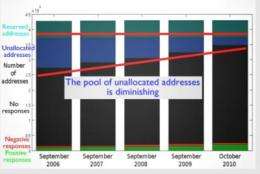
Better utilization, trading and other strategies can recover twice or four times current utilization. But requests for address double every year, so trading will only help for two years. Credit: USC Information Sciences Institute
As Internet authorities prepare to announce that they have handed over all of the available addresses, a USC research group that monitors address usage has completed the latest in its series of Internet censuses.
There is some good news, according to computer scientist John Heideman, who heads a team at the USC Viterbi School of Engineering Information Sciences Institute that has just released its results in the form of a detailed outline, including a 10-minute video and an interactive web browser that allows users to explore the nooks and crannies of Internet space themselves.
Heidemann who is a senior project leader at ISI and a research associate professor in the USC Viterbi School of Engineering Department of Computer Science, says his group has found that while some of the already allocated address blocks (units of Internet real estate, ranging from 256 to more than 16 million addresses) are heavily used, many are still sparsely used. "Even allowing for undercount," the group finds, "probably only 14 percent of addresses are visible on the public Internet."
Nevertheless, "as full allocation happens, there will be pressure to improve utilization and eventually trade underutilized areas," the video shows. These strategies have limits, the report notes. Better utilization, trading, and other strategies can recover "twice or four times current utilization. But requests for address double every year, so trading will only help for two years. Four billion addresses are just not enough for 7 billion people."
The IPv6 protocol allows many, many more addresses 1000 1000 trillion but may involve transition costs.
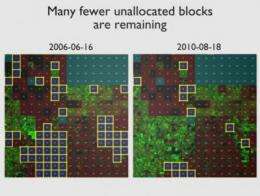
Web addresses are nearing full allocation. Yellow boxes indicate unallocated blocks, while green areas show responses to census and high utilization. Credit: USC Information Sciences Institute
Heideman's group report comes as the Number Resource Organization (NRO) and he Internet Assigned Numbers Authority (IANA) are preparing to make an announcement saying they have given out all the addresses, passing on most to regional authorities.The ISI video offers a thorough background in the hows and whys of the current IPv4 Internet address system, in which each address is a number between zero and 2 to the 32nd power (4,294,967,295), usually written in "dotted-decimal notation" as four base-10 numbers separated by periods.
Heidemann, working with collaborator Yuri Pradkin and ISI colleagues, produced an earlier Internet census in 2007, following on previous work at ISI -- the first complete census since 1982. To do it, they sent a message ('ping') each to each possible Internet address. The video explains the pinging process.
At the time, some 2.8 million of the 4.3 million possible addresses had been allocated; today more than 3.5 million are allocated. The current effort, funded by Department of Homeland Security Science and Technology Directorate and the NSF, was carried out by Aniruddh Rao and Xue Cui of ISI, along with Heidemann. Peer-reviewed analysis of their approach appeared in ACM Internet Measurements Conference, 2008.
Provided by
University of Southern California
-
From lemons to lemonade: Reaction uses carbon dioxide to make carbon-based semiconductor,
30 comments
-
Thioridazine kills cancer stem cells in human while avoiding toxic side-effects of conventional cancer treatments,
3 comments
-
SpaceX private rocket blasts off for space station (Update),
42 comments
-
Climate scientists say they have solved riddle of rising sea,
30 comments
-
Research team claims to have found evidence Lake Cheko is impact crater for Tunguska Event,
18 comments
-
Ideas to mitigate risk of 911 calls being misdirected
May 24, 2012
-
Live scribe pen?
May 10, 2012
-
Shallow water flow simulation
May 07, 2012
-
Tablet for taking notes?
May 05, 2012
-
Best fit tablet for me?
May 05, 2012
-
Measure of Informaton
May 04, 2012
- More from Physics Forums - Computing & Technology
More news stories
SpotterRF debuts Radar Backpack Kit (w/ Video)
(Phys.org) -- SpotterRF has announced a special radar backpack kit designed to enhance situational awareness for soldiers on the ground. The company says its special radar is designed for warfighters as part ...
Probability of contamination from severe nuclear reactor accidents is higher than expected: study
Catastrophic nuclear accidents such as the core meltdowns in Chernobyl and Fukushima are more likely to happen than previously assumed. Based on the operating hours of all civil nuclear reactors and the number ...
Technology / Energy & Green Tech
May 22, 2012 |
3.7 / 5 (20) |
52
|
Delphi gasoline-injection engine technique rivals hybrid's edge
(Phys.org) -- Running a diesel like engine on gasoline is something Delphi is doing in notable fashion. They claim they are on to a promising way to enjoy an engine that gives the vehicle owner high efficiency ...
HyperSolar shows dirty water no barrier to power world
(Phys.org) -- The Santa Barbara, California, company, HyperSolar, is set to transparently share the ups and downs of its research experiences toward the companys ultimate vision, successfully producing ...
Tesla to launch electric sedan in US on June 22
Tesla Motors said Tuesday it would begin deliveries of "the world's first premium electric sedan" on June 22, slightly ahead of schedule.
Technology / Energy & Green Tech
May 22, 2012 |
4.5 / 5 (11) |
18
Dell tablet leak: 10.1-inch display, two-battery choice
(Phys.org) -- Headline after headline talks about vendors tablets in the wings as likely number-one contenders for the iPad. Such claims have justifiably been taken with a grain of salt, considering ...
Scientist: Evolution debate will soon be history
(AP) -- Richard Leakey predicts skepticism over evolution will soon be history. Not that the avowed atheist has any doubts himself.
SpaceX capsule has 'new car' smell, astronauts say (Update)
SpaceX's Dragon cargo vessel smells like a new car, said astronauts at the International Space Station after opening the hatches Saturday following the spacecraft's landmark mission to the orbiting lab.
Keep food safety in mind this memorial day weekend
(HealthDay) -- Picnics, parades and cookouts are as much a part of Memorial Day weekend as tributes to the United States' war veterans.
Thousands of shellfish found dead in Peru
Thousands of crustaceans were found dead off the coast of Lima following the mystery mass death of dolphins and pelicans, the Peruvian Navy said Friday.
Australia hails surprise super-telescope decision
Australia has hailed a surprise decision giving it a role in a radio telescope project aimed at revolutionising astronomy, vowing to draw on its decades of experience in space science.

Feb 01, 2011
Rank: 5 / 5 (3)
Why hasn't everyone switched to IPv6? I don't know. The needed software support has been in operating systems for years now, and the big holdup has been some large Internet switches with software that hasn't been updated for years. In some cases the hardware version hasn't been built in years either, and the hardware vendor has stopped supporting the switch. Worse, in some cases the switch vendor has gone out of business.
I think what is needed is for the major ISPs and backhaul networks to get together and set a drop dead date for IPv4 in the US and Canada. This would require remapping software at the boundaries, but that was always part of IPv6. Of course, if the US did this, Europe and the Far East would probably follow quickly.
Feb 01, 2011
Rank: not rated yet
You're right about the hardware and right that a drop dead date is probably the only thing that will force hands. This is a substantial investment that will eat into already small profit margins (for non-giants like Comcast/Quest/etc). Bandwidth usage is 10x the concern of address shortages. ISPs will implement more NAT before investing months of profits on hardware that does not improve performance. They'll switch to IPv6 when they have to, not sooner.
Feb 01, 2011
Rank: 5 / 5 (2)
Feb 01, 2011
Rank: not rated yet
Feb 02, 2011
Rank: 5 / 5 (1)
You're still going to have to route due to the way the internet functions. It's a physics problem, not a logical division problem.
If every machine was connected to the internet directly, no one would be able to send or receive data. Keep in mind, only one computer can talk on a logical segment at a time. If you remove network segmentation, you'll bring the internet to a standstill.
Feb 04, 2011
Rank: not rated yet