New findings in India’s Bt cotton controversy: good for the field, bad for the farm?
February 7, 2011 By Neil Schoenherr
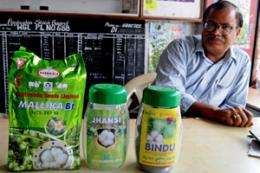
A seed vendor in Warangal, Andhra Pradesh, shows three different cotton seed brands that are all the same seed. Stone's research shows that most farmers have become unable to properly assess the seeds and sprays that are changing with increasing speed. Credit: GLENN STONE
Crop yields from Indias first genetically modified crop may have been overemphasized, as modest rises in crop yields may come at the expense of sustainable farm management, says a new study by a Washington University in St. Louis anthropologist.
The study, by Glenn Stone, PhD, professor of anthropology in Arts & Sciences, appears in the March issue of the journal World Development.
In his paper, Stone compares village yields in 2003 and 2007, which conveniently had very similar levels of rainfall. Cotton yields rose 18 percent with the adoption of genetically modified seeds, Stone says. This is less than what has been reported in some economics studies, but much better than activists have claimed.
Pesticide sprayings were also down by 55 percent with the switch to genetically modified seed.
The crop in question is Bt cotton, genetically modified to produce its own insecticide. Approved for Indian farmers since 2002, the technology is being closely watched because it is the most widely planted GM crop on small farms in the developing world.
Many activists and commentators, including Englands Prince Charles, have accused Bt cotton of failing, ruining small farmers and causing suicides, Stone claims.
Several studies by economists, however, have shown Bt cotton farmers to be getting higher yields when compared with planters of conventional cotton.
These economics studies have had a serious weakness, says Stone, the incoming president of the Anthropology & Environment section of the American Anthropological Association. The adopters of the new seeds tend to be the most prosperous and well-financed farmers, who were getting better yields than other farmers even before Bt seeds were adopted. Our anthropological research project used a different strategy to assess the seeds performance.
Stone conducted long-term research in four villages in Andhra Pradesh, India. He found that in 2003, none of the village farmers had adopted Bt seeds, but by 2007, adoption was 100 percent.
In the paper, Stone also examines overall farm management, finding that the new seeds have come with their own set of problems.
I would love to see Bt seeds as a real solution to these farmers insect problems, as many have claimed, but this may be a bit naive, Stone says. Conditions in the cotton fields change quickly. Populations of insects not affected by Bt have now begun to explode. We cant forget that cotton farmers enthusiastically adopted pesticide sprays in the 1990s, only to watch them quickly lose their effectiveness.
A cotton farmer in Warangal District, Andhra Pradesh, sprays pesticides on his Bt cotton. While overall pesticide use has been cut in half with the adoption of Bt seeds, spraying for pests not affected by Bt, such as aphids, is rising. Credit: GLENN STONE
Stone shows that the farmers real problem was never just with cotton pests.Before Bt seeds appeared, these farmers had to contend with seed and spray brands and technologies that changed so quickly that the process of judicious experimentation and adoption had broken down, he says.
The technology in genetically modified seeds is already starting to change at an even faster pace than conventional seeds and pesticides.
The real concern is whether biotechnology is providing short-term solutions at the cost of worsening the underlying problem, Stone says.
Provided by
Washington University in St. Louis
-
From lemons to lemonade: Reaction uses carbon dioxide to make carbon-based semiconductor,
30 comments
-
Thioridazine kills cancer stem cells in human while avoiding toxic side-effects of conventional cancer treatments,
3 comments
-
SpaceX private rocket blasts off for space station (Update),
42 comments
-
Climate scientists say they have solved riddle of rising sea,
30 comments
-
Research team claims to have found evidence Lake Cheko is impact crater for Tunguska Event,
18 comments
-
What would stain as translucent on light-coloured fabric?
4 hours ago
-
How do I identify different bacteria on culture plates?
14 hours ago
-
Why Do Dogs do Strange things...
May 25, 2012
-
What does exophillic and endophillic mean in terms of mosquito and their control?
May 24, 2012
-
Semen stains glows under black lights (uv light)?
May 23, 2012
-
Question on Human Chromosome 2
May 23, 2012
- More from Physics Forums - Biology
More news stories
Scientist: Evolution debate will soon be history
(AP) -- Richard Leakey predicts skepticism over evolution will soon be history. Not that the avowed atheist has any doubts himself.
3 hours ago |
3 / 5 (5) |
8
Thousands of shellfish found dead in Peru
Thousands of crustaceans were found dead off the coast of Lima following the mystery mass death of dolphins and pelicans, the Peruvian Navy said Friday.
13 hours ago |
4.8 / 5 (4) |
5
More plant species responding to global warming than previously thought
(Phys.org) -- Far more wild plant species may be responding to global warming than previous large-scale estimates have suggested.
May 22, 2012 |
4.6 / 5 (14) |
18
|
Totally rad: Scientists create rewritable digital data storage in DNA
(Phys.org) -- Scientists from Stanford's Department of Bioengineering have devised a method for repeatedly encoding, storing and erasing digital data within the DNA of living cells.
May 21, 2012 |
4.9 / 5 (17) |
11
|
For monogamous sparrows, it doesn't pay to stray (but they do it anyway)
It's quite common for a female song sparrow to stray from her breeding partner and mate with the male next door, but a new study shows that sleeping around can be costly.
May 22, 2012 |
5 / 5 (1) |
7
|
Dell tablet leak: 10.1-inch display, two-battery choice
(Phys.org) -- Headline after headline talks about vendors tablets in the wings as likely number-one contenders for the iPad. Such claims have justifiably been taken with a grain of salt, considering ...
SpaceX capsule has 'new car' smell, astronauts say (Update)
SpaceX's Dragon cargo vessel smells like a new car, said astronauts at the International Space Station after opening the hatches Saturday following the spacecraft's landmark mission to the orbiting lab.
SpotterRF debuts Radar Backpack Kit (w/ Video)
(Phys.org) -- SpotterRF has announced a special radar backpack kit designed to enhance situational awareness for soldiers on the ground. The company says its special radar is designed for warfighters as part ...
Keep food safety in mind this memorial day weekend
(HealthDay) -- Picnics, parades and cookouts are as much a part of Memorial Day weekend as tributes to the United States' war veterans.
Australia hails surprise super-telescope decision
Australia has hailed a surprise decision giving it a role in a radio telescope project aimed at revolutionising astronomy, vowing to draw on its decades of experience in space science.
Astronomers seize last chance in lifetime for Venus Transit
Astronomers are gearing for one the rarest events in the Solar System: an alignment of Earth, Venus and the Sun that will not be seen for another 105 years.

Feb 07, 2011
Rank: not rated yet
Feb 07, 2011
Rank: not rated yet
More seriously, do you think pesticide ingestion is as bad as Bt toxin?
Feb 08, 2011
Rank: not rated yet
No and No.
Pesticides can be washed off of food because they are on the surface. Even if it is absorbed it is only a little. Additionally, most of the pesticides are applied long before the actual harvest, so it has had time to wear off, especially after you wash it.
With a GM crop that produces it's own pesticide in it's cells, the ENTIRE CELL has pesticides growing and produced within it's walls...even after it has been picked and continues to ripen off the vine, such as things like tomatoes, etc. With GM food, you are literally eating not only the poisons, but the DNA and other molecular machines that make the poison.
Now of course, nobody eats cotton, so there's probably not too much of a drawback with engineering cotton.
Feb 08, 2011
Rank: not rated yet
Try to check before to talk, check the toxisity of BT toxin on humans, then check the toxisity of the pesticides which are the alternative.
And all of you who say -gm is temporary solution, why dont you tell me a permanent one that will stop the evolution of the pests!
Differnt strains of GMO are short term solutions, using GM at general is permanent one.
Feb 10, 2011
Rank: not rated yet
Uh huh...wait till we start getting bt-related cancers and who knows what else happening because of stuff like this.
Feb 11, 2011
Rank: not rated yet
I wont wait, couse I know this wont happen, on the other hand people like you pray for this to happen, but you will be really disapointed trust me!